

Meredythe | April 30, 2026 | Blog

Car accidents in Austin leave victims facing insurance companies that prioritize their bottom line over your recovery. We at Heaton Injury Law, PLLC know that winning cases aren’t built on hope-they’re built on evidence, strategy, and preparation.
The difference between a lowball settlement and fair compensation comes down to how well you document your claim and demonstrate your case’s strength. This guide walks you through the exact steps that push insurers to offer what you actually deserve.
Evidence That Insurers Cannot Ignore
Photograph the Scene From Every Angle
The moment after your accident, everything you capture becomes ammunition against lowball settlement offers. Photographs from the scene carry more weight than any verbal description you could provide to an adjuster later. You should take photos from multiple angles showing vehicle damage, license plates, the overall accident location, road conditions, traffic signals, and any visible skid marks. Weather conditions matter too-document rain, fog, or glare that may have contributed to the crash. The Texas Department of Insurance emphasizes that scene documentation forms the foundation of fault determination, yet most accident victims take only a handful of photos or none at all.
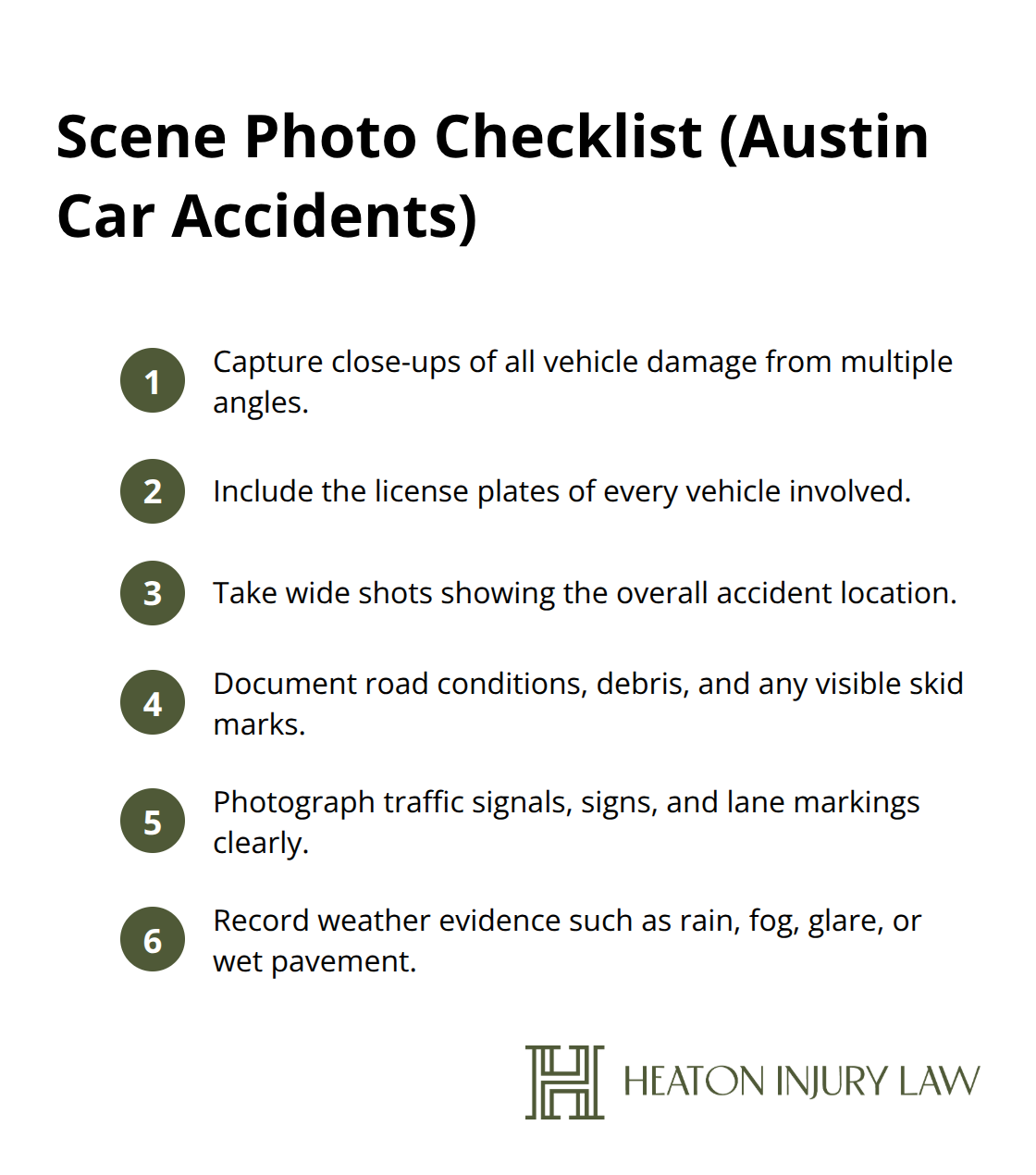
Your phone camera works perfectly; the goal is comprehensive coverage that contradicts whatever story the at-fault driver’s insurer constructs later.
Request and Review the Police Report
Police reports carry significant authority in Texas claims because they represent an objective third party’s assessment at the scene. You should request the report immediately and review it carefully for accuracy-errors in the report can undermine your case, and you have the right to request corrections. That official document becomes one of your strongest negotiating tools because adjusters know courts will consider it heavily if your case reaches trial. An inaccurate police report weakens your position substantially, so address any discrepancies right away.
Collect Witness Statements Quickly
Independent witnesses who saw the accident unfold carry far more credibility than your own account. You should collect names, phone numbers, and brief written statements from anyone who observed the crash, but do this quickly before witnesses disperse or forget details. Insurance companies know that multiple corroborating witness accounts make their defense significantly more difficult, which is why they often try to contact witnesses first to shape narratives. The faster you secure witness information, the stronger your position becomes.
Obtain Complete Medical Documentation
Medical records tell the story of your actual injuries rather than your subjective claims about pain. Insurers scrutinize medical documentation intensely-they look for gaps in treatment, frequency of visits, and whether doctors recommend ongoing care. You should obtain copies of all medical reports, imaging results, diagnostic tests, and treatment plans immediately after seeing healthcare providers. These records prove the connection between the accident and your injuries, which is essential because insurers routinely argue that pre-existing conditions or unrelated factors caused your symptoms. The stronger your medical documentation, the harder insurers push to settle rather than risk a jury seeing your injury evidence in court. This foundation of evidence sets the stage for what comes next: understanding exactly how insurers evaluate the strength of your claim and what tactics they use to minimize payouts.
What Makes Insurers Settle Fast
Insurers fear three things above all else: solid evidence of fault, documented proof of damages, and a clear signal that you’re willing to go to trial. The moment an adjuster realizes your case rests on indisputable facts and concrete evidence rather than emotion, their settlement authority increases dramatically. Cases with strong liability evidence and thorough damage documentation settle for significantly higher amounts than cases lacking these elements. According to insurance industry data, about 90% of personal injury claims resolve through negotiation rather than litigation, but that settlement happens only when insurers believe the alternative-losing at trial-costs them more money.
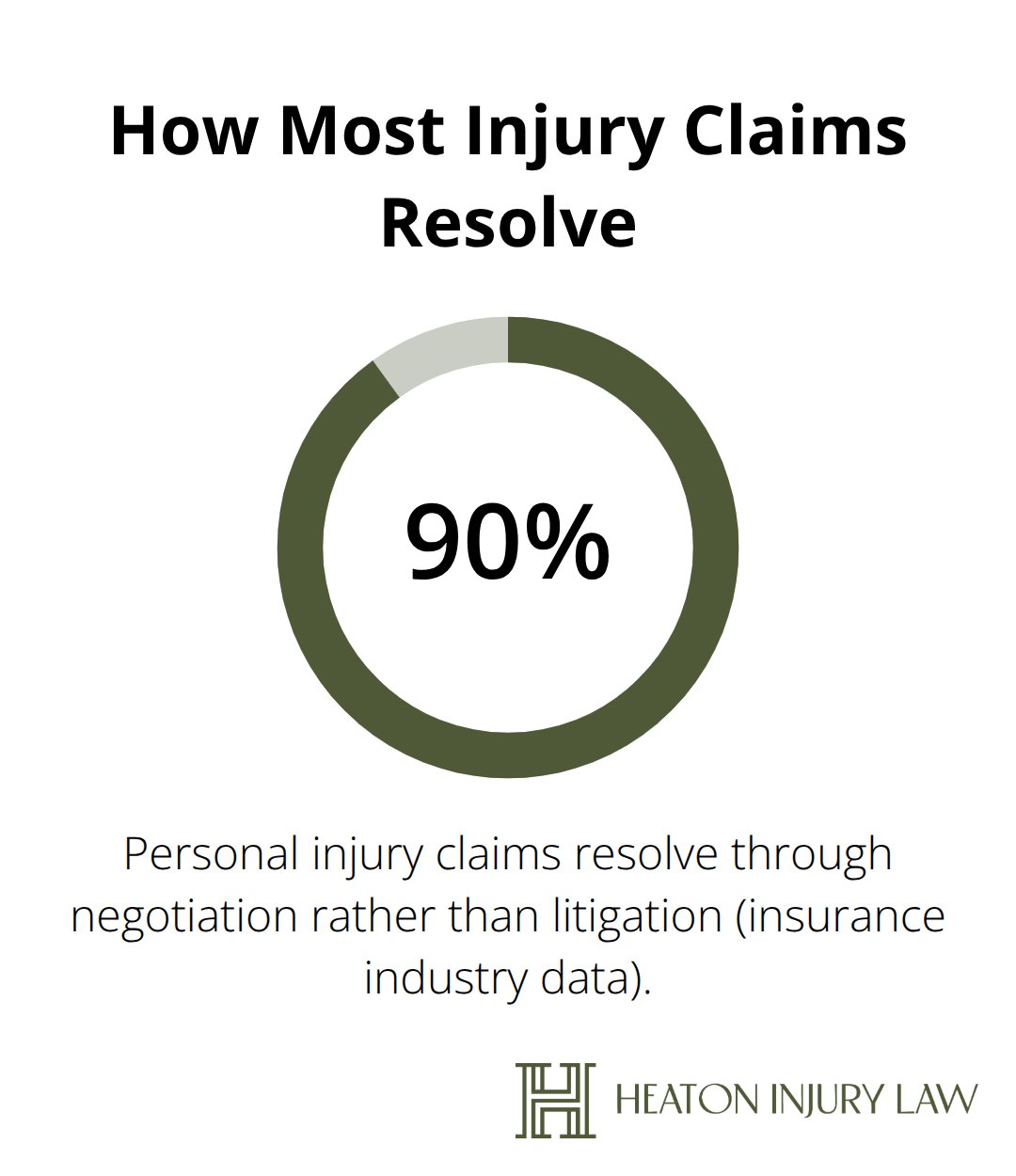
Your job is making that calculation unmistakable.
How Insurers Evaluate Liability
Liability determination starts with how clearly you can prove the other driver caused the crash. Insurers use a specific playbook: they examine the police report for any ambiguity, they look for witness statements that contradict each other, and they search for gaps in your scene documentation. If your photos show clear traffic signals, skid marks indicating speed, and vehicle positioning that tells an obvious story, the adjuster’s negotiating position weakens immediately.
Accident reconstruction experts amplify this advantage dramatically. When you hire a certified accident reconstructionist, they produce a detailed report analyzing vehicle damage, road conditions, physics, and timing to pinpoint fault with mathematical precision. Insurance companies know that juries trust these experts heavily; a reconstruction report transforms your case from he-said-she-said into objective scientific evidence. The moment an adjuster sees that report in your file, they understand trial becomes risky for them.
Medical Documentation as Your Leverage
Medical documentation serves as your second powerful tool. Insurers evaluate damages by cross-referencing your medical records against settlement benchmarks for similar injuries. A victim with consistent treatment, specialist referrals, diagnostic imaging showing structural damage, and documented functional limitations receives substantially higher valuations than someone with sporadic treatment or vague complaints.
Texas personal injury cases with strong medical documentation settle at roughly three times higher rates than those lacking comprehensive records. This is why you must obtain every report, imaging result, and treatment recommendation immediately-gaps in your timeline hand insurers ammunition to argue your injuries weren’t serious. When your medical file shows you saw a neurologist after a head injury, physical therapy twice weekly for three months, and an MRI confirming soft tissue damage or disc injuries, the adjuster cannot reasonably argue your injuries were minor. That documentation forces them to either pay fairly or explain to a jury why they doubted a medical professional’s assessment.
Why Strength Shifts the Negotiation
The combination of liability evidence and medical proof creates an undeniable position. Insurers calculate settlement offers based on trial risk-what a jury might award versus what they pay now. Strong evidence raises that trial risk substantially, which means adjusters authorize higher settlements to avoid courtroom exposure. Trial readiness demonstrates your willingness to pursue litigation, forcing insurers to recognize that refusing fair offers becomes their costlier choice. Once you understand how to value your case based on this evidence, you gain the power to counter their initial offers and push back effectively.
Know Your Case Value Before Negotiating
Calculate Economic Damages With Precision
The single biggest mistake injury victims make is walking into settlement discussions without knowing what their case is actually worth. Insurers count on this ignorance-they throw out a number, and victims either accept it immediately or negotiate blindly without understanding the real range their case should command. You need a concrete valuation before any adjuster calls, because that number becomes your anchor throughout every negotiation.
Start with economic damages and calculate them to the dollar, not estimates. Add up all medical bills, lost wages, property damage, and projected future medical care. Texas allows recovery for all past medical expenses plus reasonable future treatment costs, so obtain estimates from your healthcare providers for ongoing care. Lost wages require documentation from your employer showing actual time missed and hourly rate or salary. If the accident reduced your earning capacity long-term, that becomes part of your claim too.
Use Multipliers to Value Pain and Suffering
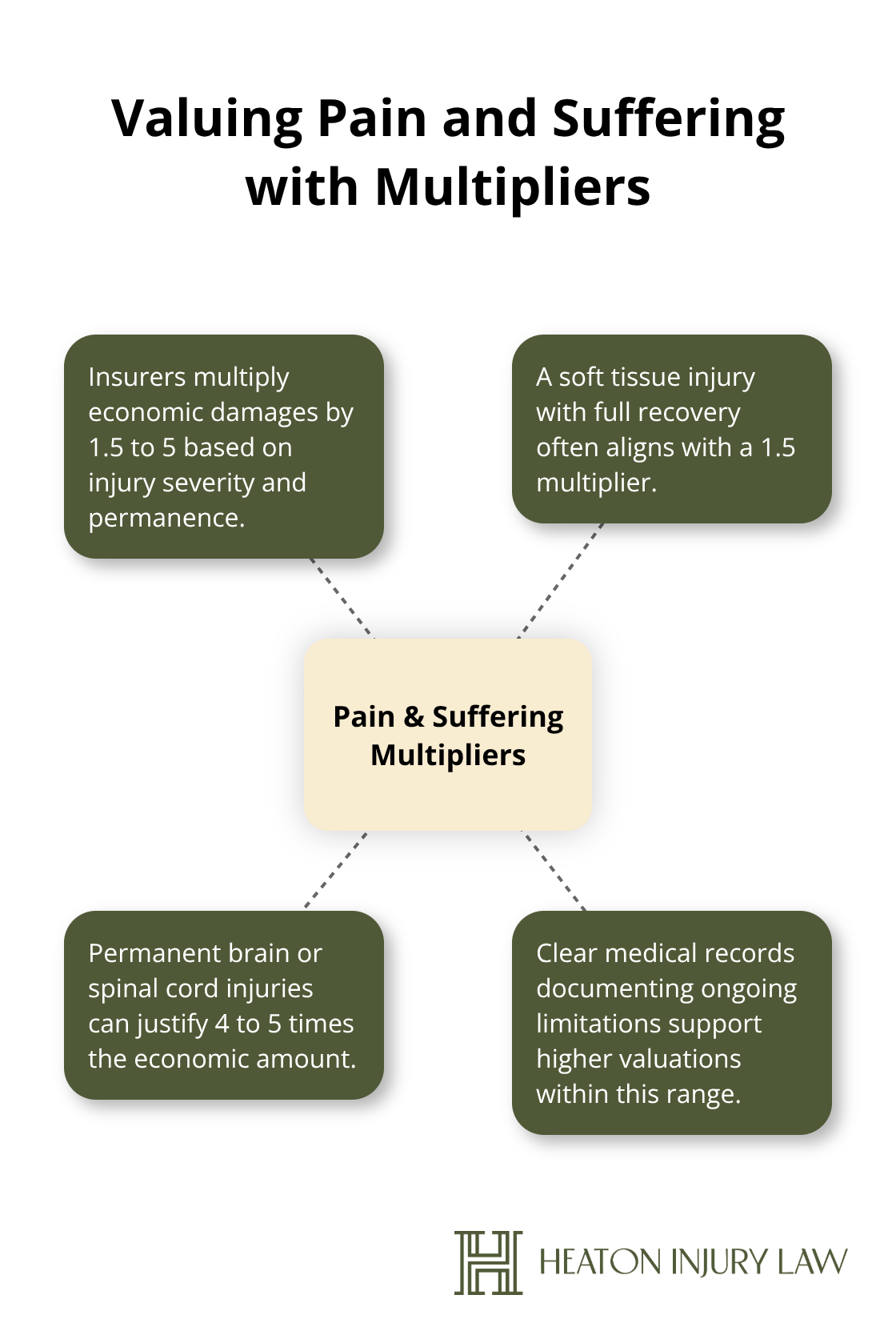
Non-economic damages for pain and suffering, mental anguish, and functional impairment require a different approach. Insurance companies use multipliers: they take your economic damages and multiply by 1.5 to 5 depending on injury severity and permanence. At times, they refuse to multiply them at all! A soft tissue injury with full recovery might use a 1.5 multiplier by carriers, while a permanent brain injury or spinal cord damage justifies 4 to 5 times, if not more, the economic amount by the carrier.
If your medical bills total $15,000 and you have permanent nerve damage affecting daily function, your pain and suffering range may extend to a higher multiplier depending on how clearly your medical records document ongoing limitations. This multiplier approach is standard practice across most insurance carriers.
Research Comparable Cases in Austin
Public court records and settlement databases reveal what comparable injuries have resolved for in your area. The Texas Department of Insurance and local courthouse records provide insight into typical verdicts and settlements. Search for cases involving similar injury types, accident circumstances, and victim profiles to establish realistic benchmarks. This research transforms your valuation from speculation into evidence-based analysis.
Present Your Case as a Professional
Once you establish your case value range with documentation, that becomes your negotiating baseline. When an insurer’s first offer arrives at $8,000 for a case you’ve valued at $45,000 to $60,000, you recognize it immediately as a lowball attempt rather than a genuine negotiating position. Counter with your documented valuation, cite the medical evidence supporting higher damages, and reference comparable cases.
Adjusters expect victims to accept initial offers or negotiate emotionally; instead, present your case like a professional who understands its actual worth. This shift in approach forces adjusters to take you seriously and move their settlement authority upward. Your preparation and documentation signal that you will not accept inadequate compensation, which changes how insurers evaluate their risk in your claim.
Final Thoughts
Cases that settle for maximum compensation share one unmistakable characteristic: they’re prepared as if trial will happen next month. This mindset transforms how insurers evaluate your claim because adjusters recognize immediately that you won’t accept inadequate offers. When your medical documentation is complete, your liability evidence is airtight, and your case valuation is professionally documented, insurers face a genuine choice between paying fairly now or risking a jury verdict that costs them far more.
Trial preparation means organizing every piece of evidence into a coherent narrative that a jury would understand instantly. Your medical experts stand ready to testify about your injuries, your accident reconstructionist can explain fault through physics and vehicle damage, and your damages calculations present themselves with precision. Insurers know that cases prepared this thoroughly have substantially higher trial value, which means their settlement authority increases dramatically when they recognize your genuine trial readiness.
An Austin car accident attorney experienced in trial preparation can accelerate this process substantially. We at Heaton Injury Law, PLLC prepare every case with trial readiness from day one, using our insider knowledge of insurer tactics and litigation strategy to maximize your recovery. Contact us for a free case evaluation to discuss how trial-ready preparation can secure the compensation you actually deserve.
The information provided in this blog is for general informational purposes only and does not constitute legal advice. Every case is unique, and laws may vary by jurisdiction. Reading this content does not create an attorney-client relationship. For guidance specific to your situation, please consult with a qualified personal injury attorney licensed in Texas.
Artificial intelligence may have been used to assist in generating some text or images in these articles.