

Meredythe | April 24, 2026 | Blog

Austin slip and fall injuries happen more often than most people realize, and they can leave you with serious medical bills and lost wages. Property owners have a legal responsibility to maintain safe premises, and when they fail to do so, you have the right to seek compensation.
At Heaton Injury Law, PLLC, we help injured Austinites understand their options and fight for the fair settlement they deserve. This guide walks you through the process of building a strong claim and protecting your rights.
Common Causes of Slip and Fall Accidents in Austin
Wet Floors and Inadequate Warning Signs
Wet floors remain the leading culprit behind slip and fall injuries across Austin, particularly in retail stores, restaurants, and office buildings. The Consumer Product Safety Commission reports that slips and falls account for more than 40 percent of all emergency room visits in the United States, and wet floors without adequate warning signs represent a significant portion of these incidents. Property owners fail to place warning signs immediately after cleaning floors or when spills occur, creating dangerous conditions that catch customers and visitors off guard. Many Austin businesses prioritize speed over safety, mopping floors during peak hours without cordoning off wet areas or posting visible caution signs. This negligence is inexcusable-Texas law requires property owners to either fix hazardous conditions or warn visitors about them clearly and promptly.
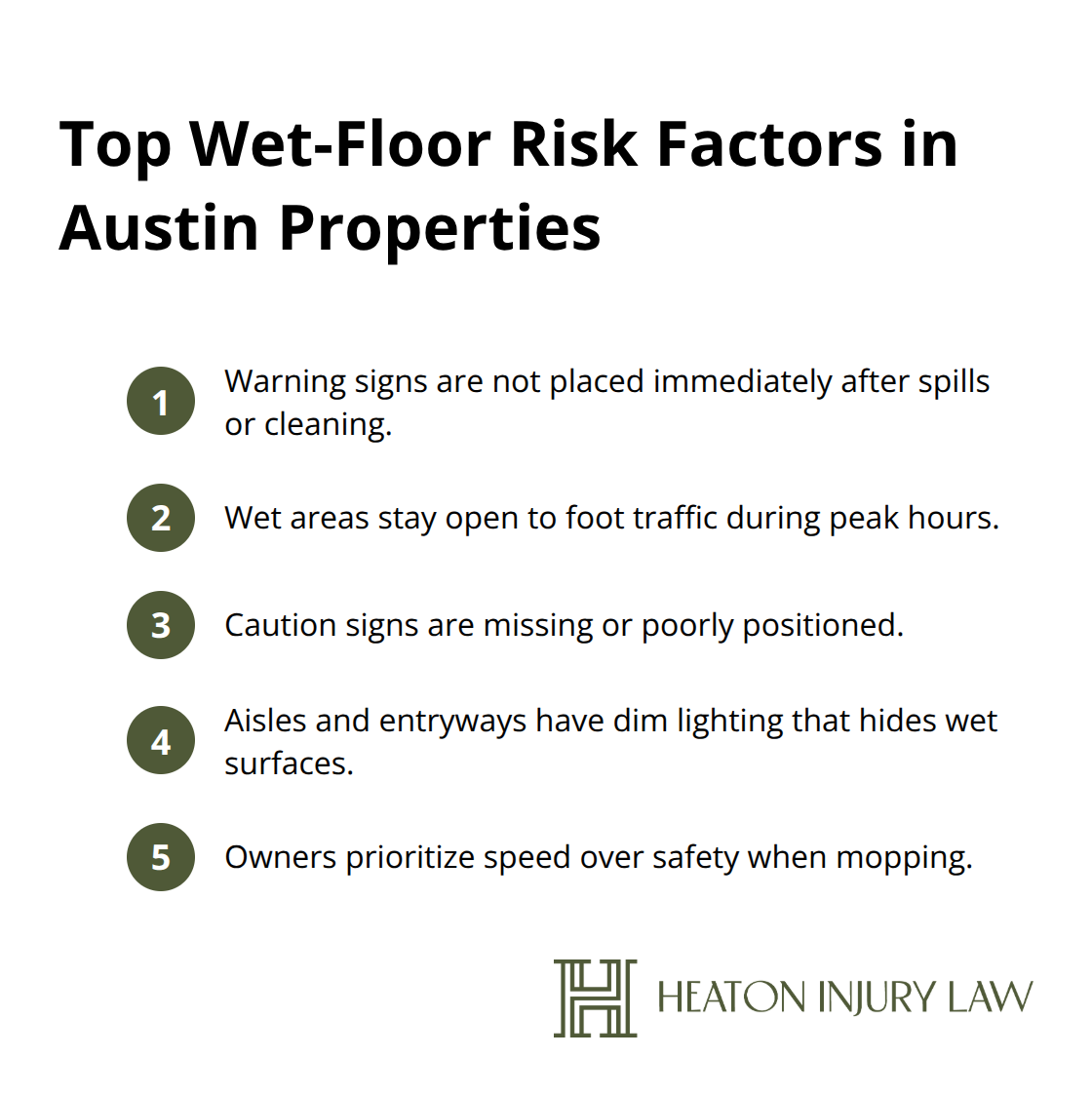
Inadequate lighting compounds the problem significantly. Customers cannot see wet surfaces in dimly lit aisles or entryways, and property owners know this reality yet do nothing to improve visibility or add warnings. The moment you slip on an unmarked wet floor, the property owner bears responsibility for failing to maintain a safe environment or warn you of the danger. Texas courts recognize that owners who neglect these basic safety measures act with disregard for visitor safety.
Poor Maintenance and Uneven Surfaces
Uneven surfaces and poor maintenance represent the second major category of slip and fall hazards in Austin. Cracked pavement, broken stairs, loose handrails, and deteriorating flooring create tripping hazards that property owners must address immediately. Under Texas premises liability law, owners must maintain their properties to a reasonable standard and conduct regular inspections to identify dangerous conditions. If a hazard persists long enough that a responsible property owner should have discovered it through normal maintenance routines, the owner faces liability even without direct knowledge of the specific problem-what courts call constructive knowledge.
Many Austin landlords and business operators ignore maintenance complaints or delay repairs for weeks or months, gambling that no one will get hurt. This pattern of neglect demonstrates a conscious choice to expose visitors to unnecessary risk rather than spend money on repairs.
Negligent Property Management and Security Failures
Negligent property management extends beyond basic maintenance to include security failures that create hazardous conditions. Broken locks on doors, inadequate lighting in parking areas, and failure to remove debris or obstacles from walkways all fall under a property owner’s duty to maintain safe premises. Property owners who neglect these responsibilities knowingly expose visitors to unnecessary risk, and Texas law holds them accountable for injuries that result.
When property owners fail to act responsibly in maintaining their premises, they establish the foundation of your claim. Understanding how these hazards develop and persist helps you recognize negligence when it occurs and strengthens your position in seeking compensation for your injuries.
Understanding Premises Liability and Your Rights
Property Owner Responsibilities Under Texas Law
Texas courts treat slip and fall injuries as premises liability cases, which means property owners owe you a duty of care based on your visitor status. If you were a customer or invitee on the property, the owner must maintain the premises in a reasonably safe condition, inspect regularly for hazards, and either fix dangerous conditions or warn you about them clearly. Texas courts distinguish between actual knowledge, where an owner knows about a specific hazard, and constructive knowledge, where a hazard has persisted long enough that a responsible owner should have discovered it through routine inspections. In the event that the owner has actual knowledge tied to the specific condition that caused your fall at the time of the incident, not just general awareness of danger, their liability is clear.
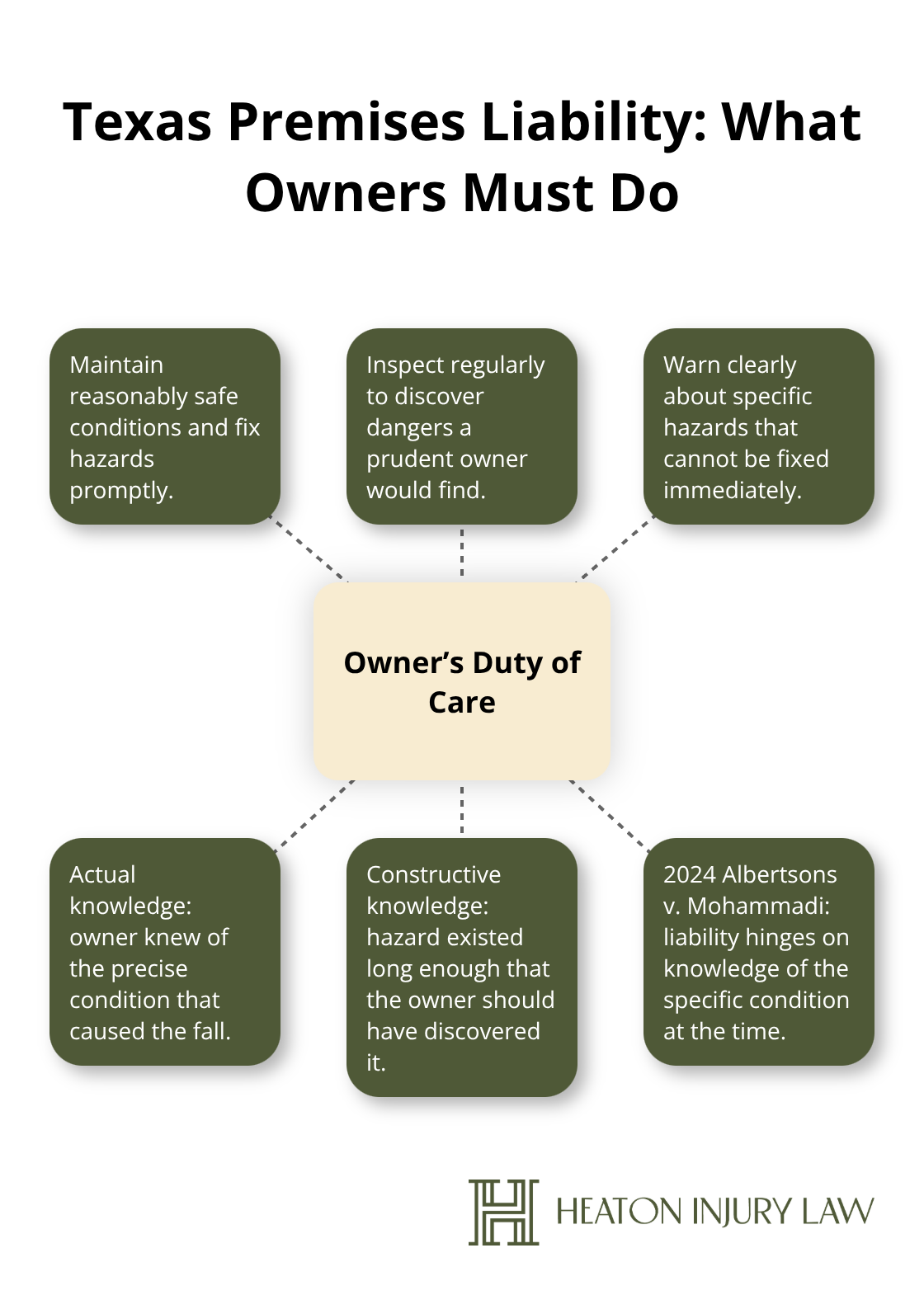
This means you need to prove that either the owner knew about the wet floor, broken stair, or uneven surface beforehand, or that the hazard existed long enough that the owner should have found it during normal maintenance routines. Your visitor status matters significantly in Texas. As a customer or business invitee, you receive the highest level of legal protection, while social guests (licensees) receive less protection, and trespassers receive almost none unless the property owner acted with gross negligence or willful misconduct.
Determining Fault in Slip and Fall Cases
You must prove four specific elements to win your claim: the hazard posed an unreasonable risk of injury, the owner had actual or constructive knowledge of it, the owner failed to fix the hazard or warn you adequately, and that failure directly caused your injuries and damages. Texas applies a modified comparative negligence rule, which means if you are found more than 50 percent responsible for your own fall, you cannot recover anything at all. If you are 50 percent or less at fault, you can still recover compensation but your award gets reduced by your percentage of fault.
This makes evidence preservation absolutely critical. If you slipped on a wet floor, the hazard must be documented before the owner cleans it up. If you tripped on broken pavement, photographs and measurements taken immediately after the fall prove the condition existed at the time of your injury. Insurance companies move fast to minimize liability, and property owners often fix hazards within days of an accident to eliminate evidence.
Time Limits for Filing Claims in Texas
Texas gives you exactly two years from the date of your slip and fall injury to file a lawsuit in court. This two-year deadline applies to all personal injury claims under Texas Civil Practice and Remedies Code Section 16.003, and missing this deadline means you lose your right to pursue compensation entirely. Do not wait months hoping the property owner’s insurance company will make a fair offer, because that delay eats into your filing window and gives the property owner time to destroy evidence, repair the hazard, or coach witnesses.
Gather photographs of the hazard immediately, collect contact information from anyone who witnessed your fall, and report the incident to the property manager or owner in writing. Contact a premises liability attorney within the first week of your injury to protect your rights and preserve evidence before it disappears. The strength of your claim depends on what you document in those critical early days, which is why acting quickly separates successful recoveries from lost opportunities.
How to Build a Strong Slip and Fall Claim From Day One
Act Immediately to Preserve Evidence
The moments after your slip and fall determine whether you win or lose your case. Property owners and their insurance companies know this reality, which is why they move aggressively to repair hazards, remove evidence, and pressure you into quick settlements before you understand what happened. You must act faster and smarter than they do. Take photographs of the exact spot where you fell while the hazard still exists. Capture the wet floor, the broken stair, the uneven pavement from multiple angles and distances. Include wide shots showing the surrounding area and close-ups that reveal the specific danger.
If inadequate lighting caused your fall, photograph the area with flash and without to show how dark it actually was. Collect the names and phone numbers of every person who saw you fall or witnessed the hazard beforehand. Write down their information immediately while they are still present-do not rely on memory later. Request a written incident report from the property manager or business owner and keep a copy for your records.
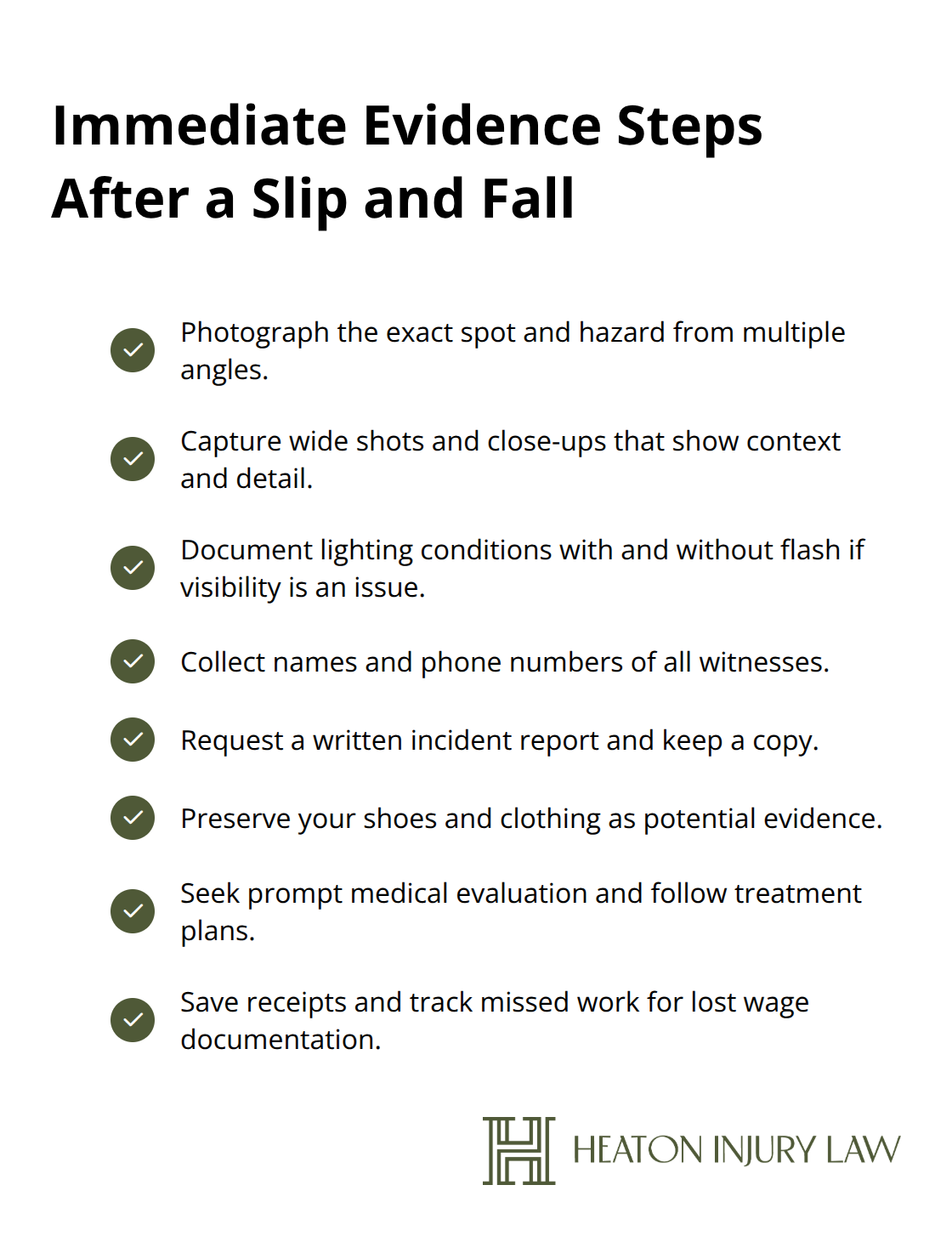
Save the shoes and clothing you wore during the fall, as wear patterns and damage can help prove the hazard’s severity.
Document Your Account and Secure Footage
Write a detailed account of what happened while your memory is sharp, including the time of day, weather conditions, what you were doing, and exactly how you fell. This contemporaneous account carries more weight in court than recollections made months later. If your slip and fall occurred at a business, obtain copies of any security camera footage that captured the incident or the hazardous condition beforehand. Request this footage in writing within days of the accident because businesses routinely delete or record over footage after short periods.
Build Your Medical and Financial Records
Seek medical attention promptly even if your injuries seem minor at first. Many slip and fall victims delay treatment, which insurance companies exploit by claiming the injuries were not serious. Document every medical appointment, prescription, and treatment plan. Keep receipts for all medical expenses, including emergency room visits, follow-up appointments, physical therapy, and medications. Track your lost wages by collecting pay stubs showing hours missed and income lost due to recovery time and medical appointments. Photograph any visible injuries like bruises, cuts, or swelling, and continue photographing as they heal to show the progression.
Protect Yourself From Insurance Tactics
Insurance adjusters will attempt to minimize your claim by offering quick settlements before you fully understand your injuries or by requesting recorded statements that they can use against you later. Do not give any recorded statement to an insurance company without legal representation, and do not accept any settlement offer without understanding the full scope of your damages. An attorney can preserve evidence aggressively through early investigation and preservation letters that legally require property owners to maintain hazard documentation and security footage. Your legal team will also obtain maintenance records and inspection logs that reveal whether the property owner had prior notice of the dangerous condition or a pattern of neglecting repairs. The difference between a strong claim and a weak one comes down to what you document in those critical first days and weeks after your injury.
Final Thoughts
Your Austin slip and fall injuries demand immediate action because evidence vanishes quickly-hazards get repaired, footage gets deleted, and witnesses move on. Property owners and insurance companies count on your hesitation to minimize what they owe you, so you must act decisively by documenting the scene, preserving photographs, and collecting witness information within days of your accident. Texas law gives you two years to file a lawsuit, but waiting months weakens your position significantly as insurance adjusters pressure you into settlements that undervalue your damages.
Professional legal representation transforms your claim because an experienced attorney investigates immediately, sends preservation letters that legally require property owners to maintain evidence, and obtains maintenance records and security footage that prove negligence. We at Heaton Injury Law, PLLC understand how insurance companies operate and use that knowledge to maximize your recovery and hold negligent property owners accountable for the harm they caused. You pay no attorney fees unless we recover compensation for you.
Contact Heaton Injury Law, PLLC for a free case evaluation and learn what your claim is actually worth. Your recovery starts with one phone call.
The information provided in this blog is for general informational purposes only and does not constitute legal advice. Every case is unique, and laws may vary by jurisdiction. Reading this content does not create an attorney-client relationship. For guidance specific to your situation, please consult with a qualified personal injury attorney licensed in Texas.
Artificial intelligence may have been used to assist in generating some text or images in these articles.