

Meredythe | April 13, 2026 | Blog

An Uber rideshare injury in Austin can leave you confused about who’s responsible and what compensation you deserve. The insurance structure for rideshare accidents work differently than standard car crashes, and understanding these differences is critical to protecting your rights.
We at Heaton Injury Law, PLLC help injured passengers and pedestrians navigate these complex claims and recover the damages they’re entitled to. This guide walks you through your legal options and the steps needed to build a strong case.
Why Uber Crashes Don’t Follow Standard Insurance Rules
Uber accidents operate in a gray zone that standard car insurance policies simply may not cover. When you’re injured in an Uber crash in Austin, the insurance picture fragments across multiple policies and coverage limits that shift based on when the accident occurred and what the driver was doing at that moment. You can’t treat an Uber injury claim like a typical car accident where one person’s insurance pays for your damages. Uber maintains a $1 million liability insurance policy for injuries, but this coverage activates only under specific circumstances-and many injured passengers or drivers never realize they might qualify for additional recovery through other insurance sources. The driver’s personal auto policy often excludes rideshare activity entirely, leaving a coverage gap that requires strategic navigation to access all available compensation.
When Uber’s Insurance Actually Covers You
Uber’s $1 million policy applies only when the driver has accepted a ride request or is actively transporting a passenger. The moment your driver goes offline, you fall back on the driver’s personal insurance, which typically excludes rideshare work. This distinction matters because it determines which insurance company pays your medical bills and lost wages.
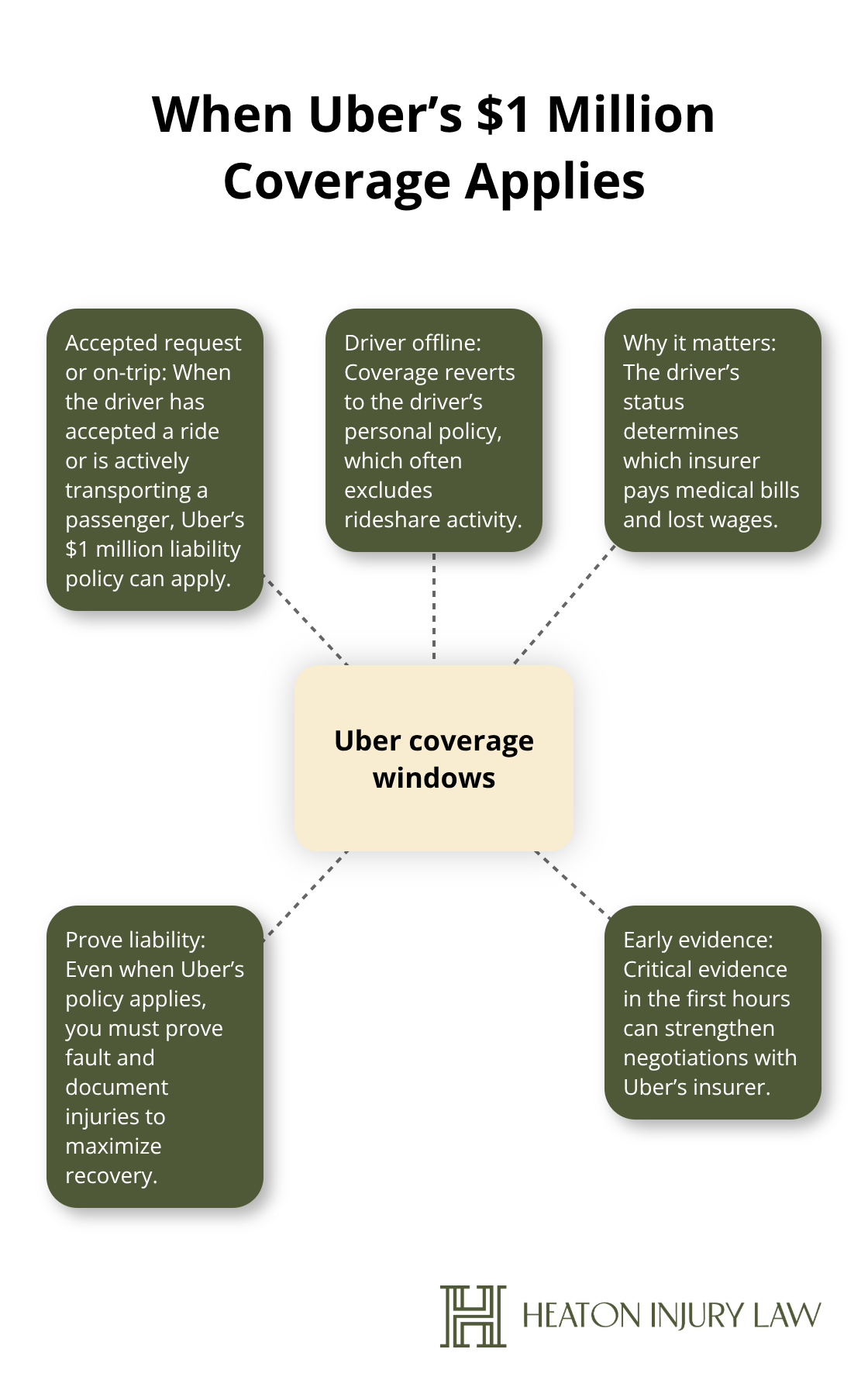
If the driver caused the accident while actively transporting someone, Uber’s coverage activates immediately, but you still need to prove liability and document your injuries thoroughly to maximize your recovery. Many injured passengers miss critical evidence opportunities in the first hours after a crash, which weakens their position when negotiating with Uber’s insurance representatives.
The Multiple-Party Liability Trap
Uber crashes frequently involve more than two vehicles, which means multiple insurance policies come into play simultaneously. If another driver hit your Uber, you potentially have claims against that driver’s insurance, the Uber driver’s insurance, and Uber’s corporate policy. Each insurer will argue they bear less responsibility than the others, and without experienced legal representation, you’ll spend months sorting through conflicting statements instead of focusing on recovery. The driver’s personal liability limits might be the minimum $30,000 in Texas, nowhere near the medical costs from serious injuries. Uber’s $1 million policy becomes your lifeline in these scenarios, but accessing it requires proving the company failed to maintain safe practices or that the driver violated platform safety standards.
Why You Need Strategic Navigation
These overlapping claims demand more than basic insurance knowledge. Identifying every responsible party and their available insurance sources separates those who recover fully from those who settle prematurely with whichever insurer contacts them first. The complexity of rideshare liability means your next step should involve understanding what legal representation can accomplish for your specific situation.
What You Can Actually Recover After an Uber Crash
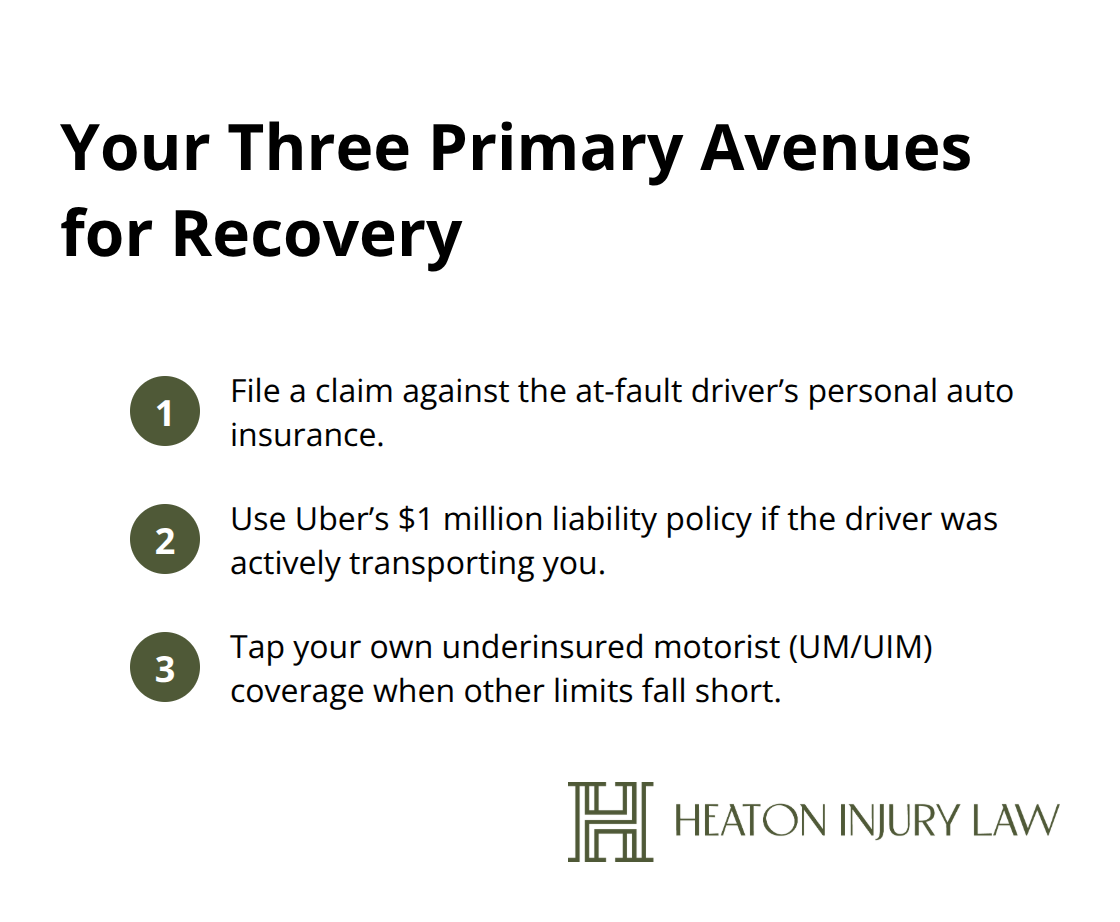
Filing a claim after an Uber accident in Austin requires understanding exactly what compensation categories exist under Texas law and acting within strict timeframes that courts enforce without exception. Texas gives you two years from the date of your injury to file a personal injury lawsuit, according to Texas Civil Practice and Remedies Code Section 16.003, but this deadline applies whether you’ve settled with insurance or not. Starting your claim immediately matters because evidence degrades, witnesses move away, and medical records become harder to obtain as time passes. You have three primary avenues for recovery: claims against the at-fault driver’s personal insurance, claims against Uber’s $1 million liability policy when the driver was actively transporting you, and claims against your own underinsured motorist coverage if the responsible party’s insurance limits fall short of your actual damages. Many injured passengers overlook their own UM/UIM coverage entirely, treating it as unnecessary when they should view it as a critical safety net that covers gaps left by other parties’ insufficient limits.
The driver’s personal policy in Texas typically carries minimum limits of $30,000 per person for bodily injury, which disappears quickly when serious injuries require surgery, hospitalization, or ongoing rehabilitation.
Economic Damages: What You Can Prove and Recover
Economic damages include documented medical expenses, lost wages from time away from work, ongoing treatment costs, rehabilitation services, and transportation expenses related to your recovery. A single emergency room visit for a crash-related injury averages $1,200 to $2,500 in Texas with health insurance, and if imaging or specialist care follows, costs escalate rapidly. Medical bills create a clear paper trail that courts accept without question, which is why you should preserve every invoice, receipt, and explanation of benefits from your healthcare providers. Lost wages require documentation from your employer showing the hours you missed and the pay rate applied to those hours due to the collision. Ongoing treatment costs-physical therapy, pain management, or specialist appointments-accumulate over months or years, and courts award these projected expenses when medical evidence supports their necessity.
Non-Economic Damages: Pain, Suffering, and Life Changes
Non-economic damages compensate you for pain and suffering, permanent scarring or disfigurement, loss of enjoyment of activities you previously did, and long-term disability that affects your quality of life. Texas courts allow juries to award substantial non-economic damages when injuries are severe, but these awards depend heavily on thorough documentation of how the injury changed your daily functioning. Photographs of visible injuries, medical records showing treatment progression, and detailed notes about activities you can no longer perform strengthen claims for pain-and-suffering compensation. Courts take a skeptical view of pain-and-suffering claims without this supporting evidence, which is why documenting injuries immediately at the scene and maintaining detailed medical records throughout your recovery directly impacts what you ultimately recover.
Building Your Documentation Strategy
Photographs taken at the accident scene establish the vehicle damage and your immediate physical condition. Medical records from your first visit onward create a timeline that connects your injuries to the crash and show the treatment path you followed. Written descriptions of how pain affects your sleep, work performance, or ability to exercise and be with family provide context that transforms abstract suffering into concrete impact. Insurance adjusters and juries respond to specific details-“I cannot walk more than two blocks without severe knee pain” carries more weight than “my leg hurts.” These details, combined with medical evidence, form the foundation that separates modest settlements from full compensation. The next section covers how to gather this evidence strategically and position your claim for maximum recovery.
Building Your Claim From Day One
The first hours after an Uber crash in Austin determine whether you recover fully or settle for far less than you deserve. Your actions at the scene and in the days following create the foundation that either strengthens or weakens every negotiation with insurance companies.
Securing Evidence at the Accident Scene
Photograph the vehicle damage from multiple angles, including close-ups of impact points and the overall accident scene showing road conditions and vehicle positions. Take screenshots of your Uber app showing the ride details, driver information, and pickup location-this digital proof that you were a passenger matters more than you’d expect when insurers question coverage. Obtain the other driver’s name, phone number, address, insurance company, and policy number directly from their license and insurance card, not from memory.
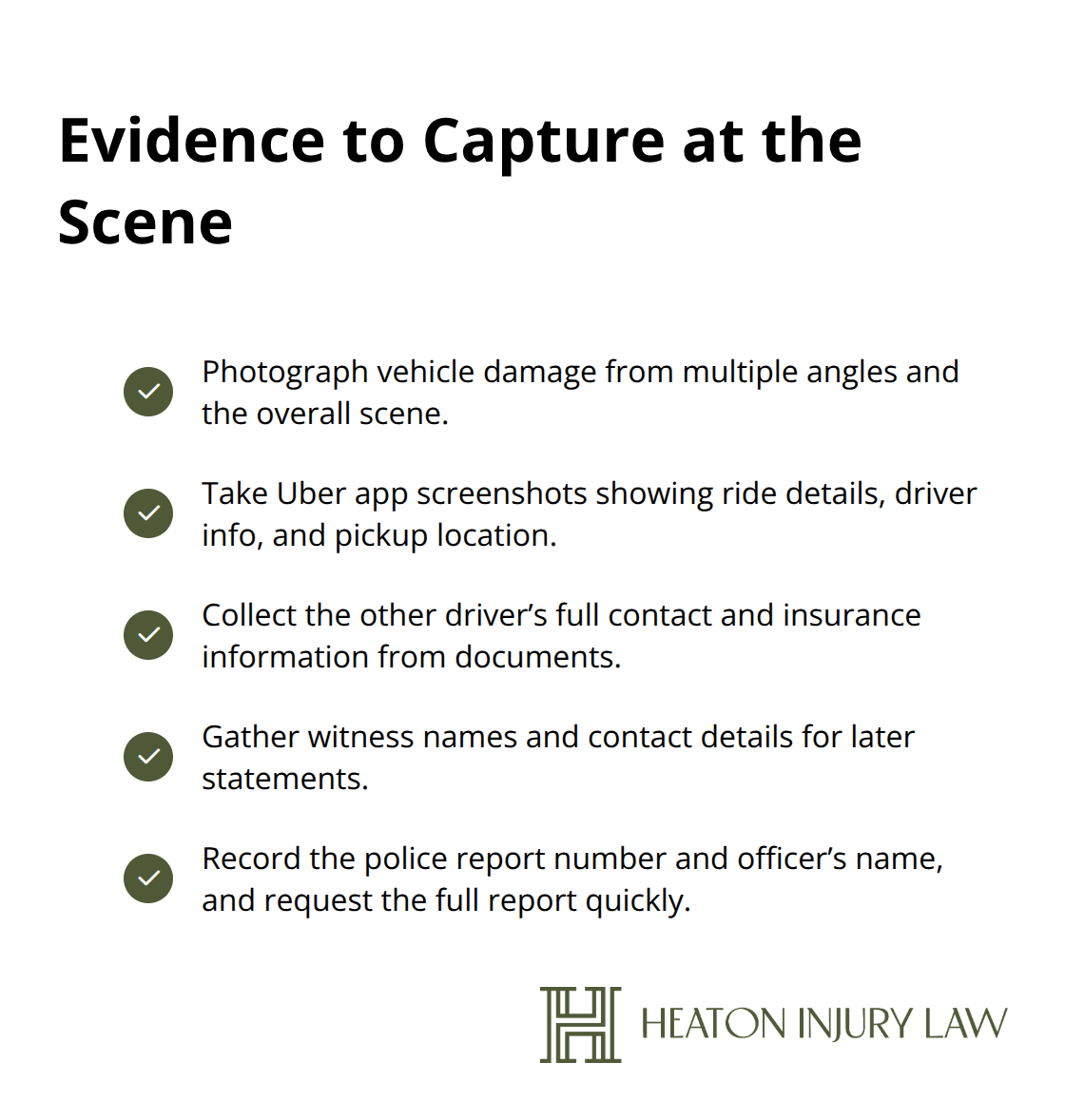
Request contact information from any witnesses who saw the crash happen, as their statements significantly strengthen liability arguments later. If police responded, get the report number and officer’s name, then request the full accident report within days rather than weeks.
Establishing the Medical Connection Immediately
Medical attention must happen immediately after the crash, even if injuries seem minor-whiplash, concussions, and soft tissue damage often worsen over days, and delaying treatment gives insurers ammunition to claim injuries weren’t serious. Your first medical visit creates the critical link between the crash and your injuries, establishing the baseline that all future treatment references. Keep every medical record, billing statement, and explanation of benefits in one organized folder, both physical and digital copies. Photograph visible injuries like bruising or cuts at the scene, then photograph them again as they heal to document progression. This visual record proves injury severity far better than your verbal descriptions months later.
Tracking Daily Impact and Treatment Costs
Insurance adjusters dismiss vague claims like “I hurt everywhere,” but specific details like “I cannot sit more than thirty minutes without severe lower back pain and numbness in my left leg” carry substantial weight in settlement negotiations. Document lost work hours with written confirmation from your employer showing dates missed and hourly wage, then calculate total lost income precisely rather than estimating. If the injury prevents you from household tasks, childcare, or activities you previously performed regularly, write these details down with dates-courts award compensation for this functional loss when evidence supports it.
Managing Medical Bills and Out-of-Pocket Expenses
Medical bills accumulate quickly in serious crashes; a hospital stay averages $2,500 to $15,000 depending on severity, and ongoing physical therapy typically costs $100 to $300 per session over months or years. Collect all invoices, receipts, and insurance explanations showing what you paid out-of-pocket versus what your health insurance covered, as you can recover both amounts in many cases. Preserve all communication with insurance adjusters, rideshare company representatives, and medical providers in writing-email or certified mail rather than phone calls that leave no record. Insurance companies count on injured people settling quickly without understanding their full damages, which is exactly why this meticulous documentation transforms a weak claim into one that generates serious settlement offers.
Preparing Before You Contact Insurance
Contact an experienced personal injury attorney before you reach out to any insurance company. Early professional guidance prevents statements that later limit your recovery potential and ensures you understand the full scope of damages you can claim (medical expenses, lost wages, pain and suffering, and ongoing treatment costs). An attorney familiar with rideshare liability can identify all responsible parties and their available insurance sources, which separates those who recover fully from those who settle prematurely with whichever insurer contacts them first.
Final Thoughts
Rideshare crashes create legal complexity that extends far beyond standard car accidents, and navigating insurance coverage, liability disputes, and damage calculations without professional guidance leaves money on the table. We at Heaton Injury Law, PLLC understand how rideshare companies operate, what insurance tactics they deploy, and exactly how to counter them with evidence and strategy. Our experience handling Uber rideshare injury cases in Austin has shown us that injured passengers who act quickly and document thoroughly recover substantially more than those who negotiate alone with insurance adjusters.
The path forward after an Uber rideshare injury in Austin requires immediate action on three fronts. First, you must gather evidence at the scene and preserve medical records from your initial visit onward, creating the documentation foundation that supports every claim you make. Second, you should contact an experienced personal injury attorney before speaking with any insurance company, because early legal guidance prevents statements that later limit your recovery and identifies all responsible parties and their available coverage. Third, you need to understand that your damages extend beyond medical bills to include lost wages, ongoing treatment costs, pain and suffering, and functional losses that affect your daily life.
We at Heaton Injury Law, PLLC have secured substantial compensation for clients injured in rideshare crashes by applying insider knowledge of insurer tactics and maintaining a trial-ready approach that forces fair settlements. Led by Meredythe Heaton Wilkinson with 14 years of experience on both sides of litigation, our firm handles your claim on contingency, meaning you pay nothing unless we recover compensation for you. Contact us today for a consultation that costs you nothing but could transform your recovery outcome.
The information provided in this blog is for general informational purposes only and does not constitute legal advice. Every case is unique, and laws may vary by jurisdiction. Reading this content does not create an attorney-client relationship. For guidance specific to your situation, please consult with a qualified personal injury attorney licensed in Texas.
Artificial intelligence may have been used to assist in generating some text or images in these articles.