

Meredythe | March 30, 2026 | Blog

Slip and fall accidents happen fast, but their consequences can last for years. If you’ve been injured on someone else’s property in Austin, you deserve to know your legal options and what compensation you might recover.
At Heaton Injury Law, PLLC, we help injured Texans navigate premises liability claims and hold negligent property owners accountable. This guide walks you through how these accidents occur, why legal representation matters, and what working with us looks like.
How Slip and Fall Accidents Happen in Austin
Common Locations Where Slip and Fall Accidents Occur
Austin’s bustling retail districts, restaurants, office buildings, and apartment complexes create constant slip-and-fall risk. Grocery stores and supermarkets rank among the most dangerous locations, where wet floors from cleaning or product spills occur throughout business hours. Restaurants and cafes rank second, particularly in kitchen areas and near bathrooms where moisture accumulates. Parking lots and sidewalks throughout downtown Austin and suburban shopping centers present hazards from uneven pavement, cracked concrete, and debris that property owners neglect to repair.
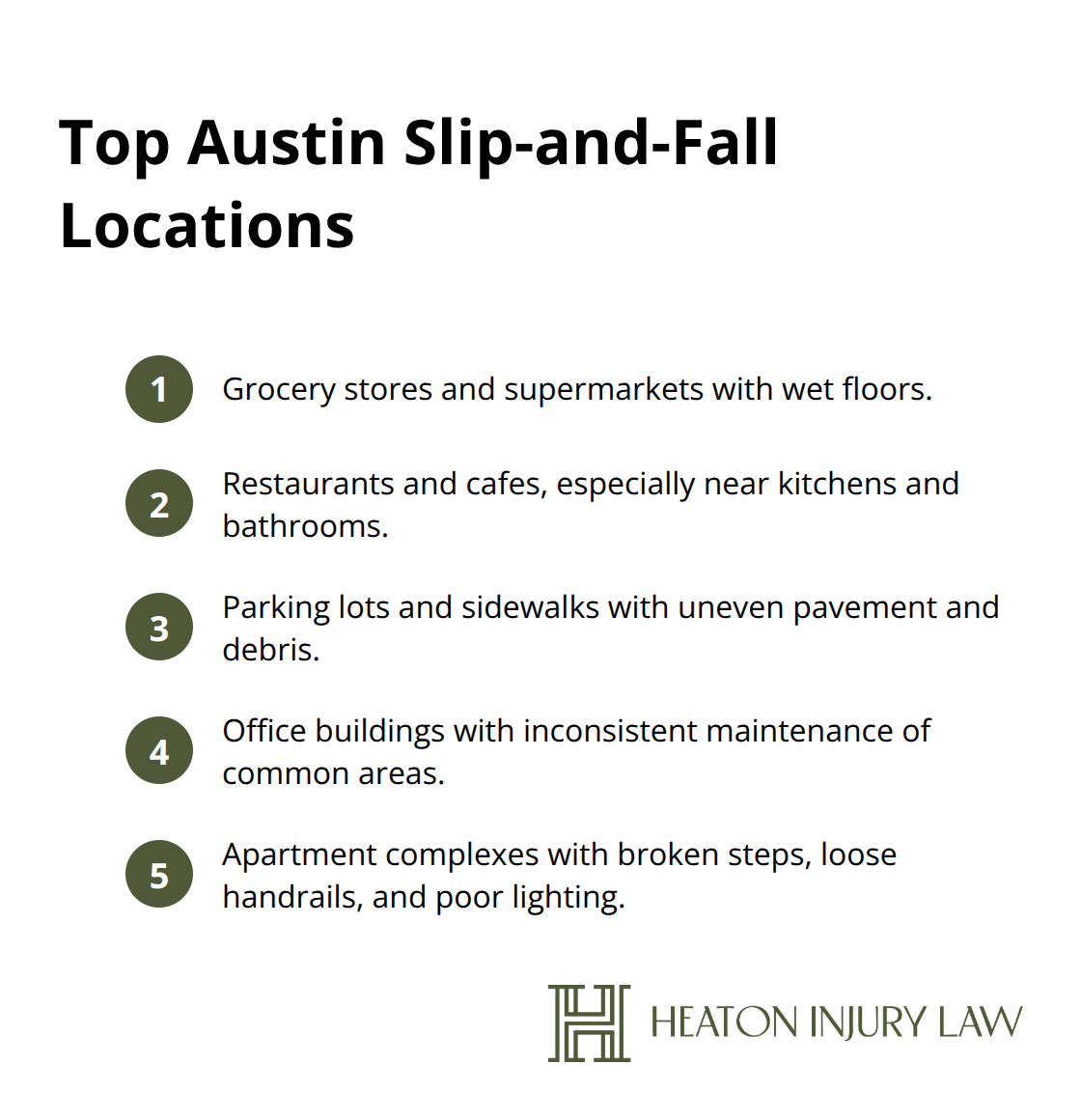
Office buildings with multiple tenants often lack consistent maintenance protocols, leaving stairwells, hallways, and common areas vulnerable. Apartment complexes frequently fail to address broken steps, loose handrails, and poor lighting in shared spaces-conditions that create liability when residents or visitors fall.
Weather and Environmental Factors That Increase Risk
Austin’s weather patterns intensify slip-and-fall risks significantly. During the rainy season from May through October, wet floors in entryways remain a persistent problem because many business owners rely on inadequate warning signs rather than actually addressing the moisture. Ice accumulation, though less common than in northern states, does occur during occasional freezes and creates treacherous conditions on parking lots and walkways that property owners fail to treat. The intense Texas heat also accelerates material degradation; asphalt deteriorates faster, concrete cracks more readily, and wooden decks warp-yet many property owners delay repairs until injuries force their hand.
Property Owner Negligence and Liability
Property owner negligence forms the core issue in almost every slip-and-fall case. Owners have a legal duty to inspect their premises regularly and address hazards promptly, yet most fail at both tasks. A property owner who knows about a wet floor but posts only a small wet-floor sign without actually mopping is negligent-the sign does not eliminate the hazard or the owner’s obligation to fix it. Owners who ignore maintenance schedules, skip inspections, or respond slowly to reported problems create the dangerous conditions that injure people.
When surveillance footage or maintenance records show a hazard existed for days or weeks before your fall, that evidence proves the owner should have discovered and corrected it long before you were hurt. Texas law holds owners accountable for hazards they knew about and those they should have known about through reasonable inspection. An owner who personally saw water on the floor has actual knowledge, while an owner whose cleaning logs show no floor check in five days has constructive knowledge-meaning a reasonable inspection would have revealed the problem. Either way, liability attaches when the owner failed to warn or fix the danger.
Understanding how these accidents occur and what makes property owners liable sets the foundation for your claim. The next section explains why legal representation becomes essential when you pursue compensation for your injuries.
Why You Need a Slip and Fall Attorney
The Burden of Proof Falls on You
Handling a slip-and-fall claim without an attorney puts you at a severe disadvantage. Property owners and their insurance companies employ experienced adjusters trained to minimize payouts, and they exploit the complexity of Texas premises liability law to deny claims outright. Texas law requires you to prove four distinct elements-that the owner owed you a duty of care, breached that duty, caused your injury, and that you suffered measurable damages-yet many injured people attempt this alone and fail.
The burden falls entirely on you to demonstrate not only that a hazard existed but that the property owner knew about it or should have known through reasonable inspection. Insurance adjusters know most people lack the evidence to meet this standard, so they deny claims or offer settlements far below actual damages. Without legal representation, you face an uphill battle against professionals whose job is to protect the property owner’s bottom line, not your recovery.
Understanding Economic and Non-Economic Damages
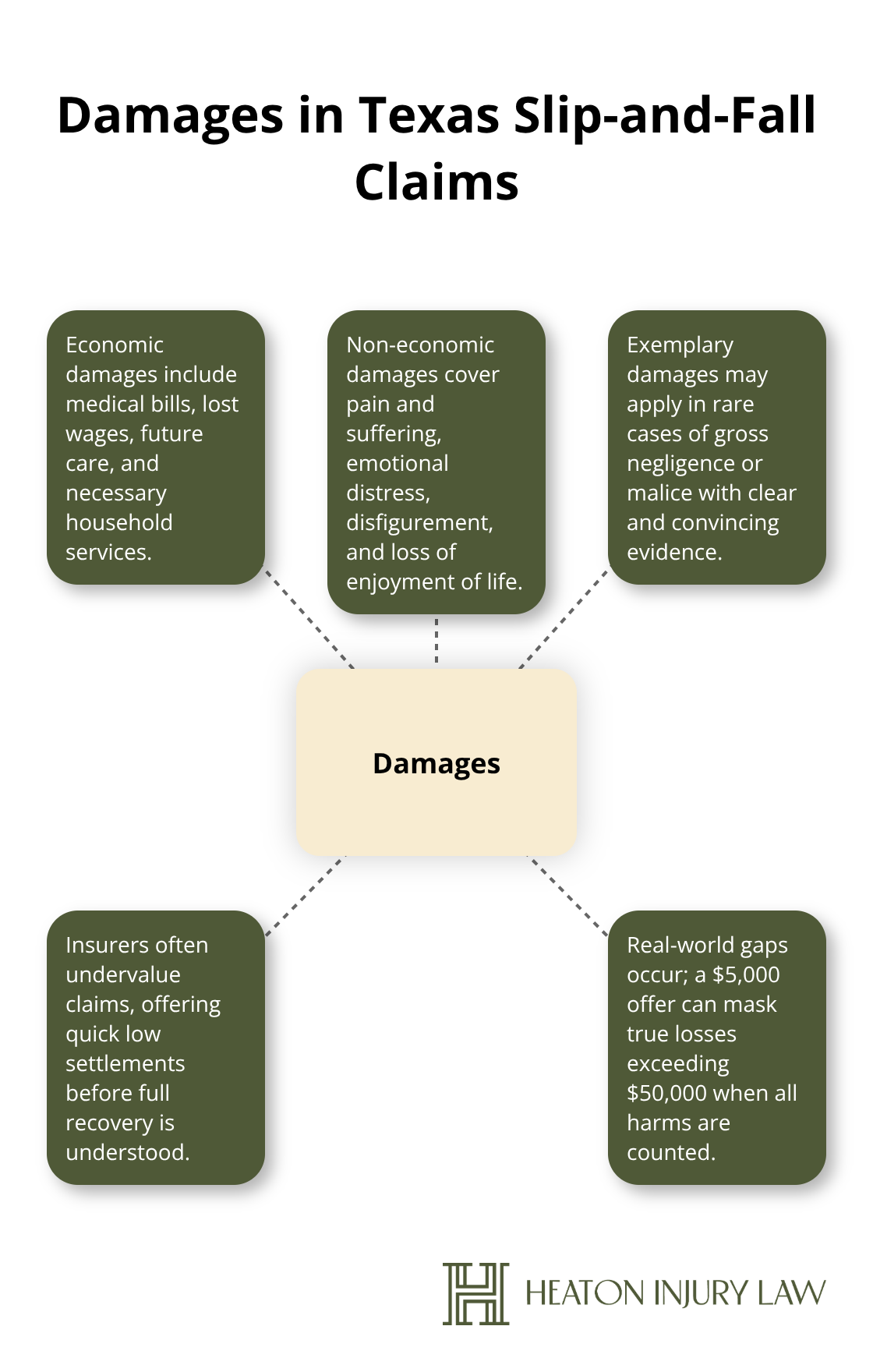
Calculating fair compensation requires understanding both economic and non-economic damages under Texas law, and this calculation differs dramatically depending on your injury severity and circumstances. Economic damages include medical bills, lost wages, future medical care, vocational retraining if your injury prevents you from returning to your job, and household services you now need because of your injuries.
Non-economic damages cover pain and suffering, emotional distress, disfigurement, and loss of enjoyment of life-categories that insurance companies routinely undervalue or ignore entirely. Texas law also allows exemplary damages in rare cases involving gross negligence or malice, requiring clear and convincing evidence that the owner’s conduct was reckless. An adjuster might offer $5,000 for a broken ankle that required surgery and left you unable to work for three months, while your actual damages exceed $50,000 when you factor in medical expenses, lost income, physical therapy, and the genuine pain you endured.
Why Insurance Companies Exploit Unrepresented Claimants
Insurance companies rely on injured people not knowing their damages are worth far more, and they count on settlements occurring quickly before you fully understand the long-term impact of your injury. Adjusters use delay tactics, request unnecessary medical records, and propose settlement figures designed to close cases quickly and cheaply. They know that most people lack the expertise to challenge their valuations or recognize when an offer falls short of what the law allows.
Navigating settlement negotiations without representation means you negotiate against someone whose expertise is extracting concessions. The adjuster controls the timeline, the information flow, and the pressure to accept an offer before your medical treatment concludes. This imbalance exists because insurance companies have handled thousands of claims while you face your first one.
What Skilled Representation Accomplishes
An attorney who understands premises liability law knows exactly what evidence proves negligence, how long hazards typically persist before discovery, and which defenses insurers will raise. We gather surveillance footage, maintenance records, witness statements, and expert analysis to build an airtight case that demonstrates the owner’s liability beyond dispute. This evidence transforms your claim from a he-said-she-said dispute into a documented record that insurers cannot easily dismiss.
Skilled representation also means knowing when to push back on settlement offers and when a case is worth pursuing through trial rather than accepting an inadequate proposal. An attorney evaluates your claim against comparable cases, understands the true value of your damages, and negotiates from a position of strength backed by evidence and legal knowledge.
Understanding what representation accomplishes sets the stage for exploring what working with us looks like and how we approach building your case from start to finish.
What to Expect When Working With Us
Initial Consultation and Case Evaluation
Our process starts the moment you contact us, and we move fast because evidence deteriorates quickly in slip-and-fall cases. During your initial consultation, we ask detailed questions about where you fell, what caused it, your injuries, and medical treatment you’ve received. We examine photographs you’ve taken, review any incident reports filed with the property owner, and identify witnesses who saw your fall or can testify about the hazard’s existence. This conversation typically reveals whether the property owner’s negligence is clear or requires deeper investigation through surveillance footage and maintenance records. Most importantly, we assess what your claim is actually worth by calculating your medical expenses, lost wages, and the non-economic impact of your injury on your daily life. We’re direct about case strength and honest when liability appears weak, because false optimism helps no one.
Evidence Preservation and Investigation
We handle the heavy lifting that property owners and insurers hope you’ll skip. We send preservation letters to prevent surveillance footage from being deleted and maintenance records from being destroyed-a critical step that stops evidence from vanishing. We obtain your complete medical records and work with medical experts to establish that your injuries resulted directly from the fall, not a pre-existing condition the property owner might claim caused the damage.
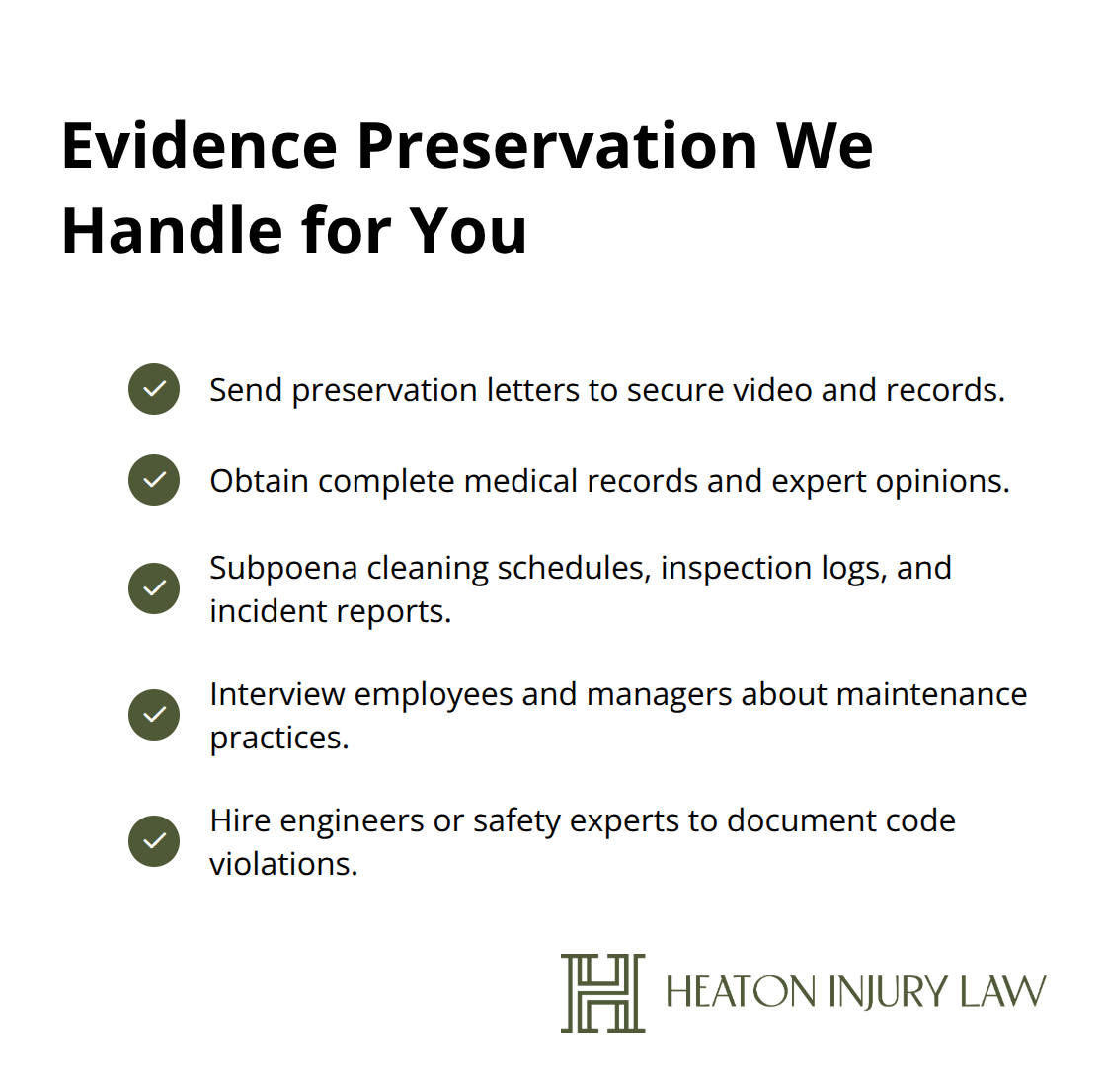
We subpoena cleaning schedules, inspection logs, and prior incident reports that prove the hazard existed long enough for the owner to discover it through reasonable maintenance practices. We interview employees and managers who can testify about how often floors were checked or whether maintenance complaints were ignored. We hire engineers or safety experts when necessary to demonstrate the hazard violated building codes or industry standards. This evidence transforms your claim from your word against theirs into a documented record of negligence.
Identifying All Responsible Parties
We investigate whether multiple parties share liability, because a shopping center owner, the individual tenant, and a contracted cleaning service might all bear responsibility for your injuries. This approach maximizes your recovery by pursuing all defendants with the resources to pay damages. We analyze lease agreements, maintenance contracts, and operational records to determine who controlled the property and who failed to maintain it safely.
Settlement Negotiations and Trial Preparation
Throughout this process, we work on contingency, meaning we absorb all investigation costs and legal fees upfront with no payment from you unless we recover compensation. You pay nothing out of pocket, and our fee comes only from what we win or settle. This alignment means we pursue your case aggressively because our success depends entirely on your recovery. When settlement negotiations begin, we know exactly what comparable claims have settled for and what juries in Travis County typically award for your injury type and severity. This knowledge lets us reject lowball offers and push insurers toward fair valuations. If an insurer refuses reasonable settlement, we prepare for trial with the same intensity we’d apply in the courtroom, because readiness to litigate often forces settlement before trial begins. We handle every aspect-depositions, discovery disputes, expert reports, jury selection, and trial testimony-so you focus on healing rather than the legal machinery grinding behind the scenes.
Final Thoughts
Slip-and-fall claims in Texas require you to prove that a property owner knew or should have known about a hazard, failed to fix or warn about it, and that failure caused your injuries. Insurance companies exploit this complexity by denying claims, delaying responses, and offering settlements that ignore the true cost of your medical care, lost wages, and pain and suffering. The two-year statute of limitations means time works against you, and evidence disappears quickly when property owners delete surveillance footage or discard maintenance records.
A slip and fall attorney in Austin understands exactly how to overcome these obstacles. We gather the evidence that proves negligence, identify all responsible parties, and calculate damages that reflect your actual losses rather than what an adjuster thinks you’ll accept. We send preservation letters immediately, obtain medical records and expert analysis, and subpoena maintenance logs that demonstrate how long hazards persisted before your fall.
At Heaton Injury Law, PLLC, we handle slip-and-fall claims with the same intensity and expertise we apply to car crashes, workplace injuries, and catastrophic injuries. Contact us for a free consultation where we evaluate your claim, answer your questions, and explain exactly what your case is worth.
The information provided in this blog is for general informational purposes only and does not constitute legal advice. Every case is unique, and laws may vary by jurisdiction. Reading this content does not create an attorney-client relationship. For guidance specific to your situation, please consult with a qualified personal injury attorney licensed in Texas.
Artificial intelligence may have been used to assist in generating some text or images in these articles.