

Meredythe | April 9, 2026 | Blog

Slip and fall accidents happen fast, but their consequences linger. A moment of lost footing on a wet floor or misplaced retail item in Austin can leave you with serious injuries and mounting medical bills.
We at Heaton Injury Law, PLLC know that building a strong slip and fall claim requires specific evidence and a clear understanding of property owner responsibilities. This guide walks you through what you need to prove negligence and protect your right to compensation.
Common Causes of Slip and Fall Accidents in Austin
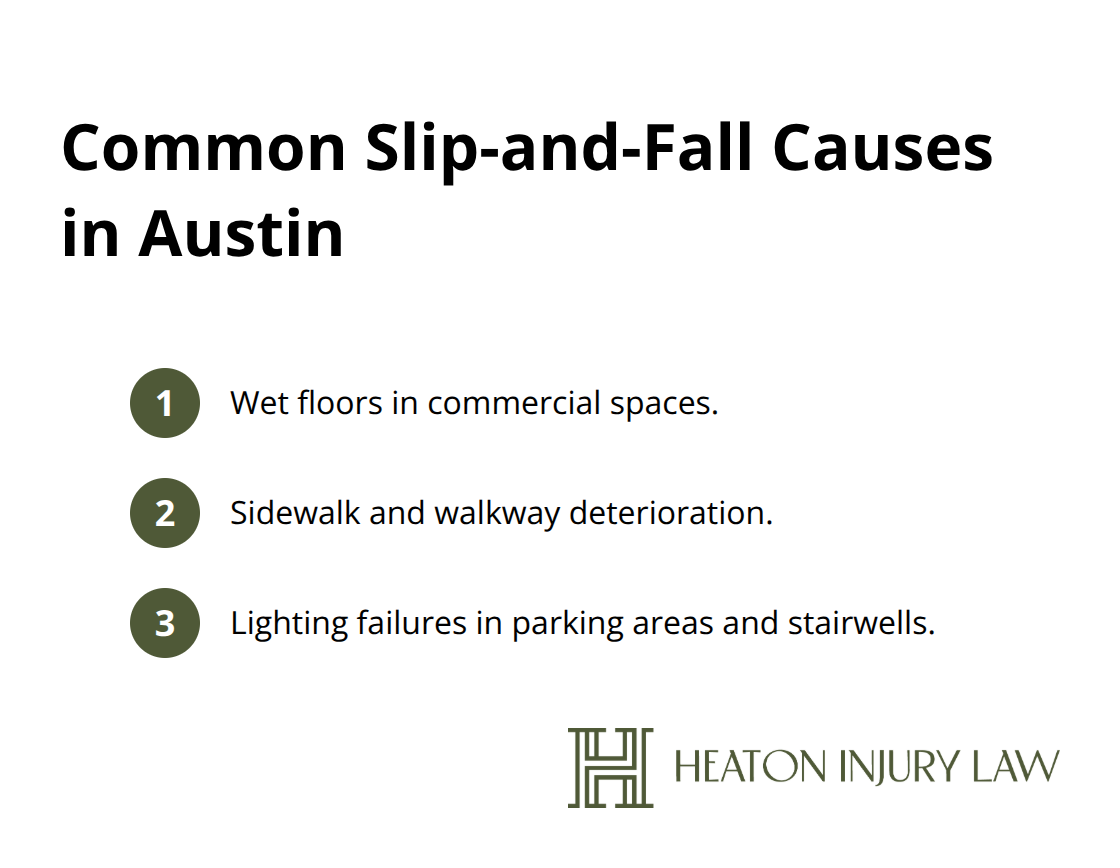
Wet floors in commercial spaces remain the leading culprit behind slip and fall injuries across Austin. According to the Consumer Product Safety Commission, slips and falls account for almost 60 percent of all reported injuries, and these accidents cause more than 40 percent of all trips to the emergency room in the United States. In Austin specifically, over 9,300 slip-and-fall claims were filed in 2016, demonstrating how common these incidents are in our community. Supermarkets, restaurants, office buildings, and retail stores frequently fail to manage water, cleaning solutions, or food debris on their floors. The problem intensifies during rainy seasons when entrance areas become hazardous collection points for moisture and tracked-in water.
Property owners often wait too long to address wet conditions, relying on customers to avoid the hazard rather than actively controlling it. This negligence directly causes injuries because businesses know wet floors create danger yet fail to post warnings, place caution signs, or clean promptly.
Sidewalk and Walkway Deterioration
Poorly maintained sidewalks and walkways throughout Austin present another serious hazard that property owners routinely ignore. Cracked pavement, uneven surfaces, and raised edges catch feet unexpectedly, especially for older adults and people with mobility challenges. Austin’s weather patterns-intense summer heat followed by occasional freeze-thaw cycles-accelerate pavement deterioration, yet many property owners delay repairs indefinitely. Building codes and municipal standards require property owners to maintain walkways in safe condition, but enforcement remains inconsistent. Photographs of the defect and its location establish constructive knowledge: if a crack or hole has existed long enough that reasonable inspection would have discovered it, the property owner bears liability even without direct notice of the hazard.
Lighting Failures in Parking Areas and Stairwells
Inadequate lighting in parking lots and stairwells creates preventable accidents that multiply liability exposure for property owners. Poor visibility prevents you from seeing obstacles, holes, or debris until your foot strikes them. Stairwells with burned-out bulbs or insufficient fixture coverage become traps for anyone unfamiliar with the space. Property owners have a duty to maintain lighting at reasonable levels, especially in high-traffic areas where falls are foreseeable. Photographs or videos taken at the time of your fall show the darkness and any broken fixtures-evidence that strengthens your claim significantly. If the property owner had received prior complaints about lighting or had failed to replace burned-out bulbs for extended periods, that history demonstrates negligence and reinforces your right to compensation.
Understanding what caused your fall is the first step toward proving liability. The next section covers the specific evidence you must collect to transform your account of what happened into a compelling legal case.
Evidence You Need to Strengthen Your Slip and Fall Claim
Medical Records Create Causation
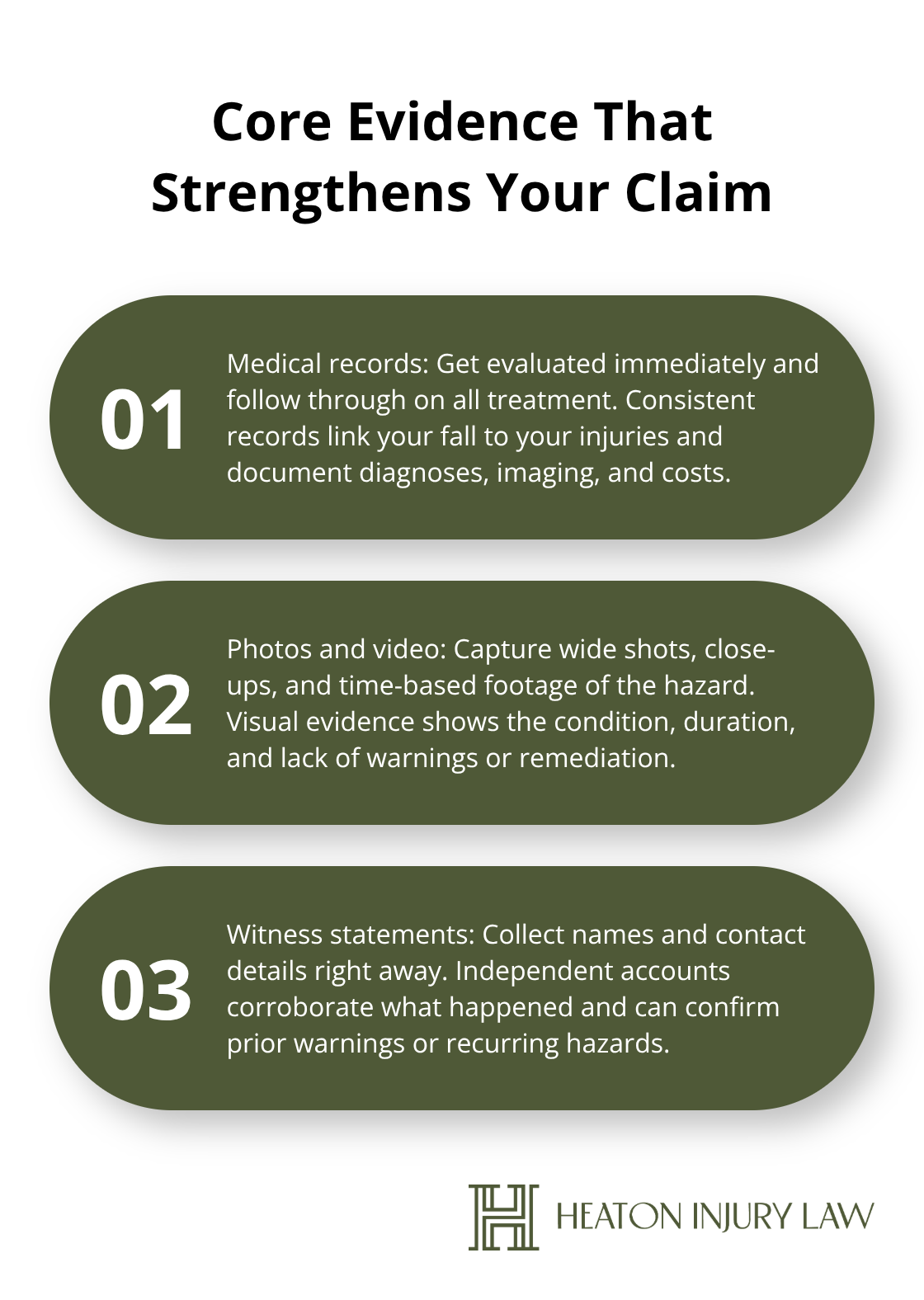
Medical records form the backbone of your claim because they create an official timeline linking your fall directly to your injuries. Seek medical attention immediately after your accident, even if you feel only minor pain. Hospitals and clinics document the date, time, and nature of your injuries, establishing causation that property owners and insurers cannot dispute. Your medical records should include initial examination findings, imaging results like X-rays or MRIs, diagnoses, treatment plans, and ongoing care notes. Keep copies of all bills, receipts for prescriptions, and invoices for physical therapy or rehabilitation. If your injuries prevent you from working, obtain a statement from your physician confirming your inability to perform job duties during recovery. Insurance companies scrutinize gaps in medical treatment, so consistent follow-up visits strengthen your case significantly. Document every expense related to your injury, including transportation to appointments and any home modifications needed for accessibility during healing.
Photographs and Video Evidence of the Hazard
Photographs and video footage of the hazard that caused your fall are non-negotiable evidence. Return to the location where you fell as soon as physically possible and capture wide-angle shots showing the entire area, close-up images of the specific hazard, and detail shots that reveal how long the condition likely existed. If a wet floor caused your fall, photograph it without caution signs or wet floor markers visible. For cracked sidewalks, include a ruler or coin in the frame to show the depth and width of the defect. Video footage is particularly persuasive because it shows the hazard’s duration and the property owner’s failure to address it. Preserve your clothing and footwear from the day of the fall because wear patterns and damage patterns can support your account of how you fell.
Witness Statements and Contact Information
Witness statements carry substantial weight in proving negligence because independent observers provide credibility your account alone cannot achieve. Immediately after your fall, ask anyone who saw the incident for their name, phone number, and email address. Request that they write a brief statement describing what they observed, including the hazardous condition and how you fell. Follow up with witnesses within days while their memories remain sharp, and ask specific questions about whether they had noticed the hazard before your accident or warned others about it. If you cannot obtain written statements at the scene, contact witnesses later and request they provide details via email or phone call documented in writing. Witness testimony becomes harder to secure as time passes because people move, change phone numbers, and forget details, so prioritizing early contact is essential.
The evidence you collect at the scene and during your recovery directly determines whether you can prove the property owner knew or should have known about the hazard. An attorney has the connections and resources to bring in experts and strengthen your case with credible, persuasive evidence when building your negligence claim.
Why Property Owner Negligence Determines Your Recovery
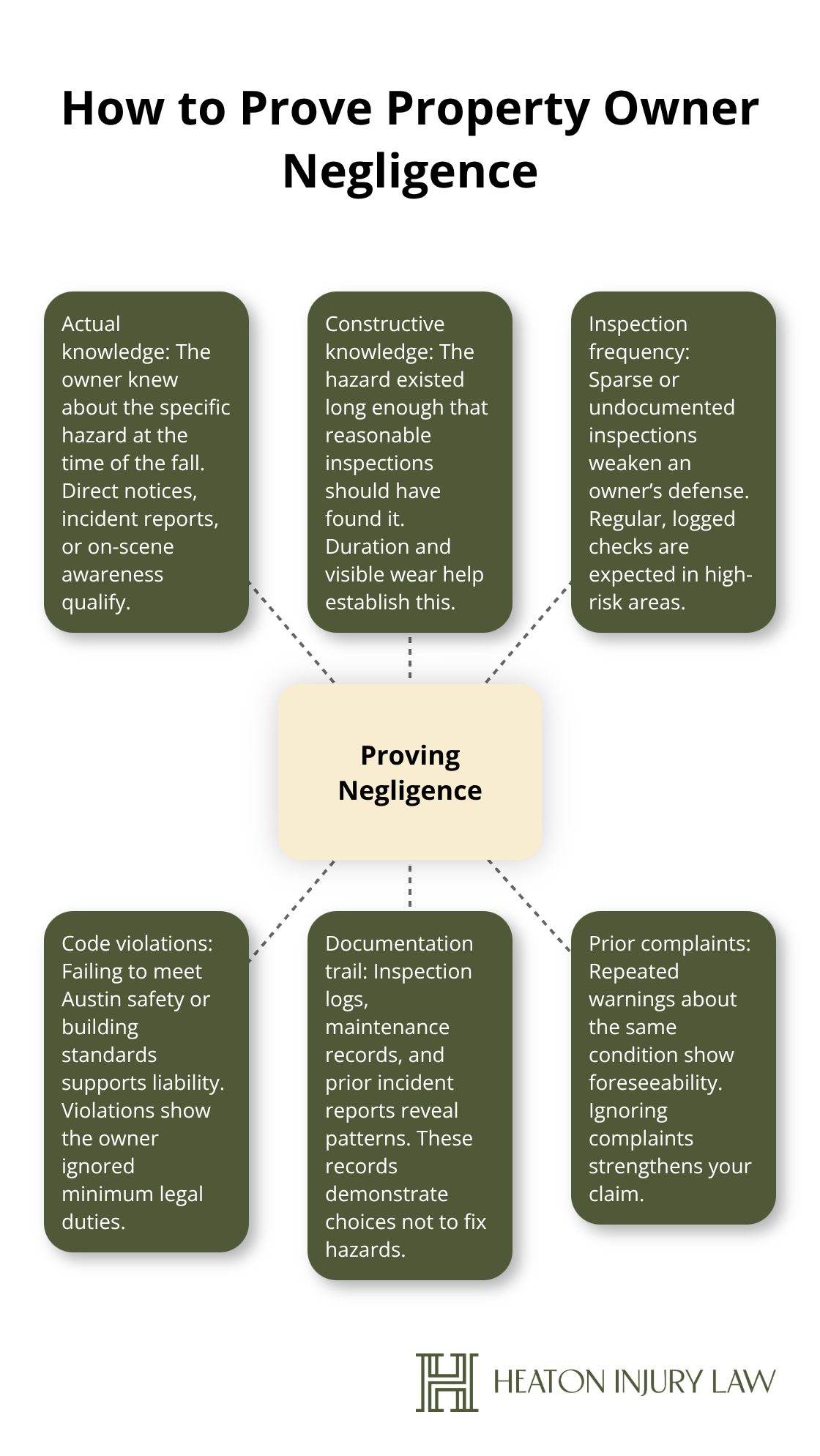
Property owner negligence is not abstract legal theory-it directly determines whether you receive compensation or walk away empty-handed. Texas law requires you to prove that the property owner knew or reasonably should have known about the hazard that caused your fall, failed to fix it or warn you, and that failure caused your injuries. This framework sounds straightforward until you realize property owners deploy aggressive defenses claiming they had no knowledge of the dangerous condition. Your job is to dismantle that defense with concrete evidence showing the owner either had actual knowledge of the specific hazard or constructive knowledge (meaning the hazard existed long enough that reasonable inspections should have discovered it). The Texas Supreme Court decision in Albertsons v. Mohammadi established that actual knowledge must relate to the specific hazard at the time of your fall-mere general awareness that spills happen in grocery stores does not satisfy this requirement. This distinction matters enormously because it forces property owners to maintain detailed inspection logs, incident reports, and maintenance records that you can demand during the legal process.
How Duration and Inspection Frequency Establish Constructive Knowledge
Constructive knowledge hinges on duration and inspection frequency. If a crack in a sidewalk has existed for six months without repair, a property owner cannot credibly claim ignorance about its existence. Similarly, if a business receives complaints about inadequate lighting or has repeatedly replaced burned-out bulbs in the same fixture without upgrading the electrical system, constructive knowledge is established. You should document everything about how long the hazard likely existed by photographing the condition’s severity, obtaining maintenance records through discovery, and identifying prior complaints or incidents at that location. The longer the hazard persists without correction, the stronger your case becomes.
Safety Standards and Building Code Violations
Safety standards and building codes matter because they set minimum expectations for property maintenance. Austin municipal codes require property owners to maintain sidewalks in safe condition and lighting at reasonable levels-violations of these codes strengthen your claim significantly. When a property owner ignores these standards, they are not merely being negligent; they are violating explicit legal requirements that courts recognize as evidence of fault. Code violations demonstrate that the owner prioritized cost-cutting over your safety and the safety of other visitors.
Building Your Evidence of Knowledge and Negligence
The stronger your evidence of what the owner knew and when they knew it, the harder it becomes for them to minimize their liability or shift blame to you. Examination of inspection schedules, maintenance budgets, prior incident reports, and code compliance records demonstrates that property owners made conscious choices about safety. These records reveal patterns of neglect and establish that the owner had the information necessary to address hazards but chose not to act. Understanding premises liability principles helps you recognize which evidence matters most when building your case.
Final Thoughts
A strong slip and fall claim in Austin rests on three interconnected elements that work together to establish liability. You must prove that a dangerous condition existed on the property, that the property owner knew or should have known about that hazard, and that this negligence directly caused your injuries through medical documentation. Property owners and their insurers attack claims by exploiting gaps in evidence, so collecting photographs, witness statements, and medical records immediately after your fall protects your right to compensation.
We at Heaton Injury Law, PLLC recognize how insurers minimize payouts on slip and fall claims throughout Austin. Our team prepares every case with a trial-ready approach, treating your claim as if it will go to court rather than accepting lowball settlement offers. This strategy forces insurers to take your case seriously and offer fair compensation that reflects the true value of your injuries and losses.
Contact us today for a free consultation to discuss your accident and assess your claim. We handle slip and fall cases on a contingency fee basis, so you pay nothing unless we recover compensation for you. The two-year statute of limitations in Texas moves quickly, and critical evidence like security footage or witness statements disappears fast, so reach out to Heaton Injury Law, PLLC now to protect your legal rights.
The information provided in this blog is for general informational purposes only and does not constitute legal advice. Every case is unique, and laws may vary by jurisdiction. Reading this content does not create an attorney-client relationship. For guidance specific to your situation, please consult with a qualified personal injury attorney licensed in Texas.
Artificial intelligence may have been used to assist in generating some text or images in these articles.