

Meredythe | May 14, 2026 | Blog

Brain injuries change lives in seconds. Whether from a car accident, fall, or workplace incident, the physical and financial consequences can be overwhelming.
At Heaton Injury Law, PLLC, we help Austin brain injury attorney clients understand their legal options and fight for the compensation they deserve. This guide covers what you need to know about brain injuries, your rights, and how to protect your future.
How Brain Injuries Happen
Three Categories of Brain Injury
Brain injuries fall into three distinct categories, each with different mechanisms and legal implications. Traumatic brain injuries result from external force-car crashes, falls, assaults, or workplace accidents. According to data from the Centers for Disease Control and Prevention, nearly half of all traumatic brain injury hospitalizations stem from falls, while motor vehicle crashes account for a significant portion of severe cases. The impact causes the brain to move within the skull, damaging nerve fibers and creating bruising. Diffuse axonal injuries occur when sudden acceleration or deceleration forces the brain to shift violently inside the skull, tearing axons that connect neurons. These injuries are common in high-speed collisions and falls from significant heights. Unlike focal injuries that show up clearly on imaging, diffuse axonal injuries can be harder to detect initially, though advanced neuroimaging like DTI scans reveals the microscopic damage.
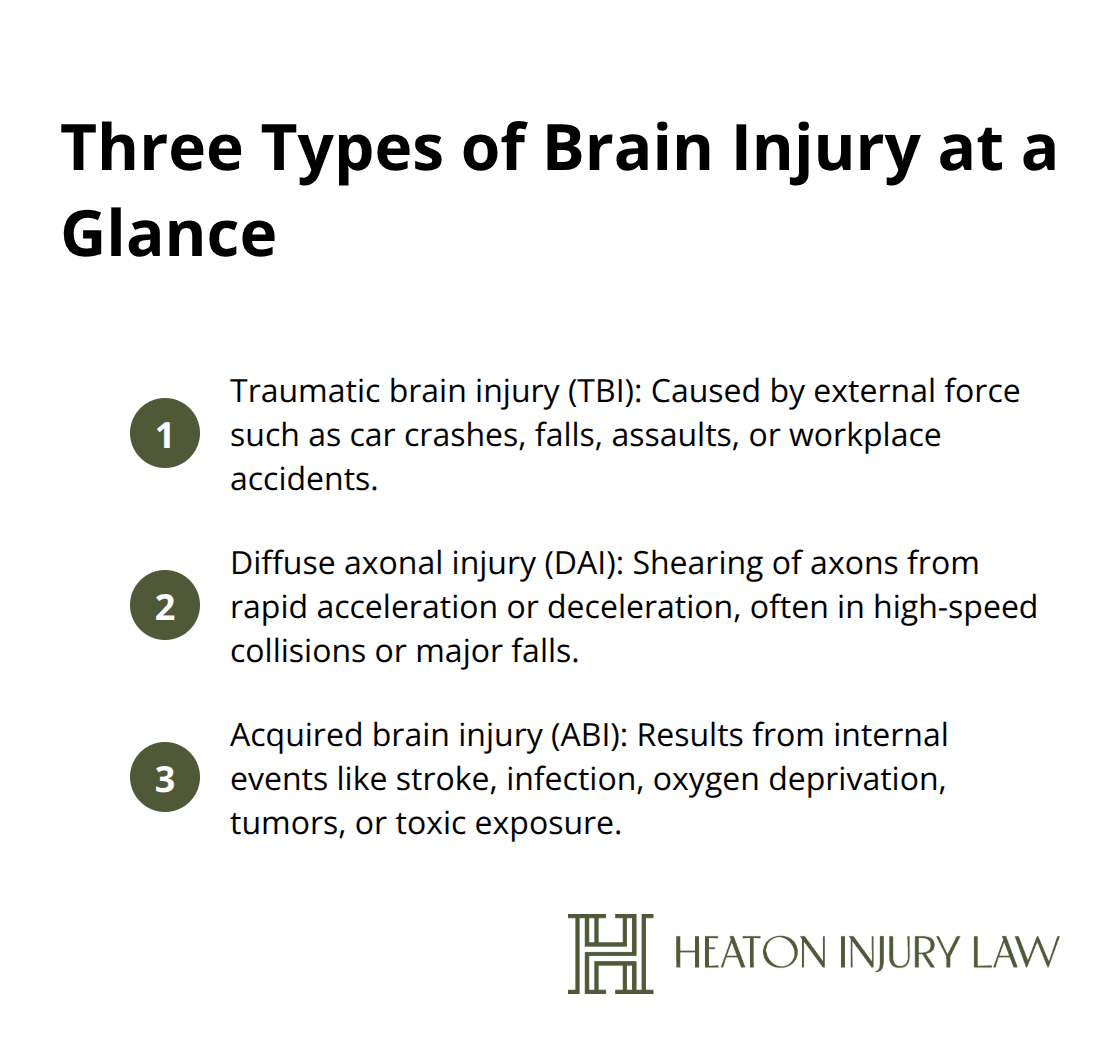
Acquired brain injuries differ fundamentally-they result from internal events rather than impact. Strokes, infections like meningitis or encephalitis, oxygen deprivation, brain tumors, and toxic exposure all cause acquired injuries.
Why the Injury Type Matters for Your Claim
The distinction between injury types matters significantly for your claim because the liable party and negligence theory change depending on how the injury occurred. A car accident victim has clear liability against a negligent driver, while a fall on unmaintained commercial property involves premises liability, requiring proof that the property owner knew or should have known about the hazard depending on your status. Workplace brain injuries may involve third-party liability against equipment manufacturers or contractors, not just your employer. Medical events that cause acquired brain injuries-such as hospital negligence leading to oxygen deprivation or failure to diagnose infection-involve medical malpractice claims with specific procedural requirements in Texas.
Evidence That Proves Your Injury
The mechanism of injury directly influences what evidence matters most in your case. Impact injuries need imaging showing contusions or hemorrhage; diffuse axonal injuries require neuropsychological testing to document cognitive changes; acquired injuries demand medical records proving the defendant’s failure to act. Identifying the precise injury mechanism and responsible parties early determines your compensation strategy and which experts will strengthen your case. This foundation shapes everything that follows-from the initial investigation through settlement negotiations or trial.
What Happens After a Brain Injury: Recognition and Medical Assessment
Immediate and Delayed Symptoms Demand Different Responses
Brain injury symptoms arrive on a spectrum-some strike immediately, others emerge days or weeks later. The Centers for Disease Control and Prevention identifies confusion, loss of consciousness, severe headache, vomiting, dizziness, and drainage from the nose or ears as signs requiring emergency care right away. Most people miss the critical reality: symptoms can surface much later. Balance problems, sleep disturbances, persistent headaches, neck pain, personality shifts, irritability, and depression or anxiety may not appear until weeks or months post-injury. This delayed presentation creates a significant gap in your legal case because insurance companies exploit the absence of immediate symptoms to minimize injury severity. Medical documentation from the moment symptoms appear-whether hours or months after the incident-becomes essential evidence that the defendant’s negligence caused lasting harm.
Advanced Testing Reveals Hidden Damage
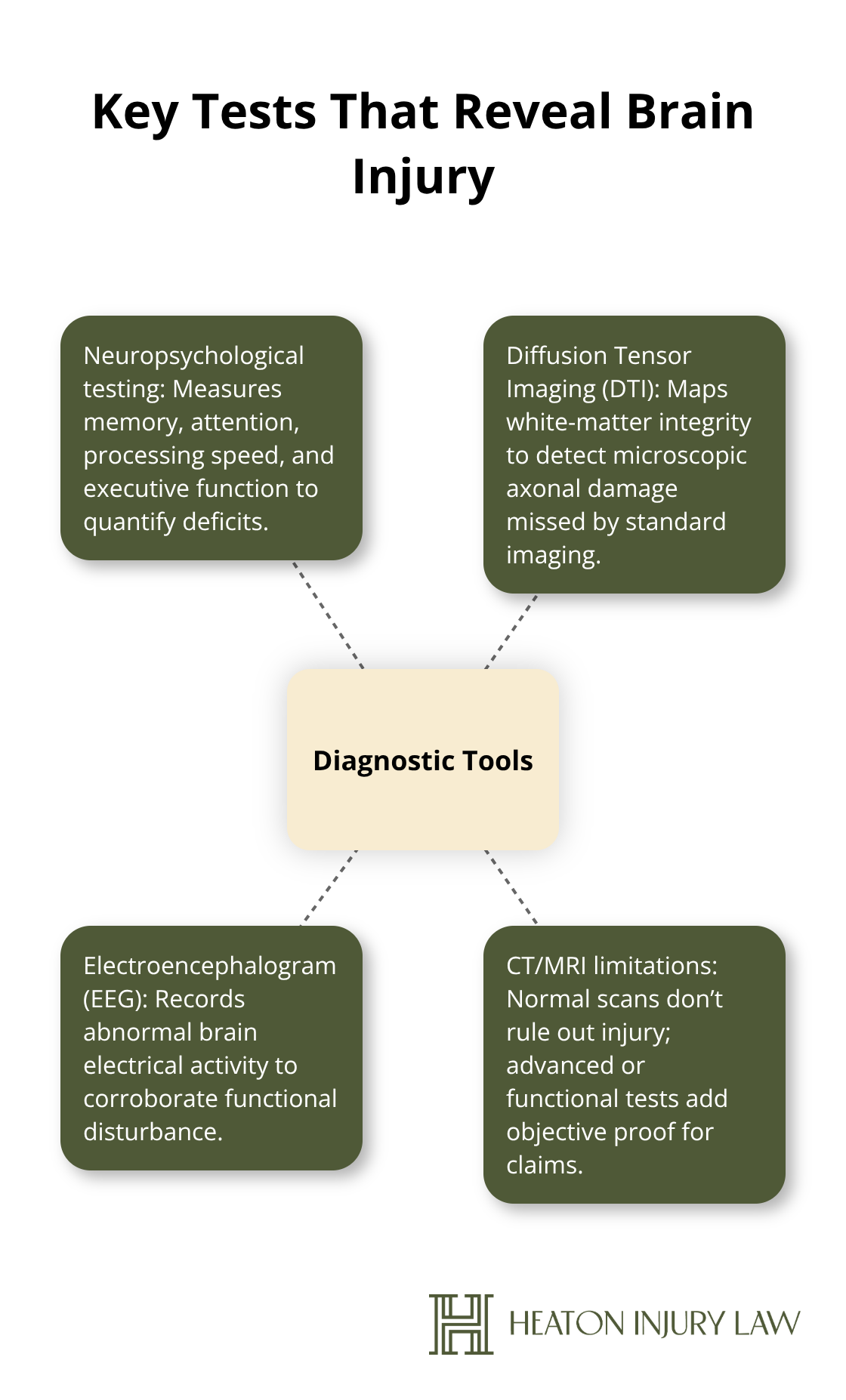
Diagnosis requires specific testing that goes beyond standard CT or MRI scans. Neuropsychological testing measures memory, concentration, processing speed, and executive function to quantify cognitive decline. Diffusion Tensor Imaging (DTI) reveals microscopic axonal damage invisible on conventional imaging. Electroencephalograms (EEGs) capture abnormal brain electrical activity. These diagnostic tools provide the objective proof insurers demand when they try to downplay subjective complaints like fatigue or concentration problems. Without them, your claim rests on your word alone-a position that weakens settlement leverage significantly.
How Brain Location Determines Long-Term Impact
Long-term consequences reshape how your brain functions and what your body can do. Frontal lobe damage produces risky behavior and impaired judgment; left-hemisphere injury causes speech and logic problems; right-hemisphere damage impairs visual processing and familiar task performance. Physical effects include seizures, balance problems, slurred speech, and movement difficulties that affect employment and independence. Cognitive effects-memory loss, trouble concentrating, planning difficulties, language issues-often prevent return to pre-injury work. Emotional effects like depression, anxiety, aggression, or paranoia strain relationships and daily life.
The Invisibility Problem in Settlement Negotiations
Texas estimates that 5.5 million residents have sustained a traumatic brain injury in their lifetime, yet brain injury remains invisible because disabilities don’t always show. This invisibility works against you in settlement negotiations because adjusters see no wheelchair or crutch and assume minimal impact. Rehabilitation is multi-disciplinary-physical therapy, occupational therapy, speech therapy, psychology, and social work-and intensive effort produces better outcomes than passive recovery. The more structured and consistent your rehabilitation, the stronger your argument for ongoing care costs and future medical expenses in your damage claim.
Persistent Symptoms Strengthen Your Position Over Time
Some symptoms persist years after injury, so ongoing monitoring and updated medical evaluations strengthen your position as time passes and long-term impairment becomes undeniable. This documentation trail transforms what initially appeared as a minor incident into evidence of serious, lasting harm. Your medical records and rehabilitation progress directly support the damages you pursue in negotiations or at trial.
What You Can Actually Recover in a Brain Injury Claim
Establishing Negligence and Liability
Proving negligence in a brain injury case requires establishing four elements: the defendant owed you a duty of care, breached that duty through their actions or inaction, directly caused your injury, and caused measurable damages. Texas uses a modified comparative fault rule, meaning if you bear more than 50 percent responsibility for the incident, you cannot recover anything. If you’re found partially at fault, your damages reduce proportionally to your percentage of fault. This standard makes evidence of the defendant’s negligence critical-surveillance footage, witness statements, accident reports, and police records form the foundation of liability arguments.
The mechanism of injury determines which negligence theory applies and what evidence will convince an adjuster or jury that the defendant bears responsibility. A car crash victim has clear duty against a negligent driver; a fall on unmaintained property requires proving the owner knew or should have known about the hazard depending on your status; a workplace injury might involve third-party liability against equipment manufacturers or contractors. Medical malpractice cases involving acquired brain injuries follow different procedural rules under Texas law and require expert reports before filing suit.
Economic Damages: Quantifying Your Losses
Damages in brain injury claims split into economic and non-economic categories, and you must quantify both aggressively. Economic damages cover past and future medical expenses, lost wages, lost earning capacity, rehabilitation costs, in-home care, and assistive devices-these are calculable and documented. Insurance adjusters will lowball your claim if you rely solely on medical bills; instead, work with life-care planners and economists who project future care costs over your lifetime and calculate lost earning capacity based on your pre-injury career trajectory.

A 35-year-old professional facing decades of cognitive impairment and ongoing therapy has vastly different lifetime costs than a retiree with similar symptoms. This distinction matters enormously in settlement negotiations because it separates serious claims from minor ones in the adjuster’s mind.
Non-Economic Damages and Punitive Awards
Non-economic damages address pain and suffering, mental anguish, loss of enjoyment of life, emotional distress, and loss of consortium with your spouse or family. Texas allows punitive damages when a defendant acted with gross negligence, malice, or fraud, though these are separate from compensatory damages and reserved for egregious conduct.
Building Your Documentation Strategy
Settlement negotiations fail when your documentation doesn’t match the defendant’s insurance offer, so gather medical records from all providers, employment records showing pre- and post-incident performance changes, testimony from family and coworkers about personality or functional changes, and rehabilitation progress notes that demonstrate ongoing care needs. Most brain injury claims settle before trial, but insurers resist fair value because symptoms are subjective and invisible.
Prepare your case as if it will go to trial-this strengthens your bargaining position and prevents adjusters from dismissing your claim as weak. The statute of limitations in Texas is two years from the injury date, so timely action preserves evidence and witness credibility before memories fade or documentation disappears.
Final Thoughts
Brain injury recovery demands both medical attention and legal protection. Your injury type determines liability, your documentation determines settlement value, and your timeline determines whether you preserve your right to compensation. Texas gives you two years from injury to file suit, but waiting costs you credibility and evidence as memories fade and medical records become harder to obtain.
We at Heaton Injury Law, PLLC understand that brain injuries remain invisible to insurance adjusters but visible in your daily struggles with cognitive changes, emotional shifts, physical limitations, and lost earning capacity. Insurance companies count on you accepting lowball offers before the full scope of your injury becomes clear, exploiting the gap between immediate symptoms and delayed effects. An Austin brain injury attorney who prepares your case for trial from day one changes the negotiation dynamic entirely by gathering surveillance footage, medical records, employment data, and expert testimony early.
Contact us for a free, confidential case review with no legal fee unless we win. We travel to you for consultations and help connect you with trusted medical care in the Austin area so you can focus on recovery while we handle the legal complexity. Visit Heaton Injury Law, PLLC today to protect your rights and secure the compensation your recovery demands.
The information provided in this blog is for general informational purposes only and does not constitute legal advice. Every case is unique, and laws may vary by jurisdiction. Reading this content does not create an attorney-client relationship. For guidance specific to your situation, please consult with a qualified personal injury attorney licensed in Texas.
Artificial intelligence may have been used to assist in generating some text or images in these articles.