

Meredythe | July 15, 2026 | Blog

An injury can strip away your income overnight, leaving you scrambling to cover bills and expenses. At Heaton Injury Law, PLLC, we help injured Texans understand their rights to recover lost wages.
Lost wages recovery strategies aren’t one-size-fits-all. This guide walks you through calculating what you’re owed, gathering proof, and rebuilding your financial stability after injury.
What Income Actually Counts in Your Lost Wages Claim
Salary, Hourly Pay, and Beyond
Texas law recognizes that injury costs you far more than just your base salary. The types of income you can recover depend on what you actually earned before the injury. If you worked as a salaried employee, your annual salary forms the foundation of your claim. Hourly workers recover based on the hours they missed multiplied by their hourly rate. If you earned overtime regularly before the injury, that overtime income is recoverable too.
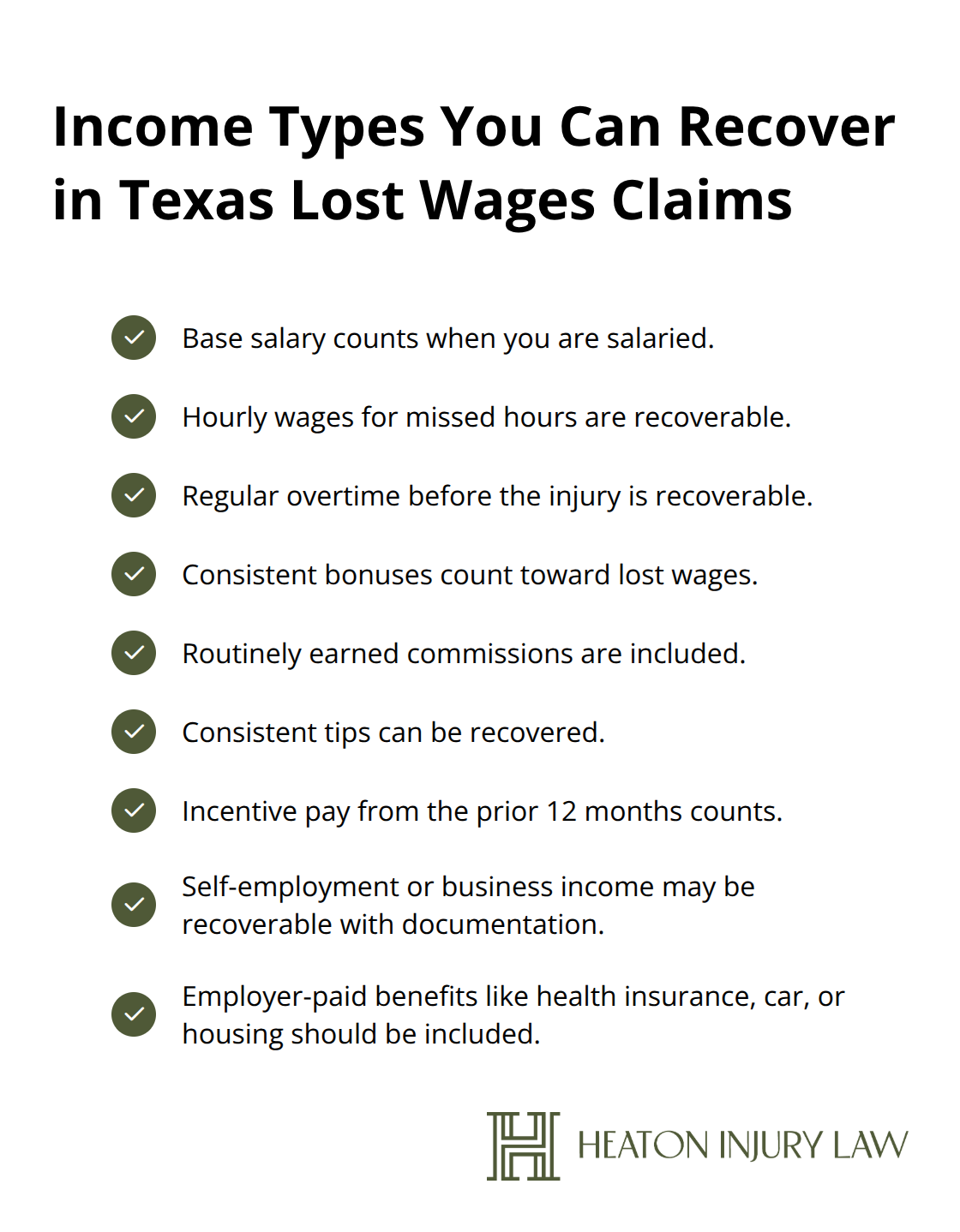
Bonuses, commissions, tips, and incentive pay all count if you received them consistently in the 12 months before your injury.
Self-Employment and Business Income
Self-employed individuals and business owners can recover lost business income, though this requires detailed documentation like tax returns, invoices, and bank statements showing what you would have earned. Non-pecuniary benefits matter as well-health insurance premiums, car allowances, or housing benefits that your employer paid on your behalf are part of your total compensation and should be included in your calculation.
Net Income, Not Gross Income
The calculation itself hinges on one critical fact: net income after taxes, not gross income. Texas courts recognize that you don’t actually take home your full salary because federal, state, and payroll taxes reduce what lands in your account. An employer letter confirming your role, normal pay rate, schedule, and the exact dates you missed work is the foundation of any strong claim.
Documentation Requirements by Employment Type
Salaried employees should gather recent pay stubs and W-2 forms from the past two years to establish their typical earnings. Hourly workers need time records and pay stubs that show their normal schedule and rates. Self-employed individuals must compile multiple years of tax returns, bank statements, invoices, and client contracts to establish what their typical net income was.
Calculating Your Specific Lost Wages
For salaried employees, the math is straightforward: divide your annual salary by 2,080 hours, then multiply by the hours you missed. If you earned $40,000 annually and missed 24 hours of work, your lost wages equal approximately $461.54. For hourly workers earning $20 per hour who missed 24 hours over three days, the calculation is $20 multiplied by 24 hours, totaling $480. The most important documentation you can provide is a note from your doctor detailing your recovery time and work restrictions-this medical evidence directly connects your injury to your time away from work and makes your claim credible to insurance adjusters. With your income types identified and calculations complete, the next step involves gathering the specific proof that transforms these numbers into a compelling case.
Turning Medical Records Into Wage Documentation
Your Doctor’s Note as the Foundation
Your doctor’s note is not optional-it forms the foundation that connects your injury to lost income. Insurance adjusters will not accept your word that you missed work. They need medical evidence showing exactly when you were unable to work and what restrictions prevented you from performing your job. Start collecting this documentation immediately after your injury. Request a detailed note from your treating physician that specifies the dates you were unable to work, any work restrictions (such as no lifting over 10 pounds or no standing for more than two hours), and when those restrictions are expected to end. This note should be specific enough that an adjuster can match it directly to the days you missed on your employer’s records. Most doctors’ offices will provide this at no extra charge if you ask during your appointment.
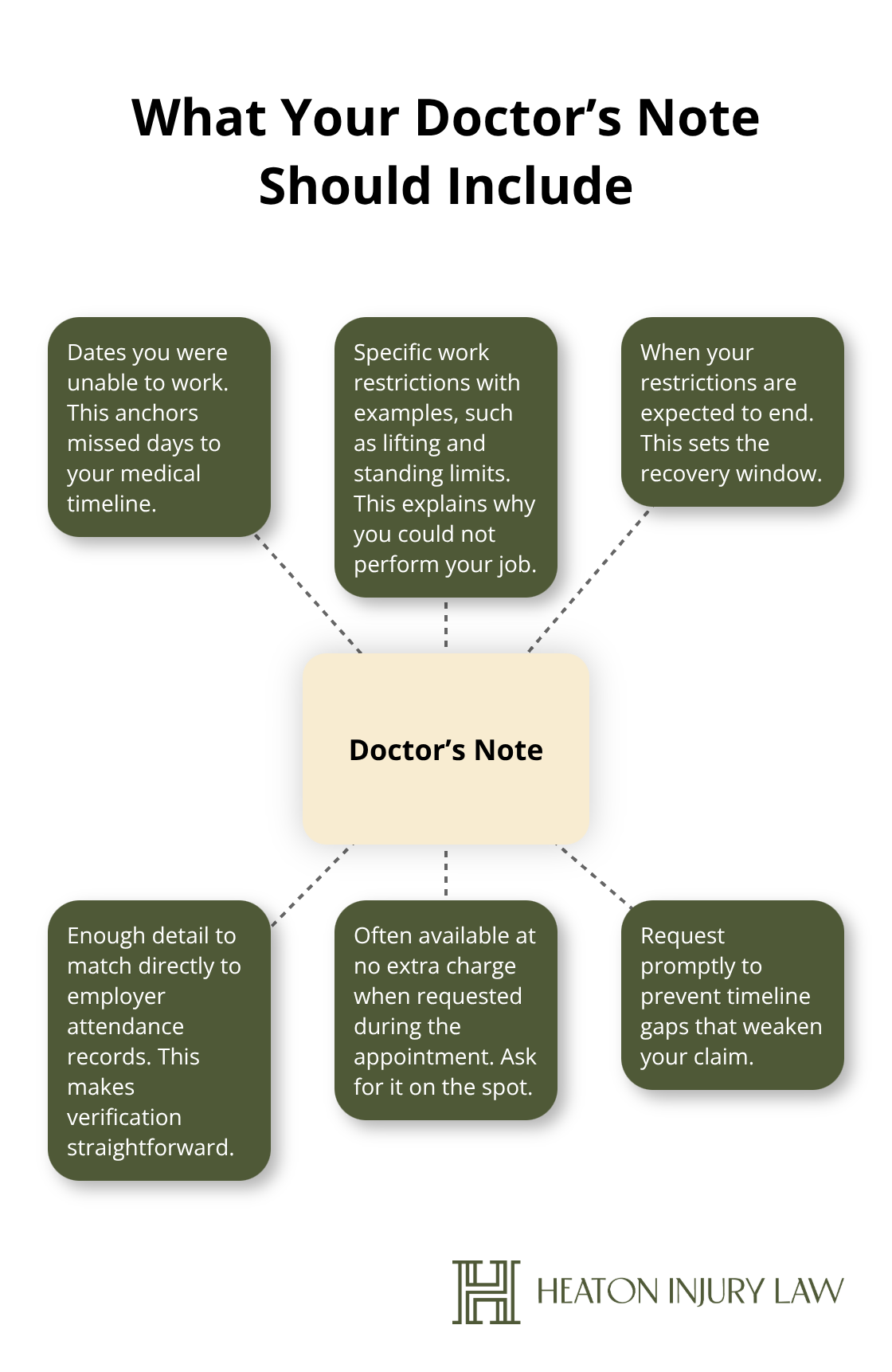
Do not wait weeks later to request it-the longer you delay, the harder it becomes to reconstruct the timeline.
Matching Medical Evidence to Employment Records
Your employer’s confirmation letter should reference your doctor’s restrictions and show exactly which dates fell outside your ability to work. If your employer resists providing this letter, that signals you need legal guidance. Insurance adjusters constantly challenge lost wage claims by suggesting light-duty work was available or that you exaggerated your recovery time. A contemporaneous medical record stating your restrictions defeats this tactic before it starts. The Texas Workforce Commission recognizes that injuries affect earning capacity differently depending on your job. A construction worker with a broken arm faces different restrictions than an office worker, and your medical documentation should reflect your specific job demands.
Countering Insurance Company Tactics
Insurance companies employ standard tactics to minimize what they pay for lost wages, and you must counter them with evidence they cannot dismiss. Adjusters frequently request recorded statements, hoping you will contradict yourself or downplay your injuries. Do not give a recorded statement without legal guidance-anything you say can be used against you later. Instead, provide written documentation that speaks for itself: pay stubs showing your normal hours, employer letters confirming your missed days, medical records detailing your restrictions, and tax returns establishing your baseline income.
Documentation Strategies for Self-Employed Workers
Self-employed individuals face particular skepticism because adjusters claim business fluctuations make income unpredictable. Combat this by providing tax returns from at least three years before your injury, showing consistent earnings patterns. Bank statements and invoices for the period you should have worked demonstrate what income you lost. If you had a profitable contract that fell through because of your injury, document this with email communications and the client’s confirmation. For overtime and bonus income, show that you received these consistently in the 12 months before your injury-do not claim overtime you rarely worked.
Using Economic Experts to Quantify Future Losses
Adjusters also dispute future earning capacity aggressively, but economic experts can quantify this loss in present-value terms that juries understand. An economist analyzes your age, education, work history, and the specific limitations your injury creates, then projects how much income you will lose over your remaining career. This expert testimony transforms abstract future losses into concrete numbers that support your settlement demand. The strength of your claim depends entirely on how thoroughly you document the gap between what you earned before and what you can earn now. With your medical records and wage documentation in place, you can now focus on the negotiation phase-where presenting this evidence strategically determines whether you settle fairly or need to pursue litigation.
Rebuilding Financial Stability After Injury
Income Replacement Programs in Texas
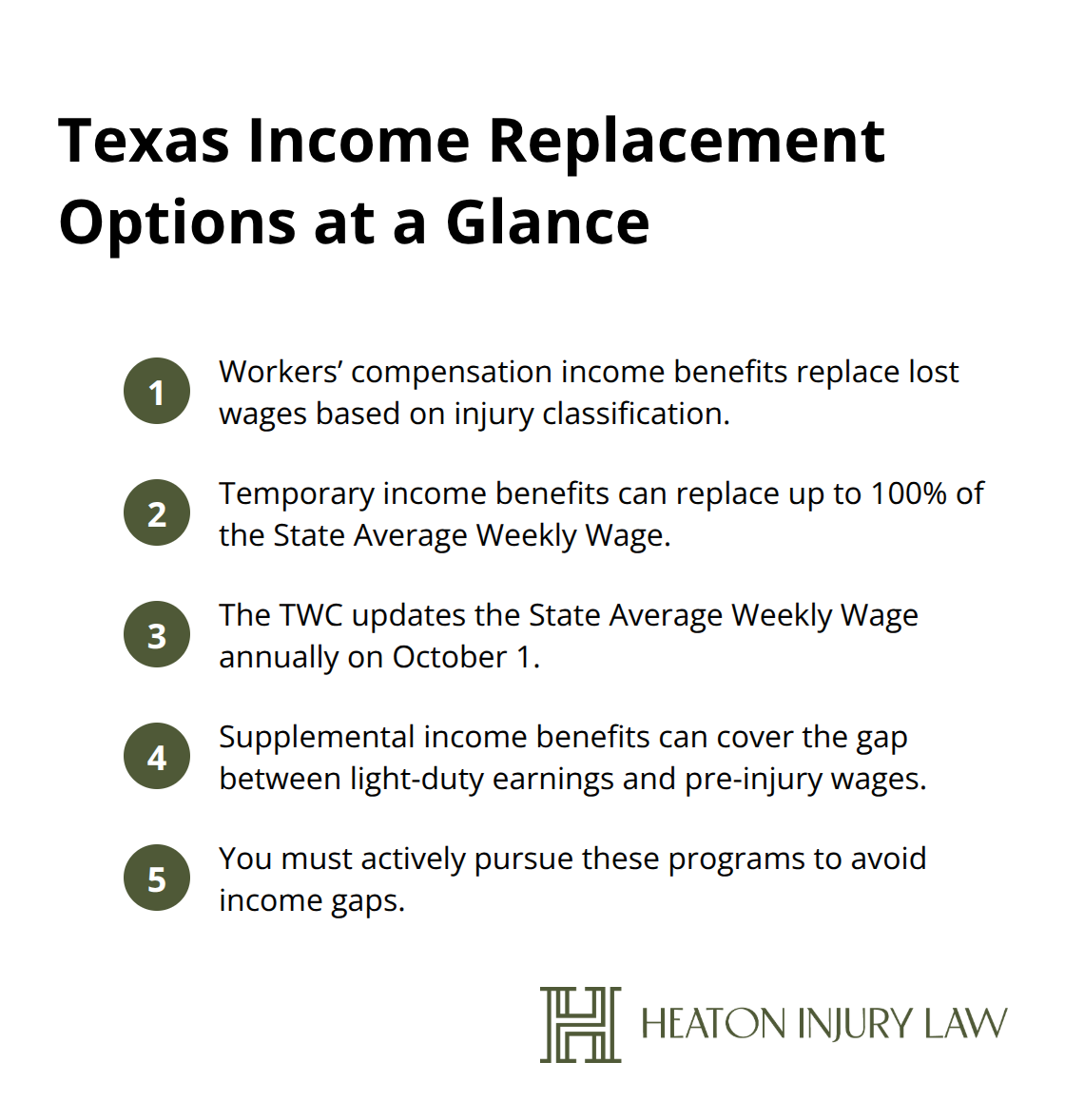
Most injured workers face a critical gap between when they stop earning and when they can return to work. Texas offers structured programs designed to accelerate your return to income, though you must actively pursue them rather than wait passively for recovery. The Texas Workforce Commission administers workers’ compensation income benefits that replace lost wages at specific rates depending on your injury classification. Temporary income benefits replace up to 100 percent of your State Average Weekly Wage, which the TWC updates annually on October 1st. If your injury prevents full-time work but you can perform light duty, supplemental income benefits cover the gap between what you earn in reduced capacity and your pre-injury weekly wage.
Communicating Restrictions to Your Employer
The key involves documenting your actual restrictions with your physician and communicating them clearly to your employer and insurer. Many employers in Texas partner with vocational rehabilitation providers who assess your capabilities and identify transitional work within your medical restrictions. Request this service immediately after your injury is classified as permanent or if your recovery extends beyond eight weeks. Vocational specialists can often place you in modified-duty roles that pay close to your regular wage while you heal, preventing a complete income collapse.
Retraining for Permanent Restrictions
Retraining becomes necessary only if your injury creates permanent restrictions that eliminate your pre-injury job entirely. Rather than accepting reduced earning capacity, investigate whether you can transition to a related field that accommodates your limitations. If you worked in construction with a permanent back injury, administrative or estimating roles in the same industry preserve much of your earning potential. The Texas Workforce Commission offers retraining programs through community colleges and vocational schools, and workers’ compensation may cover tuition and books if your injury prevents return to your original occupation. Calculate whether retraining costs are justified by comparing your reduced earning capacity against the investment required. A 35-year-old electrician with a permanent hand injury might justify one year of schooling for an electrical inspector certification, gaining 30 years of modified-income opportunity. Meanwhile, a 62-year-old facing early retirement may accept reduced benefits rather than spend resources on retraining with limited years remaining in the workforce.
Building Your Recovery Budget
Financial planning during recovery requires honest assessment of your timeline and prognosis. Build a recovery budget that accounts for medical expenses, reduced income, and the actual timeline your physician provides, not the timeline you hope for. Contact the Texas DWC Consumer Hotline at 800-252-7031 to verify your benefit eligibility and payment schedule before relying on income projections. If insurance benefits fall short, explore whether you have uninsured or underinsured motorist coverage that can supplement lost wage recovery while you rebuild (this coverage varies by policy, so check your documents carefully).
Final Thoughts
Lost wages recovery strategies require thorough documentation, strategic negotiation, and experienced legal guidance working together. Insurance adjusters will challenge your claim regardless of how solid your evidence is-they dispute injury severity, suggest light-duty work was available, or request recorded statements designed to trap you into contradictions. Your documented medical restrictions, employer confirmation letters, and tax returns form an impenetrable defense against these tactics.
We at Heaton Injury Law, PLLC understand insurer tactics and counter their arguments before they gain traction. Our founder, Meredythe Heaton Wilkinson, brings 14+ years of experience handling car, motorcycle, truck, brain and catastrophic injuries, rideshare crashes, slip-and-fall, workplace injuries, and wrongful-death claims. This insider knowledge means we protect your lost wages claim and maximize what you recover.
Contact us today for a free consultation to review your specific situation, estimate your lost wages including future earning capacity, and explore your options for settlement or litigation. The two-year deadline to file a personal injury lawsuit in Texas moves quickly, and early action preserves evidence that weakens over time. Heaton Injury Law, PLLC stands ready to help you rebuild your financial stability.
The information provided in this blog is for general informational purposes only and does not constitute legal advice. Every case is unique, and laws may vary by jurisdiction. Reading this content does not create an attorney-client relationship. For guidance specific to your situation, please consult with a qualified personal injury attorney licensed in Texas.
Artificial intelligence may have been used to assist in generating some text or images in these articles.