

Meredythe | August 28, 2026 | Blog
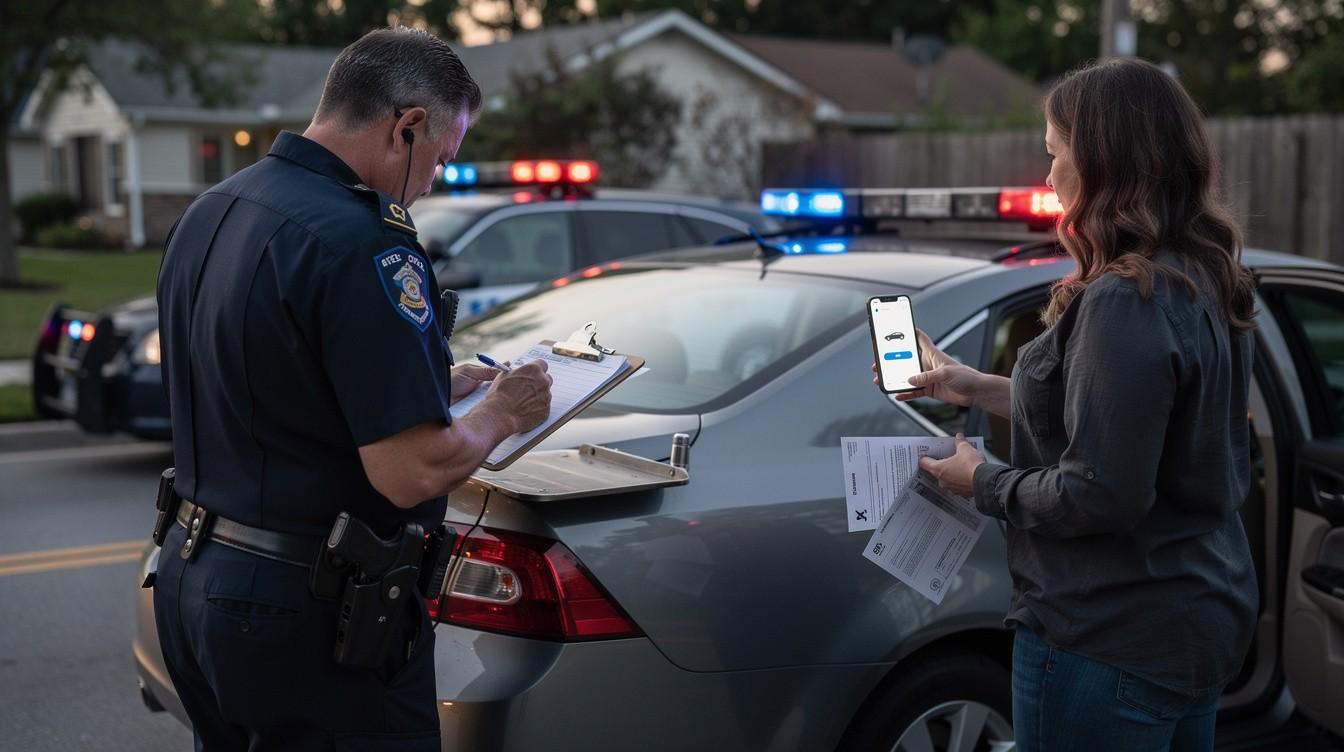
A rideshare accident can leave you shaken and unsure about what comes next. Understanding the rideshare police report process is essential to protecting your legal rights and building a strong claim.
At Heaton Injury Law, PLLC, we guide injured Texans through every step of this process. This guide walks you through what to expect from the moment of impact through obtaining your official report.
What to Do Right After a Rideshare Crash
Call 911 Immediately for Medical Care and Police Response
Your first minutes after a rideshare accident determine how strong your claim becomes. If you or anyone else sustained injuries, call 911 immediately-do not wait. According to TxDOT data from 2023, more than 18,000 people sustained serious injuries in Texas crashes, many of whom delayed medical assessment and later faced complications. Adrenaline masks pain and injury severity, so even if you feel fine, request an ambulance. Police will arrive and file an official CR-3 crash report, which records critical details including driver information, time, location, road conditions, and statements from all parties. This report becomes foundational evidence for determining liability and supporting your insurance claim.
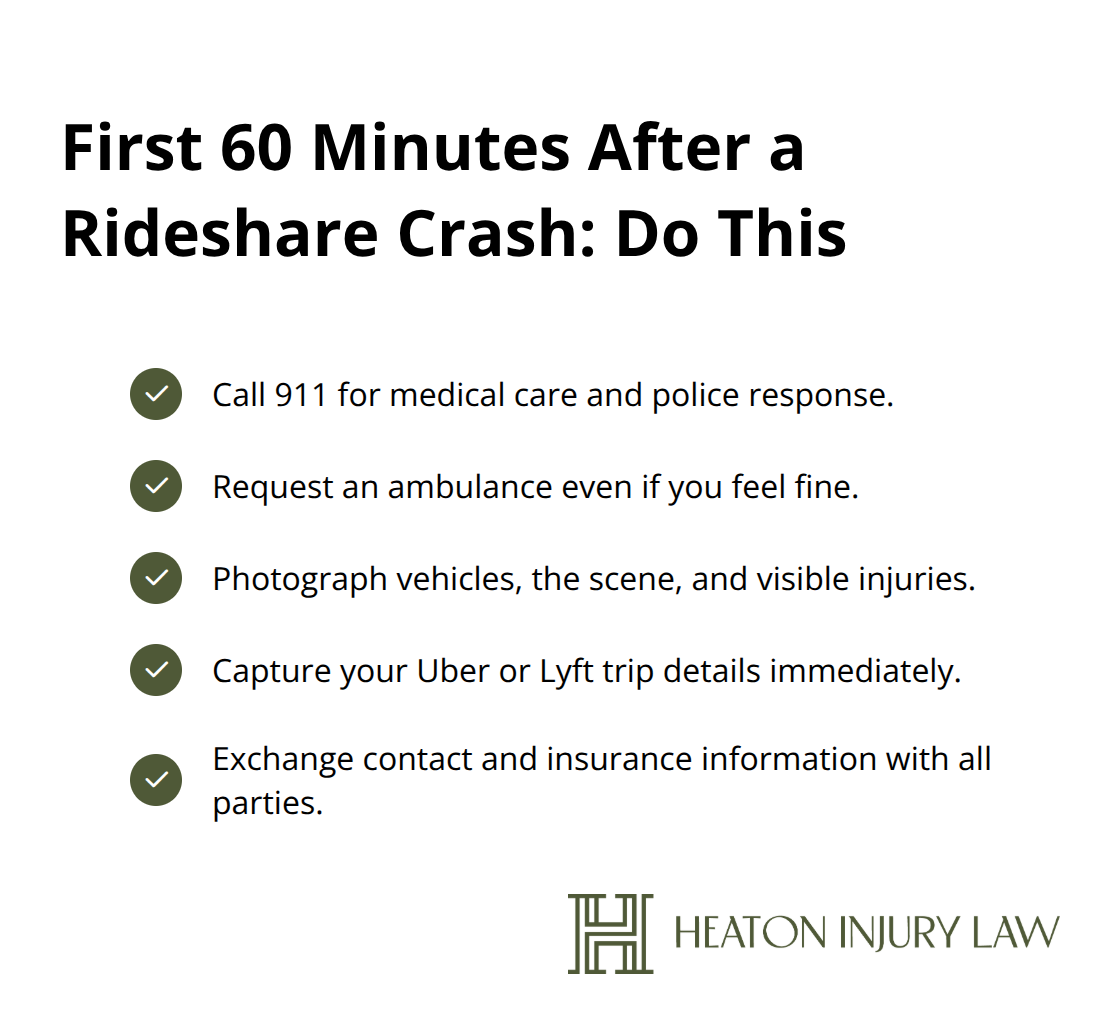
If injuries are minor or you feel uncertain, still seek medical evaluation at an urgent care or hospital within hours. Documented medical records prove your injuries occurred at the scene, not days later, which protects your claim from insurer challenges.
Preserve Evidence at the Scene
While waiting for emergency responders, preserve evidence from your location. Take photos and videos of vehicle damage from multiple angles, road conditions, traffic signals, and any visible injuries. Screenshot your Uber or Lyft trip details immediately, including the driver’s name, vehicle information, and pickup location-this data proves the driver’s app status at the time of impact, which determines insurance coverage.
Exchange contact information with the other driver, passengers, and any witnesses; obtain their names, phone numbers, addresses, driver’s license numbers, and insurance details. Write down your own observations about what happened while memory is fresh, noting weather, time of day, traffic patterns, and how the crash occurred. Do not admit fault or apologize for the accident, as these statements can be used against you later.
Cooperate with Police Without Overcommitting
Once police arrive, provide factual information but avoid giving a recorded statement to any insurance adjuster without consulting a lawyer first. In Texas, reporting requirements depend on severity-crashes with injuries, fatalities, or property damage exceeding $1,000 must be reported to law enforcement, which 911 handles automatically. The officer will document everything you tell them in the official report, so stick to facts: what you saw, heard, and felt at the moment of impact. This official documentation protects you far more than any informal statement to an insurance company ever could.
What the Police Report Contains and How to Get Yours
Understanding the CR-3 Report’s Critical Contents
The CR-3 crash report filed by responding officers becomes your most valuable document in a rideshare claim. This official record captures the officer’s observations, statements from all parties, witness contact information, vehicle damage descriptions, road and weather conditions, and traffic control device status. The report includes specific details like the exact time of impact, location coordinates, vehicle identification numbers, driver license information, and insurance details for all parties involved. Insurance adjusters and opposing counsel will reference this documentation extensively, and courts give significant weight to official police records.
When Texas Law Requires a Police Report
In Texas, law enforcement must file a report within a specified timeframe when injuries, fatalities, or property damage exceeding $1,000 occur-which virtually all rideshare accidents meet. The responding officer documents everything at the scene, creating an objective account that protects you far more than any informal statement to an insurance company ever could. This official documentation establishes a timeline and factual foundation that strengthens your position from day one.
How to Obtain Your Police Report
Ask the responding officer for the report number and the jurisdiction handling the case before leaving the scene. In Texas cities, local police departments file reports; rural areas may involve county sheriffs or Texas Highway Patrol.
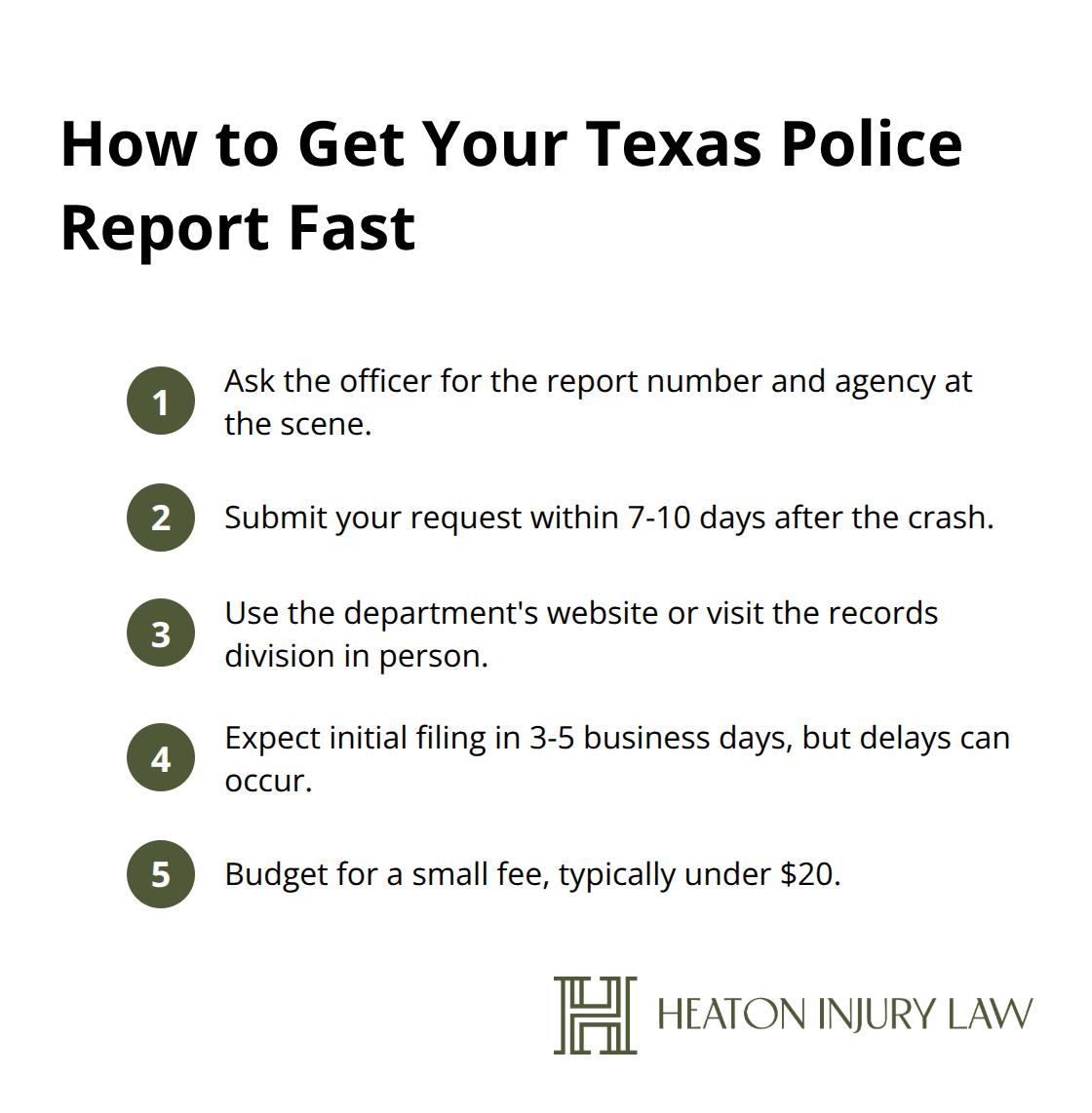
Request the police report number and follow up to obtain the full report within 7-10 days, not weeks. Most departments allow online requests through their websites or require an in-person visit to the records division; some charge a small fee, typically under $20.
Request multiple certified copies since your doctor, insurance company, and any attorney handling your case will each need one. Expect the initial report to be filed within three to five business days, though some jurisdictions may take longer during high-volume periods. Do not delay this step-timely acquisition of the police report demonstrates to insurers that you take your claim seriously and prevents coverage gaps that can arise from delayed reporting.
Moving Forward With Your Documentation
Once you hold your official police report, you possess the foundation for all next steps in your claim. This document proves what happened, when it happened, and who was present-information that becomes essential as you notify your rideshare company and contact insurance carriers about your accident.
What to Do After Police File Your Report
File an In-App Accident Report Immediately
Your police report marks the transition from crisis management to strategic claim building. Within 24 hours of the accident, file an in-app accident report through Uber or Lyft. This action creates a timestamped record that triggers their insurance process and protects you from coverage denials based on delayed notification. The rideshare company needs to know about the incident, but never admit fault in that report. Stick to factual details: date, time, location, and that a crash occurred.
Avoid Recorded Statements and Premature Settlements
Do not provide a recorded statement to anyone at the rideshare company or to insurance adjusters at this stage. Insurance adjusters are trained to minimize payouts, and anything you say without legal counsel can be used to reduce your claim value. Your police report already documents your account; additional statements only create opportunities for inconsistencies that insurers will exploit.
Do not accept any settlement offer in the first weeks after an accident. Insurance companies count on injured people making quick decisions under stress. Medical complications often emerge weeks or months later; accepting $5,000 today when your injuries require $50,000 in future treatment is irreversible.
Identify Which Insurance Policy Applies
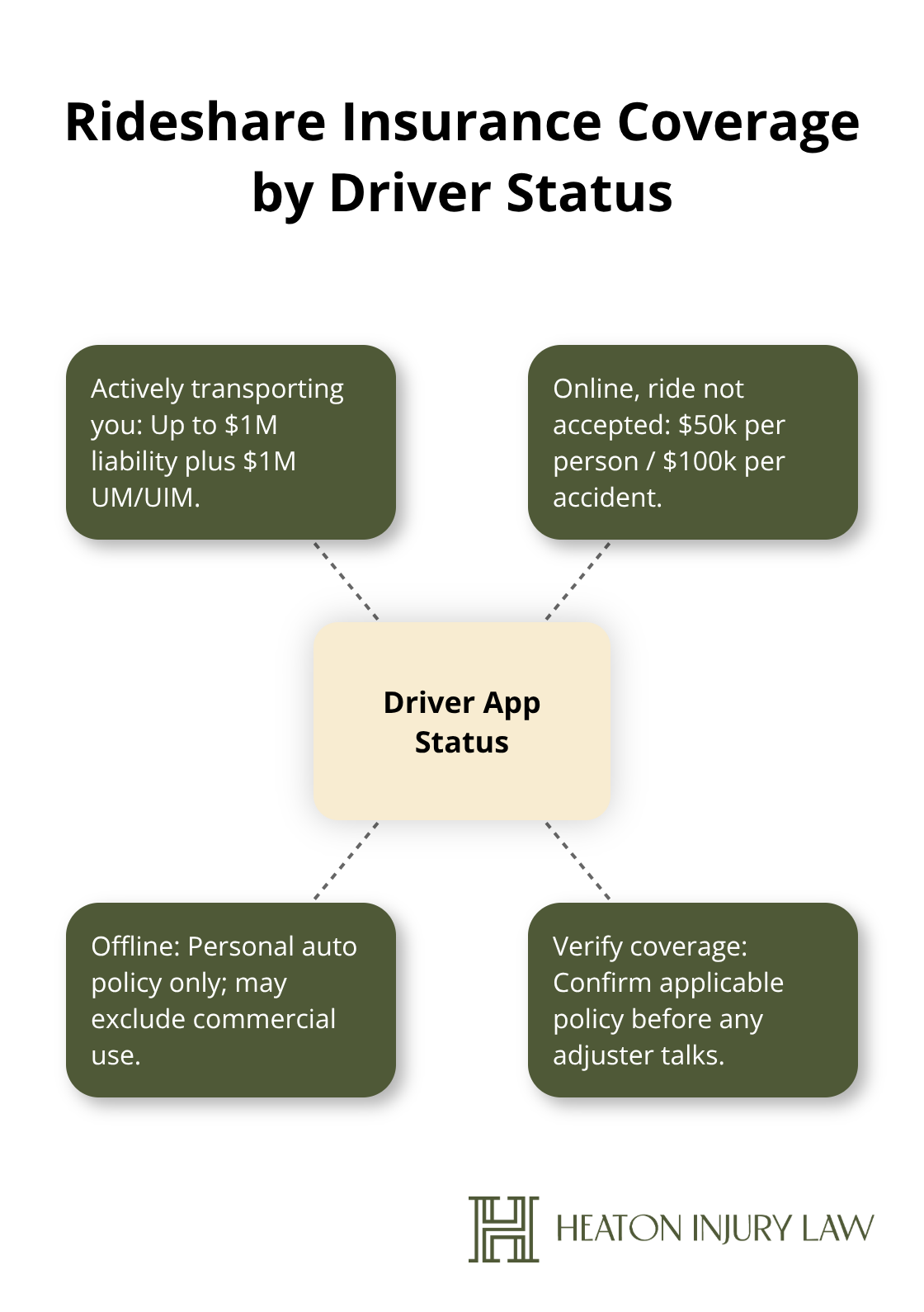
After notifying the rideshare company, contact the insurance carrier handling the claim. In Texas, rideshare crashes typically involve multiple policies depending on the driver’s app status at impact. If the driver was actively transporting you, Uber or Lyft’s commercial policy provides up to $1 million in liability coverage plus $1 million in uninsured and underinsured motorist protection. If the driver was online but hadn’t accepted your ride, coverage drops to $50,000 per person and $100,000 per accident. If the driver was offline, only their personal auto insurance applies-which often excludes commercial activity entirely. Verify which policy applies before discussing your claim with any adjuster.
Build Your Medical Documentation
Focus on comprehensive medical documentation. Preserve all medical records, treatment plans, prescriptions, and receipts. Each hospital visit, physical therapy session, and specialist consultation strengthens your damage calculation and prevents insurers from claiming your injuries were minor.
Contact an Attorney When Complexity Arises
When injuries are serious, fault is disputed, multiple insurers are involved, or the insurance company delays your claim beyond 30 days, contact a rideshare accident attorney immediately. We at Heaton Injury Law, PLLC handle these cases on contingency, meaning you pay nothing unless we recover compensation for you. We investigate the crash thoroughly, obtain trip data from Uber or Lyft, secure video and witness evidence, coordinate with all insurers, and calculate your full damages including medical expenses, lost wages, pain and suffering, and permanent disability. Many injured Texans wait weeks or months before calling a lawyer, only to discover that critical evidence has disappeared or coverage disputes have already damaged their position. Early legal representation prevents these costly mistakes.
Final Thoughts
The rideshare police report process creates an official, objective record that insurance companies cannot dismiss or reinterpret later. Your police report, combined with preserved evidence and medical documentation, establishes a foundation that strengthens your position throughout the claims process. Insurance adjusters begin building their defense strategy within days of your accident, so documenting everything immediately counters these tactics before they gain momentum.
Rideshare crashes involve multiple insurance policies, independent contractor status, and coverage disputes that make these cases fundamentally different from standard car accidents. Texas law gives you two years to file a personal injury lawsuit, but waiting months to gather evidence means losing critical information-witnesses move away, surveillance footage gets deleted, and app data becomes harder to retrieve. The complexity demands immediate action on your part.
We at Heaton Injury Law, PLLC understand the pressure you face after a rideshare accident. Contact us today for a free consultation about your rideshare accident claim, and let our team handle the investigation, insurance coordination, and damage calculation while you focus on recovery.
The information provided in this blog is for general informational purposes only and does not constitute legal advice. Every case is unique, and laws may vary by jurisdiction. Reading this content does not create an attorney-client relationship. For guidance specific to your situation, please consult with a qualified personal injury attorney licensed in Texas.
Artificial intelligence may have been used to assist in generating some text or images in these articles.