

Meredythe | October 27, 2026 | Blog

Truck crashes leave victims facing staggering medical bills that pile up fast. Between emergency care, surgery, rehabilitation, and ongoing treatment, costs can easily reach hundreds of thousands of dollars.
At Heaton Injury Law, PLLC, we help injured Texans understand their options for managing these expenses and recovering what they’re owed. This guide walks you through the real costs you’ll face and concrete strategies to address them.
What Medical Bills Actually Cost After a Truck Crash
Emergency and Initial Hospital Charges
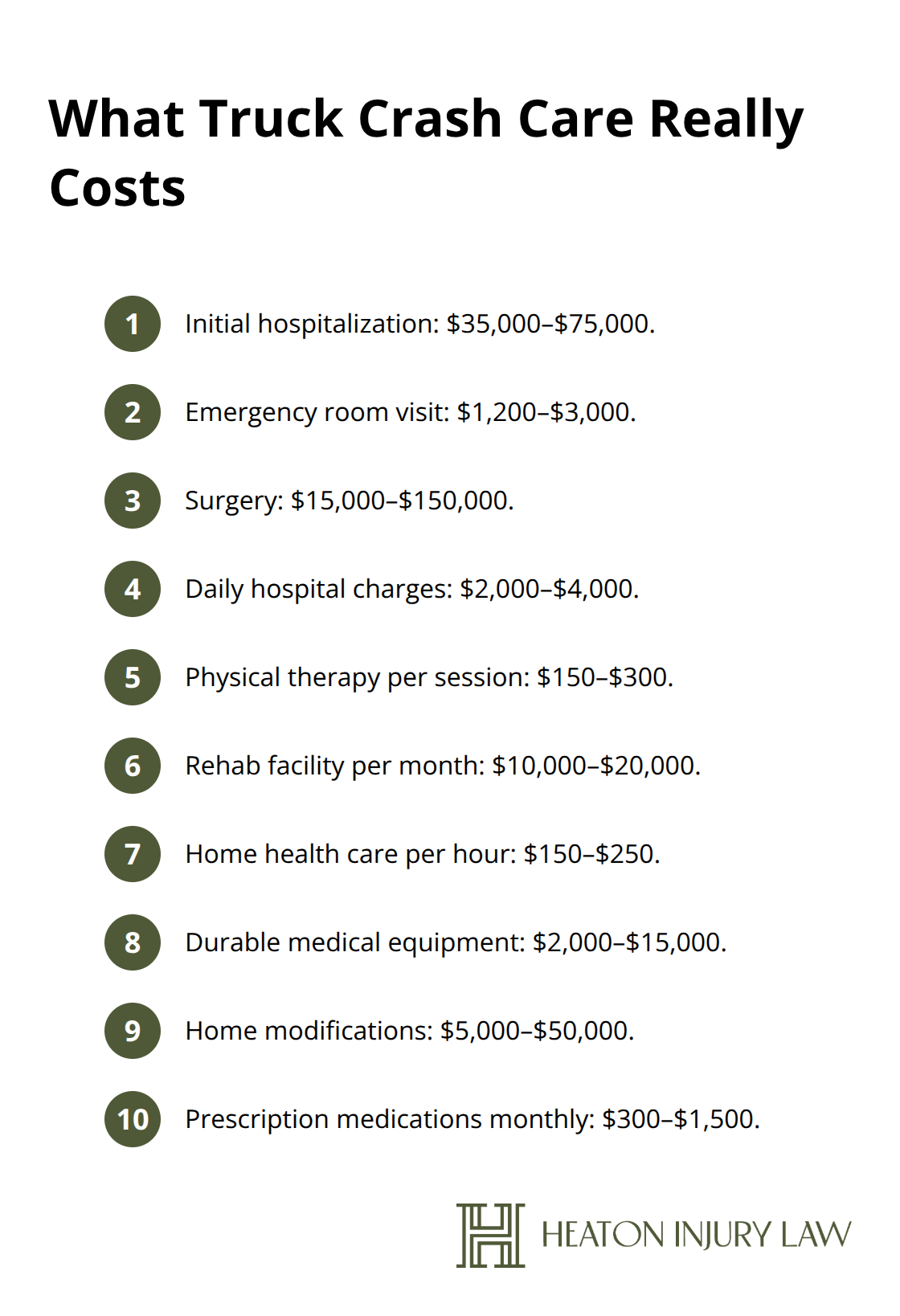
Truck crash injuries generate medical expenses that shock most victims. An average hospitalization for a serious truck crash injury costs between $35,000 and $75,000 for the initial stay alone, according to data from the Agency for Healthcare Research and Quality. Emergency room visits typically run $1,200 to $3,000 just for the assessment and stabilization phase.
If your crash required surgery-and many truck collisions do-expect surgical costs ranging from $15,000 to $150,000 depending on the complexity. These numbers represent only the first few days of treatment. Most truck crash victims spend weeks or months in hospitals, and each additional day adds $2,000 to $4,000 in facility charges alone.
Diagnostic Testing and Imaging Expenses
Imaging studies like CT scans and MRIs cost $500 to $3,000 per scan. If you suffered spinal injuries, traumatic brain injuries, or fractures requiring multiple procedures, hospitals will order several imaging studies throughout your recovery. Medication administration fees, anesthesia charges, and surgical supplies stack on top of the base procedure cost.
Many victims don’t realize that hospitals charge separately for nearly every service. The surgeon’s fee, the anesthesiologist’s fee, the facility fee, and the equipment fee all appear as individual line items on your bill. This itemization means your total bill reflects dozens of separate charges rather than one bundled cost.
Rehabilitation and Ongoing Care Expenses
Rehabilitation and ongoing care expenses compound the initial shock. Physical therapy typically costs $150 to $300 per session, and serious truck crash injuries often require 2 to 3 sessions per week for 3 to 6 months. Occupational therapy, speech therapy, and mental health counseling add additional weekly expenses.
If you sustained a spinal cord injury or traumatic brain injury, you’re looking at specialized rehabilitation facilities that cost $10,000 to $20,000 per month. Home health care services-including nursing, physical therapy, and personal assistance-run $150 to $250 per hour. Many victims need 8 to 12 hours of daily care initially, though this typically decreases over time.
Long-Term Medical and Equipment Costs
Prescription medications for pain management, infection prevention, and chronic conditions can cost $300 to $1,500 monthly depending on what you’re taking. Durable medical equipment like wheelchairs, hospital beds, and mobility aids costs $2,000 to $15,000. Long-term disabilities from truck crashes sometimes require permanent home modifications such as wheelchair ramps, accessible bathrooms, or elevator installations (expenses ranging from $5,000 to $50,000).
Future care needs for catastrophic injuries demand structured planning. Many victims face decades of medical expenses that extend far beyond the initial crash recovery period. Understanding these long-term financial obligations helps you prepare for the full scope of your recovery costs and recognize why pursuing compensation through a personal injury claim matters so significantly.
How to Cut Your Medical Bills in Half
Request Itemized Bills and Identify Errors
Hospital bills after a truck crash often contain errors, inflated charges, and negotiable line items that most victims never challenge. You have far more power to reduce these costs than you realize. Start by requesting an itemized bill from every provider involved in your care-emergency room, hospital, surgeons, imaging centers, and rehabilitation facilities. These detailed breakdowns expose overcharges and duplicate billing that occur more often than hospitals admit. The American Hospital Association data shows that 1 in 5 hospital bills contains significant billing errors.
Once you have the itemized statements, compare charges across facilities. A CT scan at one hospital might cost $1,200 while another charges $3,500 for the identical scan. Contact the billing department and ask them to match lower rates you found elsewhere. Many hospitals will negotiate rather than lose the account.
Negotiate Payment Terms and Discounts
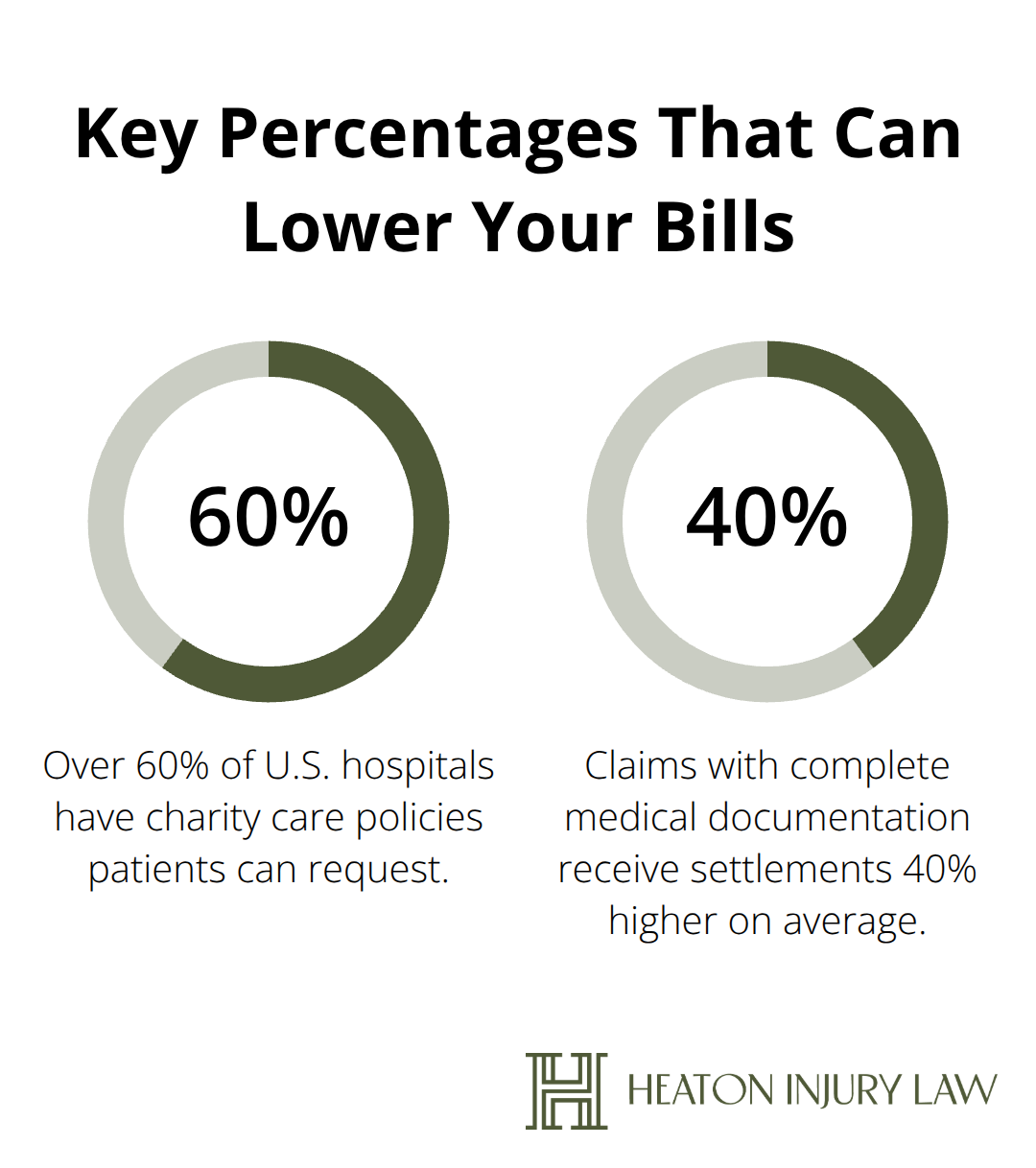
Request a prompt-pay discount if you can settle quickly. Hospitals often offer 10-15% reductions for immediate payment because they value cash flow over extended payment plans. If you genuinely cannot pay, ask about financial hardship programs. The Patient Advocate Foundation reports that over 60% of hospitals have charity care policies, yet most patients never ask. Some facilities will write off 30-50% of bills for qualifying low-income patients.
Medicaid also covers certain truck crash-related injuries in Texas, though eligibility depends on your specific situation and income level. Contact your local Medicaid office to determine whether you qualify for coverage that reduces your out-of-pocket expenses.
Leverage Insurance Coverage You Already Have
Your insurance policy likely has coverage limits that cap what your carrier pays, but you’re not stuck absorbing the rest. Review your policy documents carefully-many people discover they have underinsured motorist coverage that kicks in when the at-fault driver lacks sufficient insurance. This coverage often pays medical bills regardless of the provider’s charges.
Understanding these insurance options requires careful attention to your specific policy language and coverage triggers. The complexity of insurance claims and negotiation strategies makes professional guidance valuable as you move forward with your recovery plan.
Recovering Medical Costs Through a Personal Injury Claim
Document Every Medical Expense
A personal injury claim transforms your medical bills from an impossible burden into a recoverable asset. The at-fault driver’s insurance exists specifically to compensate victims for these expenses, yet most injured Texans fail to document their costs properly or understand how to calculate the full scope of damages they’re entitled to recover.
Create a comprehensive medical expense file that includes every receipt, invoice, and billing statement from your crash onward. This means hospital discharge summaries, itemized bills from every provider, prescription receipts, medical equipment invoices, and documentation of mileage to treatment appointments (the IRS allows 21 cents per mile for medical travel as of 2026). Insurance adjusters scrutinize claims that lack detailed documentation, and vague expense summaries give them room to deny or reduce your recovery.
Request records directly from healthcare providers rather than relying on memory or partial paperwork. Many providers charge $15 to $50 for medical records, but this investment protects your claim significantly. The National Association of Insurance Commissioners found that claims with complete medical documentation receive settlements 40% higher on average than those with incomplete records.
Calculate Total Economic Losses Beyond Medical Bills
Your medical bills represent only one component of damages you can recover through a personal injury claim. Calculate your total economic losses by including lost wages during recovery, reduced earning capacity if your injuries limit future work, home modification costs, and ongoing treatment expenses extending years into the future.
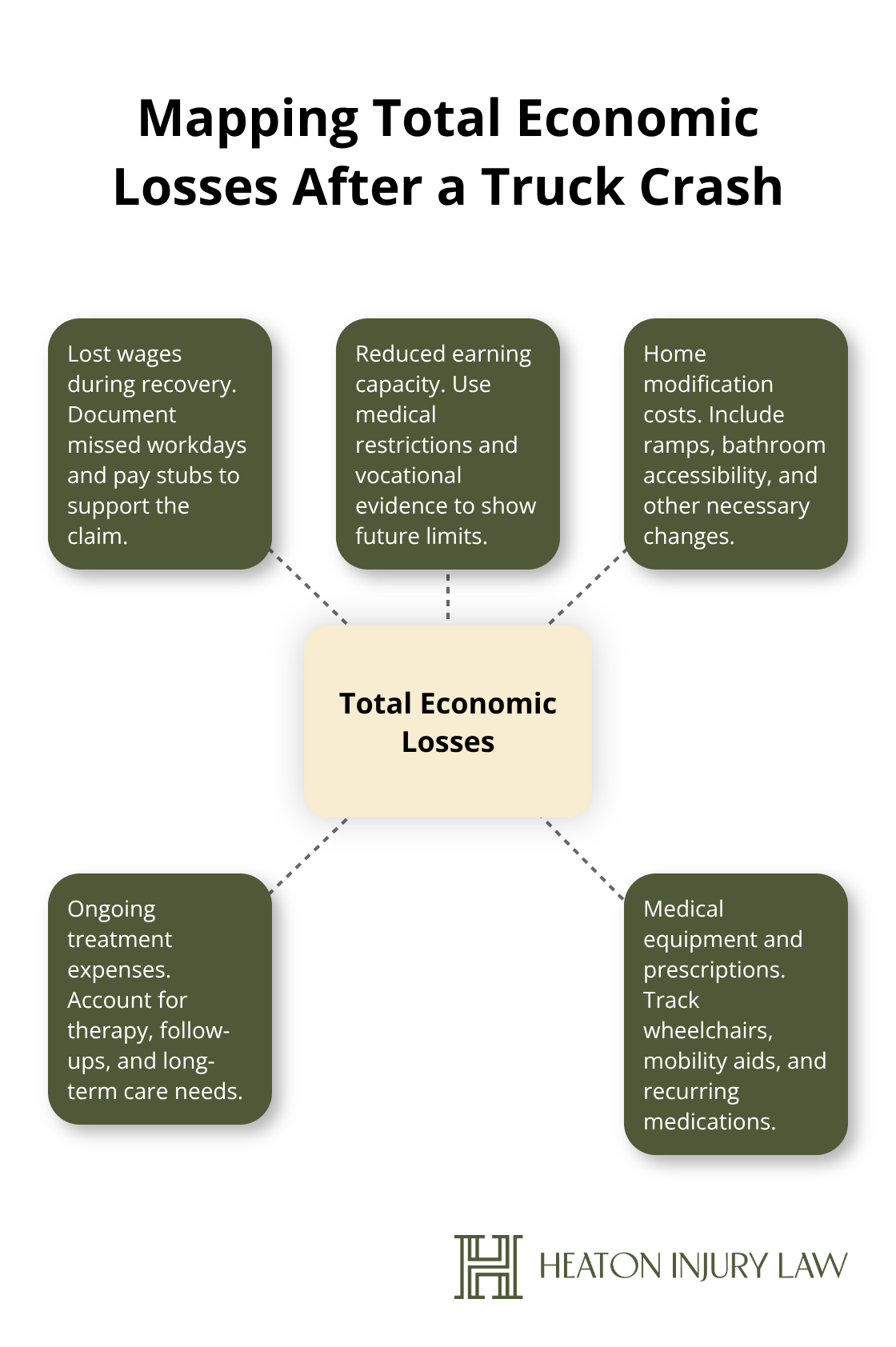
A truck crash victim earning $60,000 annually who cannot work for six months has $30,000 in lost wages that the at-fault driver’s insurance must cover. If your injuries permanently reduce your earning potential, you can recover the difference between your pre-crash and post-crash lifetime earnings. This calculation requires documentation of your job duties, medical restrictions from your healthcare providers, and vocational expert testimony in serious cases.
Understand Insurance Company Tactics
Insurance adjusters operate under profit incentives that conflict with fair compensation, and they rely on most injured people accepting lowball offers without understanding their full entitlement. An experienced personal injury attorney knows the specific medical cost benchmarks for Texas truck crashes, negotiates directly with insurance carriers, and structures settlement demands that reflect your actual damages rather than the minimal figure an adjuster initially offers.
We at Heaton Injury Law, PLLC understand how insurance companies undervalue these future losses. Our trial-ready approach and insider knowledge of insurer tactics help injured Texans recover what they’re actually owed rather than settling for inadequate compensation.
Final Thoughts
Truck crash medical costs demand immediate action, not passive acceptance. Start by gathering every bill and receipt from your crash, request itemized statements from all providers, and identify billing errors that hospitals routinely overlook. Contact your insurance company to understand what coverage applies to your situation, and apply for financial hardship programs or Medicaid if you qualify.
The reality is that truck crash medical costs extend far beyond initial hospital bills-rehabilitation, ongoing treatment, lost wages, and future care needs represent substantial damages that the at-fault driver’s insurance should cover. Most injured Texans underestimate their total losses and accept settlements that leave them financially vulnerable years later. Insurance adjusters operate under profit incentives that conflict with fair compensation, and they rely on most injured people accepting lowball offers without understanding their full entitlement.
We at Heaton Injury Law, PLLC handle truck crashes and catastrophic injuries throughout Texas. Our founder, Meredythe Heaton Wilkinson, brings 14+ years of litigation experience, giving us insider knowledge of how insurance companies undervalue claims. Contact us to discuss your specific situation and learn what your case is actually worth.
The information provided in this blog is for general informational purposes only and does not constitute legal advice. Every case is unique, and laws may vary by jurisdiction. Reading this content does not create an attorney-client relationship. For guidance specific to your situation, please consult with a qualified personal injury attorney licensed in Texas.
Artificial intelligence may have been used to assist in generating some text or images in these articles.