

Meredythe | October 29, 2026 | Blog

Truck accidents in Texas cause catastrophic injuries that car crashes rarely match. The stakes are higher, the liability is more complex, and the insurance battles are fiercer.
A big rig crash attorney understands these differences and knows how to fight for your rights. At Heaton Injury Law, PLLC, we guide injured Texans through every step of their recovery and claim.
Why Truck Crashes Demand Different Legal Strategy
Truck crashes operate under an entirely different legal framework than passenger vehicle collisions, and this distinction matters enormously for your claim. An 18-wheeler weighing up to 80,000 pounds creates damage patterns that courts and insurance companies treat as categorically different from a two-car fender bender. The Federal Motor Carrier Safety Administration enforces strict regulations on truck operations, driver hours, vehicle maintenance, and cargo securing that simply don’t exist for regular drivers. When a truck crash occurs in Texas, federal standards become the measuring stick for negligence, not just state traffic laws. This means your case involves multiple layers of compliance violations that a standard car accident attorney may never encounter.
Liability Gets Complicated Fast
Truck crashes almost always involve more than one responsible party, and identifying them requires systematic investigation. The truck driver bears direct liability for their actions, but the trucking company shares responsibility for hiring, training, and supervising that driver. The truck owner may be different from the company operating it, creating additional liability pathways. Shippers and freight brokers become liable if cargo was loaded improperly or weight limits exceeded. Maintenance contractors become liable if mechanical failures like brake failure caused the crash. Vehicle manufacturers may share liability if defects contributed to the collision.
Texas law recognizes all these relationships, but standard insurance claims processes often ignore secondary defendants to protect their own interests. Your attorney must identify every liable party to maximize your recovery, because settling with just the driver’s insurance leaves millions on the table when other defendants should contribute.
Injuries From Big Rigs Are Categorically Severe
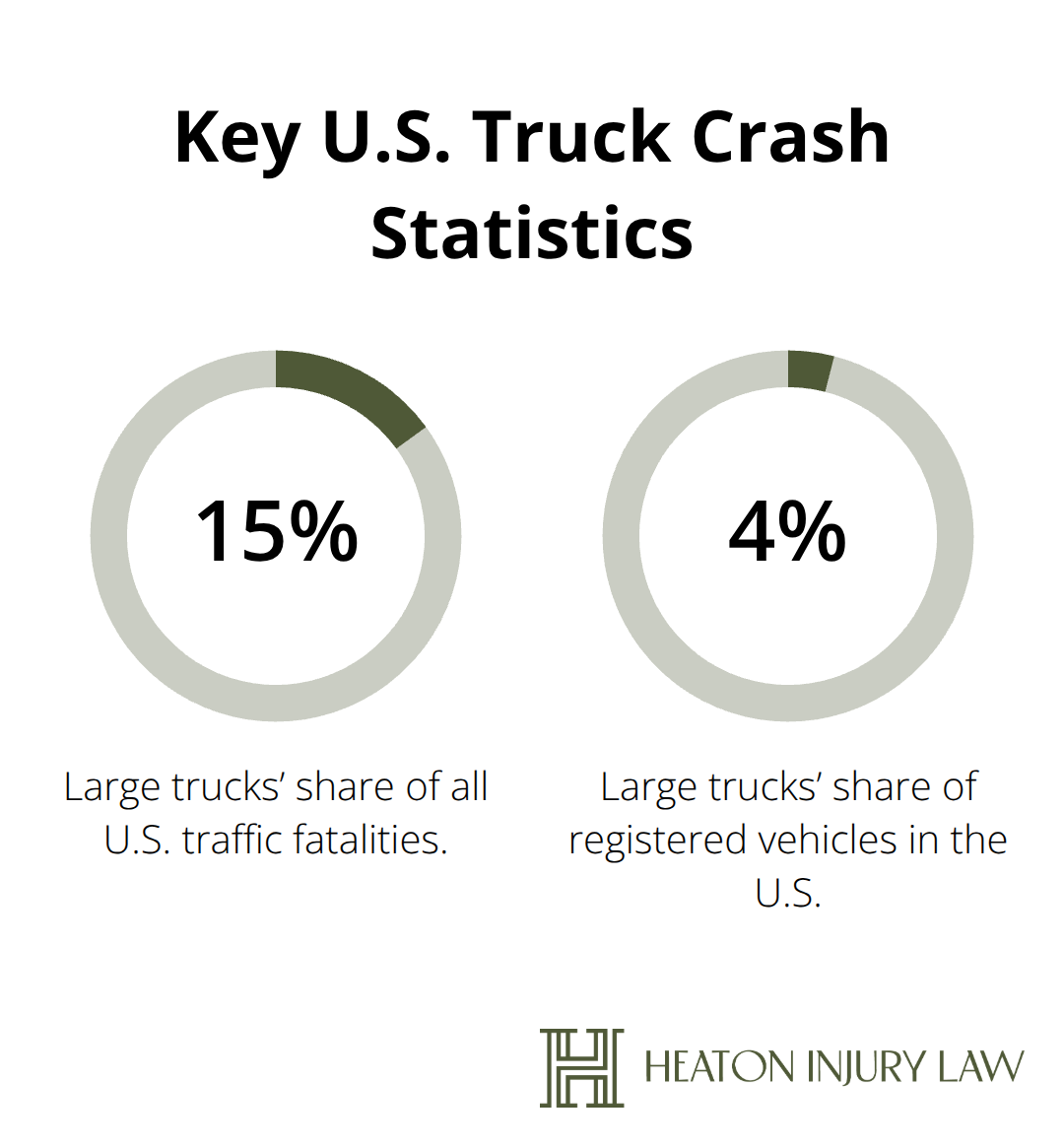
The National Highway Traffic Safety Administration reports that large trucks are involved in approximately 5,000 fatal crashes annually in the United States, accounting for roughly 15 percent of all traffic fatalities despite representing only 4 percent of registered vehicles. Survivors of truck crashes suffer catastrophic injuries at rates far exceeding car accidents because of the physics involved.
Spinal cord injuries, traumatic brain injuries, severe burns from fuel fires, and crush injuries occur routinely in big rig collisions. These injuries generate lifetime medical costs that can exceed $4 million for spinal cord damage alone, according to the Christopher and Dana Reeve Foundation.
Insurance companies know these figures and fight harder to deny claims or minimize payouts. Federal regulations require specific insurance minimums for commercial trucking, but those minimums often fall short of actual damages (sometimes by millions of dollars), forcing injured victims to pursue additional defendants for full compensation. This is where understanding the full scope of your case becomes essential.
What to Do Immediately After a Truck Crash
The first hours after a truck accident determine whether you have strong evidence for your claim or a weakened case. Most injured people focus on pain and shock, but the trucking company’s insurance adjuster is already working to minimize what you’ll receive. You need to act strategically while protecting yourself.
Prioritize Safety and Official Documentation
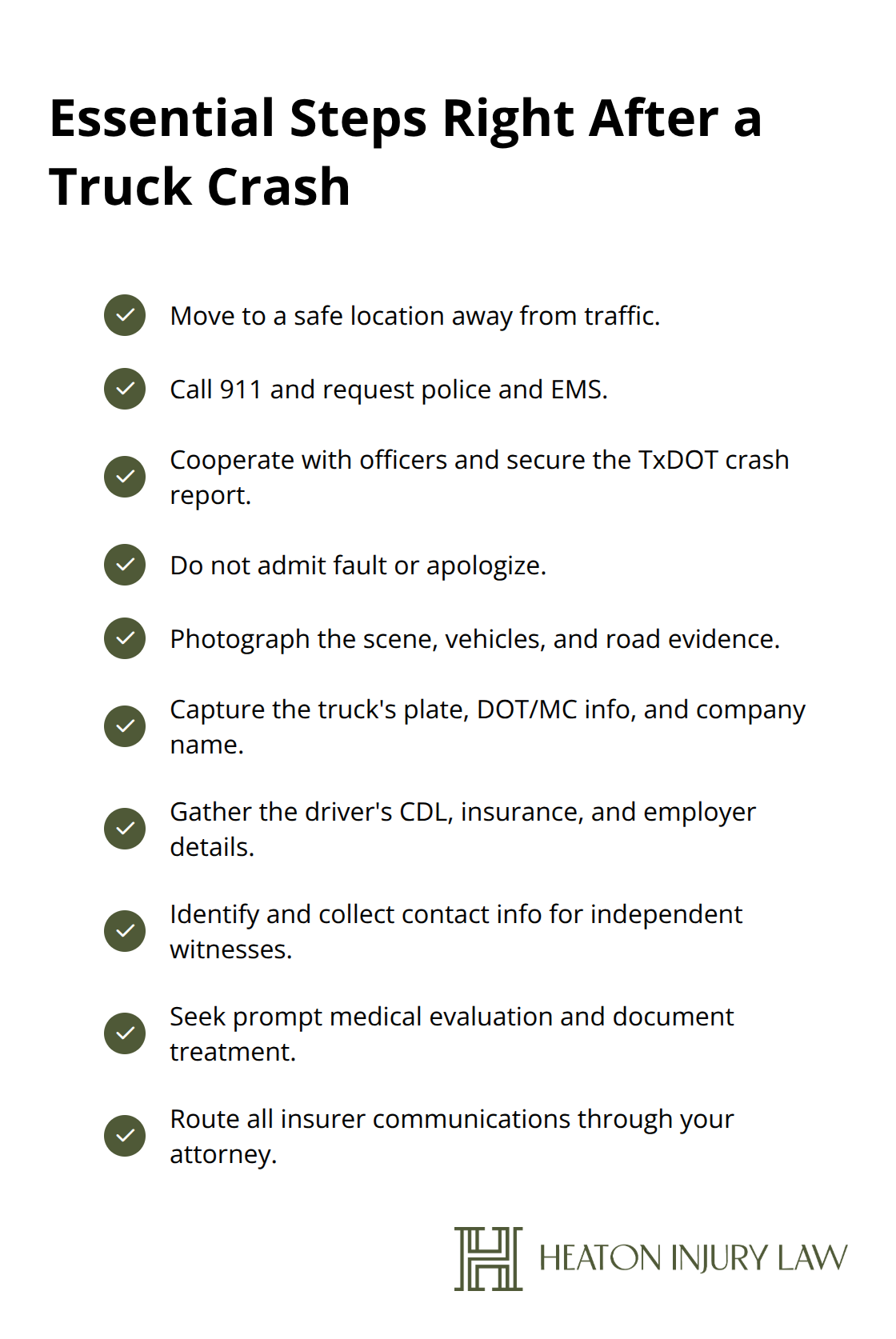
Move to safety if the crash occurred on a highway or busy road. Call 911 immediately, even for injuries that seem minor, because emergency responders create official documentation that later becomes critical evidence. The police report from the Texas Department of Transportation becomes the foundation of your case, so cooperate fully with officers and provide accurate statements about what happened. Do not admit fault or apologize for the accident, as these statements get used against you in claims.
Capture Evidence at the Scene
Take photographs of the truck’s position, skid marks, road conditions, traffic signals, and any visible damage to your vehicle before anything moves. Photograph the truck’s license plate, company name, and any visible damage to the big rig itself. Get the truck driver’s name, commercial driver’s license number, trucking company name and address, insurance information, and phone number. Write down the names and contact information of at least three independent witnesses who saw the crash happen, not just people traveling with the truck driver.
Ask witnesses to describe what they saw before they leave the scene.
Obtain Medical Records and Treatment Documentation
Medical documentation from the emergency room or hospital becomes your injury evidence, so seek treatment immediately even if you feel relatively okay. Truck crash injuries often develop over hours or days as adrenaline wears off, and delaying treatment gives insurance companies ammunition to claim your injuries weren’t serious. Request copies of all medical records, imaging reports, and physician notes before you leave the hospital. Keep detailed records of every medical appointment, prescription, therapy session, and medical expense from this point forward (including dates, providers, and costs). Document how your injuries affect your daily life through photos and written notes about activities you can no longer perform.
Preserve Evidence and Control Communications
Preserve the damaged vehicle without allowing repairs until your attorney reviews it, because the damage pattern helps establish how forcefully the truck struck you. Contact the trucking company’s insurance carrier only through your attorney, never directly, because anything you say becomes part of their defense strategy. Insurance adjusters exploit statements made by injured victims to reduce payouts, so protecting your words protects your recovery. Your attorney handles all communication with insurers and defendants so you can focus on recovery without accidentally damaging your case. This separation between you and the insurance company prevents the other side from using casual remarks against you later.
The evidence you gather and the medical documentation you obtain form the backbone of your case. Understanding how to investigate negligence and liability requires legal expertise that goes beyond what you can accomplish alone.
How Your Attorney Fights for Maximum Recovery
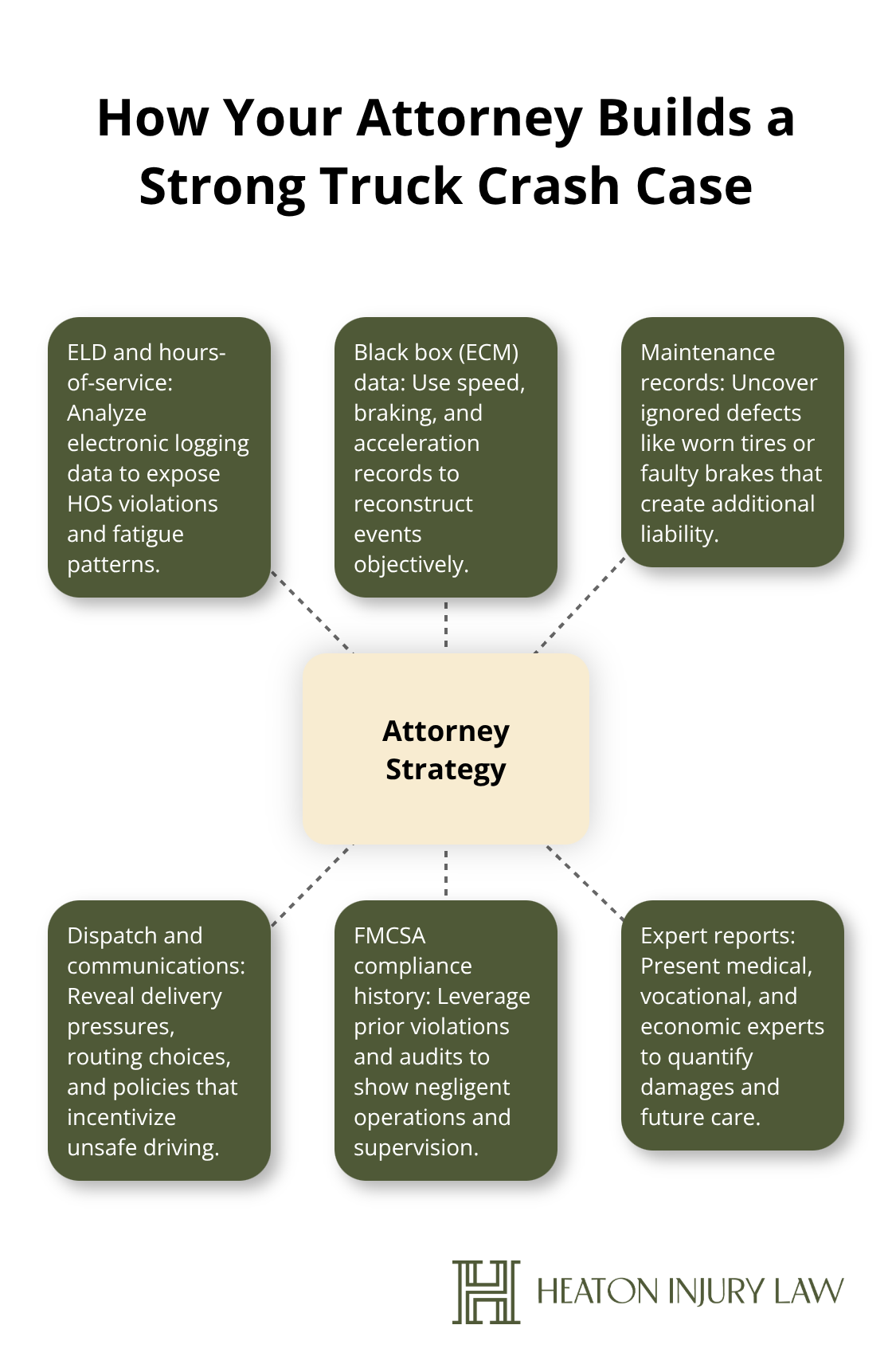
An experienced truck crash attorney transforms raw evidence into a compelling case that insurance companies cannot dismiss. Your attorney begins with a forensic investigation that extends far beyond the police report, examining electronic logging device data from the truck to prove hours-of-service violations, obtaining maintenance records to identify mechanical failures, and analyzing dispatch communications to show unrealistic delivery pressures that forced dangerous driving. The Federal Motor Carrier Safety Administration maintains detailed compliance records on trucking companies, and your attorney requests these documents to prove a pattern of violations that courts recognize as evidence of negligence. Insurance adjusters rarely dig this deep because they work on volume, not thoroughness, but your attorney’s investigation uncovers liability layers that multiply your recovery potential.
Uncovering Hidden Liability Through Evidence
When a truck driver violated hours-of-service regulations, that violation becomes admissible evidence of negligence in Texas courts, shifting the burden toward the defendant to prove they followed federal law. Your attorney also obtains the truck’s black box data, which records speed, braking patterns, and acceleration in the seconds before impact, providing objective proof of how the crash occurred and who caused it. This data often contradicts the truck driver’s account of events and establishes clear negligence that juries find persuasive. Maintenance records reveal whether the trucking company failed to repair known defects like faulty brakes or worn tires, creating additional liability pathways beyond the driver’s actions.
Countering Insurance Company Tactics
Navigating insurance claims after a truck crash requires understanding that commercial trucking policies operate differently from standard auto insurance. Trucking companies carry policies with higher coverage limits (often $1 million or more), but insurers employ aggressive strategies to minimize payouts, including claiming your injuries preexisted the crash or that your medical treatment was unnecessary. Your attorney knows these specific tactics and counters them with medical expert testimony, vocational rehabilitation assessments, and life-care plans that document your actual damages. These expert reports establish the true cost of your injuries in ways that insurance adjusters cannot dispute.
Preparing for Trial When Settlement Falls Short
If the trucking company’s insurance offer falls short of your actual losses, your attorney prepares the case for trial by filing discovery requests that force defendants to produce documents, scheduling depositions where you question the truck driver and company officials under oath, and assembling expert witnesses including accident reconstruction specialists, medical doctors, and economists who calculate your lifetime earning losses. Texas juries understand the severity of truck crashes and award substantial damages when evidence proves negligence, with many verdicts exceeding the insurance policy limits. Your attorney’s trial preparation begins immediately after the accident, not months later, because early investigation preserves evidence that deteriorates over time and prevents witnesses from disappearing. This comprehensive approach means you recover damages that reflect your actual injuries, not what an adjuster decides to offer.
Final Thoughts
Truck crashes demand legal representation because the stakes extend far beyond standard vehicle collisions. Your injuries, medical bills, lost wages, and lifetime care needs require a big rig crash attorney who understands federal trucking regulations, identifies all liable parties, and refuses to accept lowball settlement offers from insurance companies protecting their profits. Without experienced legal guidance, you’ll face sophisticated adjusters trained to minimize payouts while you’re focused on recovery and pain management.
A big rig crash attorney investigates what happened with forensic precision, uncovers violations that courts recognize as negligence, and prepares your case for trial if necessary. This approach transforms your claim from a simple insurance negotiation into a comprehensive legal strategy that holds all responsible parties accountable. The difference between settling quickly and fighting for full compensation often amounts to hundreds of thousands of dollars.
Contact an experienced truck crash attorney before the insurance company’s settlement deadline passes. Early legal involvement preserves critical evidence, prevents you from making statements that damage your case, and positions you for maximum recovery. Contact Heaton Injury Law, PLLC today to discuss your truck crash claim and learn how we can support your recovery.
The information provided in this blog is for general informational purposes only and does not constitute legal advice. Every case is unique, and laws may vary by jurisdiction. Reading this content does not create an attorney-client relationship. For guidance specific to your situation, please consult with a qualified personal injury attorney licensed in Texas.
Artificial intelligence may have been used to assist in generating some text or images in these articles.