

Meredythe | September 10, 2026 | Blog
A commercial truck crash attorney handles something most personal injury lawyers won’t touch. These cases demand specialized knowledge of federal regulations, multiple defendants, and catastrophic injuries that leave victims facing enormous medical bills.
At Heaton Injury Law, PLLC, we’ve seen how quickly insurance companies mobilize their legal teams after a big rig collision. You need someone equally prepared to fight back.
Why Insurance Companies Fight Back Hard
Insurance carriers defending big rig cases deploy specialized legal teams with massive budgets and years of experience minimizing payouts. These aren’t generalist adjusters-they’re defense attorneys trained to challenge liability, downplay injuries, and exploit procedural delays. The Federal Motor Carrier Safety Administration reports that large trucking companies carry liability insurance policies averaging $750,000 to $5 million per incident, and their insurers protect that investment aggressively. Without an attorney matching their expertise, you negotiate alone against a coordinated defense operation.
Federal Regulations Create Hidden Complexity
Commercial truck collisions trigger federal oversight that most personal injury cases never encounter. The FMCSA enforces hours-of-service rules, vehicle maintenance standards, and driver qualification requirements that become central to liability. A truck driver working beyond the 11-hour daily limit or operating a vehicle with documented brake failures transforms a simple crash into a case involving regulatory violations. These violations often prove negligence more powerfully than accident reconstruction alone.
Many trucking companies maintain records showing prior safety violations or maintenance failures-evidence that disappears without prompt investigation. Identifying these violations requires understanding federal trucking law deeply, not just general accident knowledge. The regulations exist specifically because the trucking industry poses elevated risks to other motorists.
Medical Costs and Wage Loss Demand Aggressive Representation
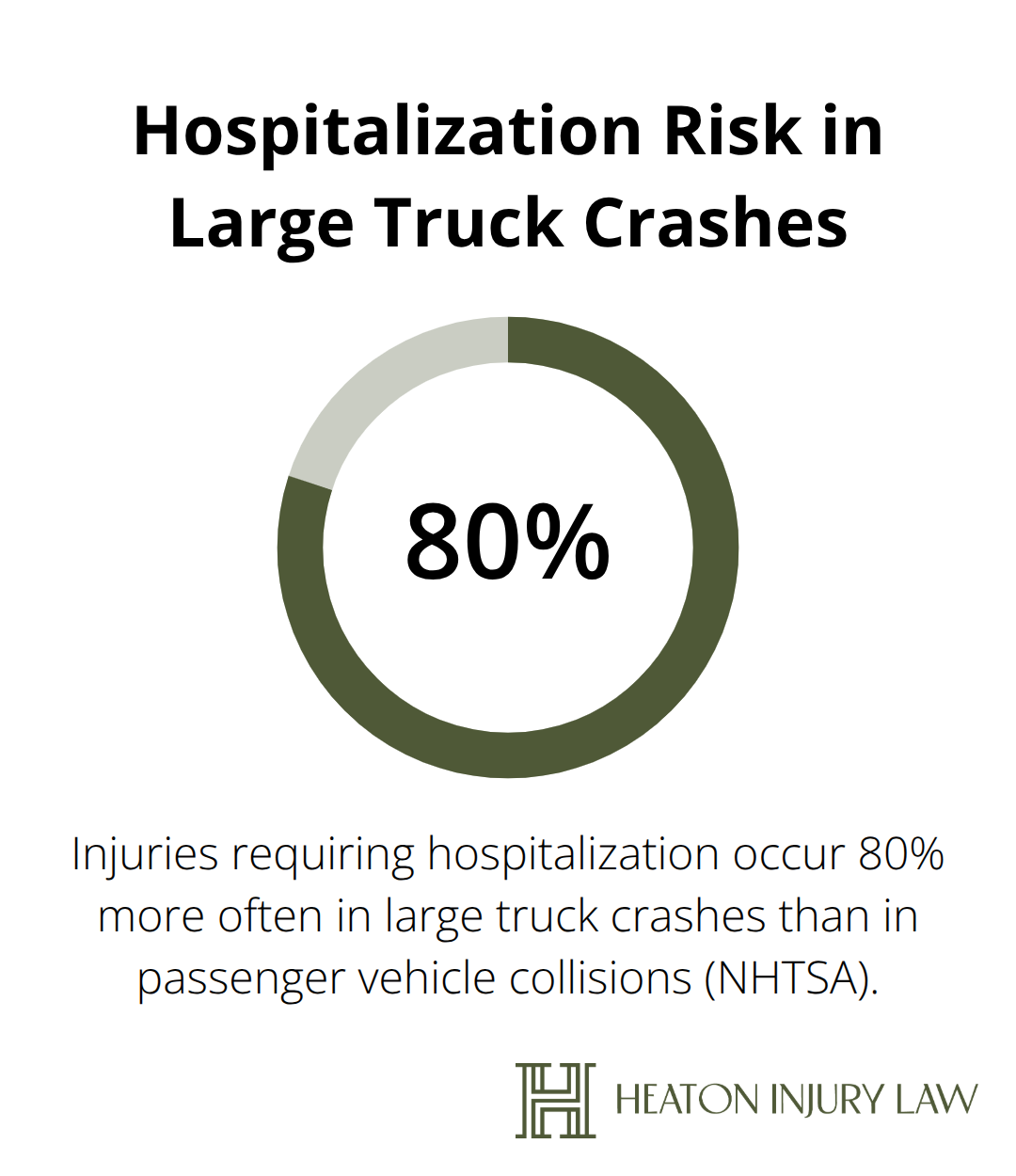
The National Highway Traffic Safety Administration data shows that large truck crashes result in injuries requiring hospitalization at rates 80 percent higher than passenger vehicle collisions. A single hospitalization for catastrophic injuries can generate $100,000 to $500,000 in medical expenses within months. Lost wages compound quickly-a construction worker or commercial driver earning $60,000 annually loses $5,000 monthly during recovery.
Insurance adjusters count on injured people accepting early settlements before the full scope of long-term care, rehabilitation, or lost earning capacity becomes clear. Acting fast to document injuries and secure experienced representation prevents accepting settlements that later prove inadequate when medical complications emerge or return-to-work timelines extend far longer than initially expected.
Why Speed Matters in Truck Crash Cases
Evidence from truck crash scenes deteriorates rapidly. Skid marks fade, vehicle debris gets cleared, and witness memories blur within weeks. Trucking companies also move quickly to preserve their own records selectively-they control driver logs, maintenance documents, and safety reports that prove negligence. An attorney who acts immediately can secure evidence before it vanishes and before the defense team shapes the narrative.
The stakes in these cases demand representation that matches the insurance company’s resources and determination.
What to Look for in Your Truck Crash Attorney
Hiring the wrong attorney after a commercial truck collision costs you money-sometimes hundreds of thousands of dollars. The attorney you choose will either stand up to the insurance company’s defense team or fold under pressure when settlement offers come in below what your case actually warrants. This decision matters more than most people realize because truck crash cases operate under completely different rules than standard car accidents. You need someone who understands federal trucking regulations as thoroughly as the defense does and refuses to accept inadequate settlements.
Experience with Federal Trucking Law Separates Competent Attorneys from Specialists
Most personal injury attorneys have never read the Federal Motor Carrier Safety Administration regulations. They don’t understand the difference between a violation of 49 CFR 392.16 (speed regulations for commercial vehicles) and a violation of 49 CFR 396.11 (vehicle maintenance requirements). This knowledge gap becomes catastrophic in truck cases because these violations often prove negligence more effectively than eyewitness testimony. An attorney who handles truck crashes regularly must track hours-of-service violations, maintenance failures documented in logbooks, and safety inspection records that typical lawyers never encounter. When you interview potential attorneys, ask them specifically about the last three truck cases they handled and what federal violations they identified. If they cannot articulate specific regulatory violations from their recent cases, they lack the specialized experience your case demands.
Settlement Records Reveal How Aggressively an Attorney Fights
Insurance companies test attorneys constantly. They send lowball offers to see who will accept them quickly and who will push back. An attorney with a track record of substantial settlements and verdicts in truck cases has earned respect from defense counsel through proven willingness to take cases to trial. You want an attorney who has actually tried truck crash cases to juries, not someone who settles everything for whatever the insurance company offers initially. Ask potential attorneys for specific settlement amounts and verdict amounts from their truck cases within the last three years. If they claim confidentiality prevents disclosure, that’s reasonable, but they should at least confirm they have tried cases to verdict and secured awards exceeding $500,000 when injuries justified it. Trial readiness forces insurance companies to value cases correctly from the beginning.
Catastrophic Injury Expertise Matters Because Truck Collisions Cause Severe Damage
Truck crash injuries differ fundamentally from typical auto accidents. The National Highway Traffic Safety Administration reports that occupants of passenger vehicles struck by large trucks face fatality rates five times higher than those involved in passenger vehicle-only collisions. Survivors often suffer spinal cord injuries, traumatic brain injuries, internal organ damage, and chronic pain conditions that require lifetime medical management. An attorney without catastrophic injury experience will undervalue these long-term consequences. When you evaluate attorneys, ask how they calculate future medical expenses and lost earning capacity for clients with permanent disabilities. Attorneys experienced with catastrophic injuries understand that a 35-year-old construction worker with a spinal cord injury needs calculations covering 50+ years of medical treatment, assistive devices, home modifications, and lost wages. Generic personal injury attorneys frequently settle these cases for 30 to 40 percent below actual value because they fail to account for the lifetime costs of catastrophic injury management.
Trial Readiness Separates Attorneys Who Maximize Recovery from Those Who Don’t
An attorney’s willingness to prepare for trial transforms how insurance companies approach settlement negotiations. Defense counsel knows which attorneys will actually walk into a courtroom and which ones will accept inadequate offers to avoid trial. Attorneys who have tried multiple truck cases to verdict understand jury psychology, know how to present complex federal regulations to lay jurors, and can articulate the lifetime impact of catastrophic injuries in compelling terms. This trial experience becomes your leverage in settlement discussions because insurance adjusters recognize that you have representation capable of winning at trial. When you speak with potential attorneys, ask them directly how many truck cases they have tried to verdict in the past five years and what the outcomes were. An attorney who has tried even three or four truck cases to verdict possesses experience that most personal injury lawyers never develop. This specialized trial background means the insurance company cannot simply wear you down with delay tactics or lowball offers-they know you have representation that will fight in court if necessary.
How the Truck Crash Claim Process Actually Works
The moment a commercial truck collision happens, the trucking company and its insurance carrier launch a coordinated effort to control the narrative and minimize what they’ll pay you. Your attorney must move faster and more strategically than their defense team, which means understanding exactly what happens during each phase of a truck crash claim. The process differs dramatically from standard car accidents because federal regulations create multiple investigation angles, numerous liable parties emerge beyond just the driver, and the stakes justify aggressive defense tactics that smaller cases never encounter. Insurance adjusters working these cases follow playbooks designed to delay, challenge medical necessity, and exploit gaps in your documentation. An experienced truck crash attorney recognizes these tactics immediately and counters them with evidence that your team collects within days, not weeks.
Preserve Evidence Before It Vanishes
Evidence preservation starts before settlement negotiations ever begin, and this window closes faster than injured people realize. Trucking companies maintain electronic logging devices that record hours of service, vehicle maintenance records, driver qualification files, and safety inspection reports-documents that prove violations of Federal Motor Carrier Safety Administration regulations. These records often show that a driver exceeded the 11-hour daily operating limit, that the truck failed its last safety inspection with documented brake or tire defects, or that the company ignored prior safety complaints. Defense attorneys work quickly to compartmentalize these records and argue they’re irrelevant to liability, but an attorney investigating immediately can secure this evidence before selective destruction occurs. The National Transportation Safety Board has documented cases where trucking companies claimed records were lost or unavailable when investigation happened months after a collision, yet those same records appeared when subpoenas arrived within two weeks.
Scene evidence deteriorates rapidly as well-skid marks fade within days, vehicle debris gets cleared within a week, and witness memories become unreliable within three weeks. Photographs of road conditions, vehicle positions, and damage patterns must be captured immediately, along with recorded statements from witnesses who typically scatter quickly. An attorney who delays investigation loses leverage in negotiations because insurance adjusters know that critical evidence has disappeared, making their lowball offers more defensible to a jury that never sees the strongest proof of negligence.
Identify All Liable Parties Beyond the Driver
Identifying liable parties in truck collision cases requires understanding the industry structure that most personal injury attorneys never encounter. The driver obviously bears responsibility for their actions, but the trucking company itself faces liability for negligent hiring, failure to maintain the vehicle, failure to enforce safety policies, and violation of FMCSA regulations that the company itself controls. Maintenance contractors hired by the trucking company can face liability if they failed to repair known defects or performed negligent maintenance that caused brake failure or tire blowouts.
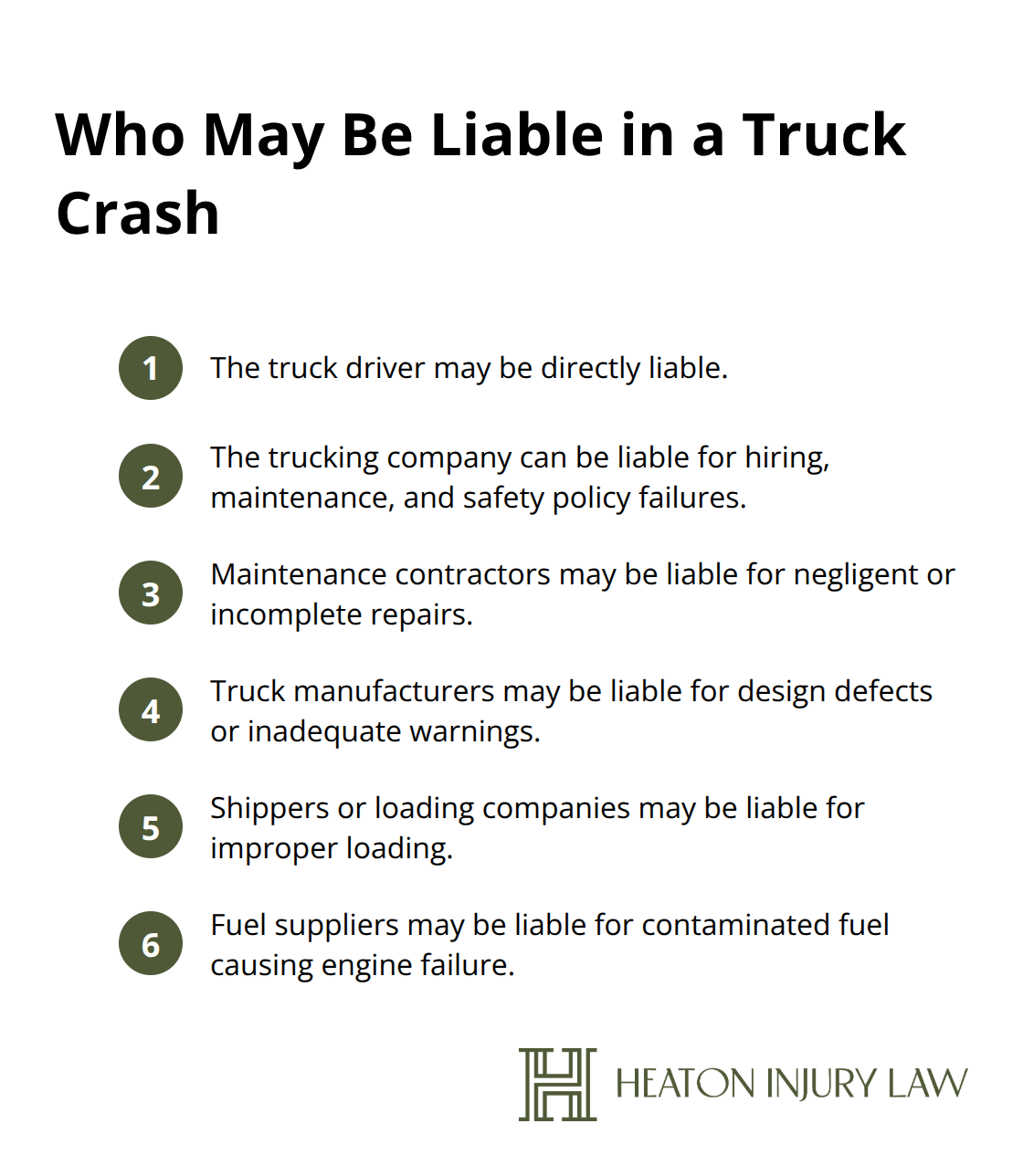
Truck manufacturers face liability if design defects or inadequate warnings contributed to the collision. Shippers or loading companies face liability if improper loading caused instability or brake failure. Fuel suppliers face liability if contaminated fuel caused engine failure.
Insurance adjusters will aggressively argue that only the driver bears responsibility, but federal regulations explicitly hold trucking companies liable for maintaining safe vehicles and enforcing compliance. An attorney who fails to identify and pursue these additional defendants leaves millions on the table because settlements increase substantially when multiple defendants face exposure. Defense counsel divides their resources among multiple defendants, each paying a portion of the total settlement rather than one defendant absorbing the full amount.
Negotiate Against Lowball Settlement Offers
Negotiation with insurance adjusters requires understanding that their initial offers typically fall 40 to 60 percent below what cases actually warrant, according to data from trial consultants analyzing settlement patterns in commercial vehicle cases. Adjusters deploy specific tactics: they dispute causation by arguing pre-existing conditions caused injuries rather than the collision, they minimize medical expenses by challenging the necessity of certain treatments or rehabilitation, they cap future medical costs by arguing recovery timelines are shorter than medical evidence supports, and they exploit procedural delays hoping injured people accept inadequate offers rather than wait for trial.
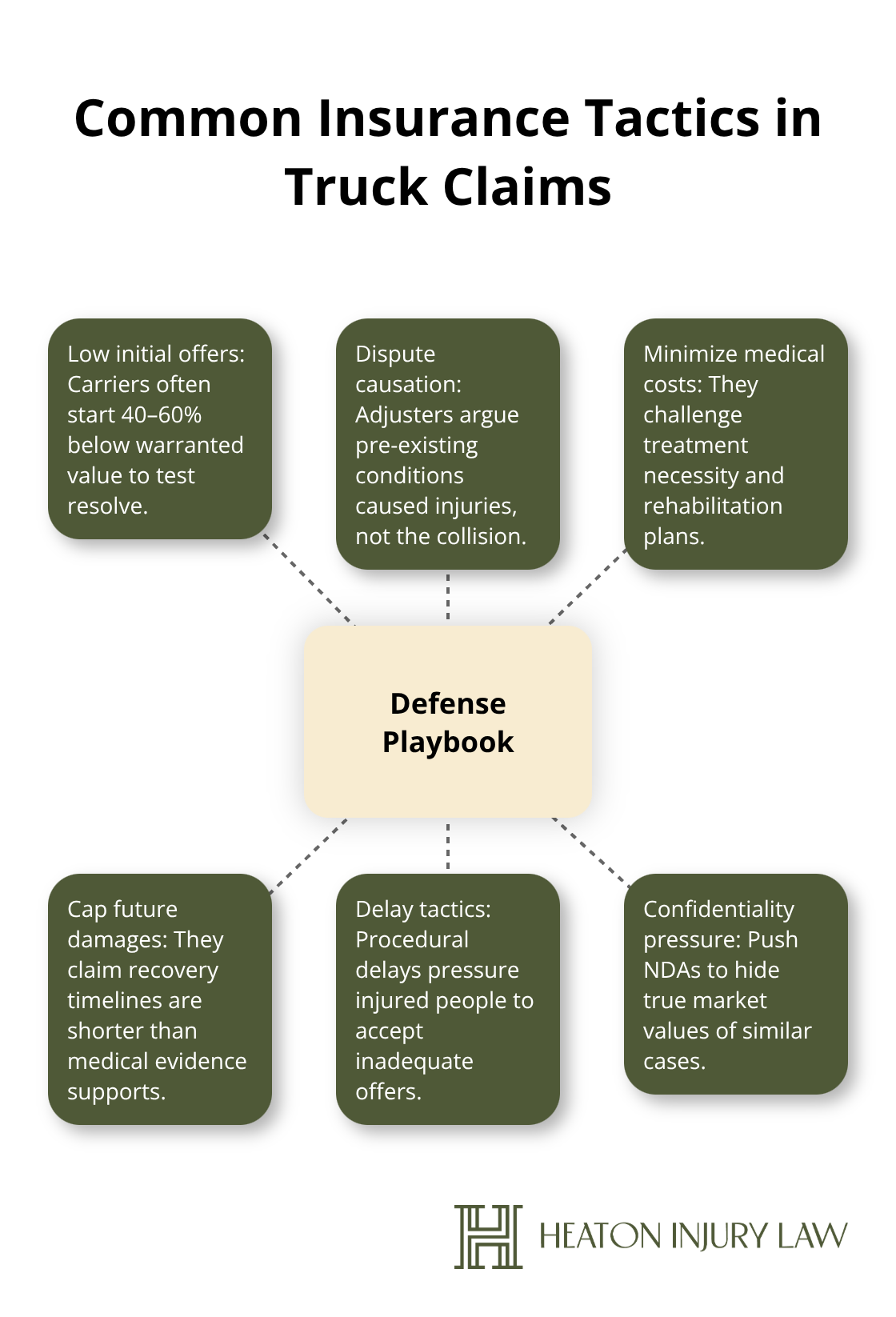
An attorney’s trial readiness transforms these negotiations because adjusters recognize that you have representation willing to proceed to court. Insurance companies budget for settlement offers based on their assessment of trial risk, and an attorney with actual truck case trial experience forces them to increase their initial offers substantially. Adjusters also test whether your attorney will accept confidentiality agreements that prevent discussion of settlement amounts-these agreements benefit the insurance industry by preventing injured people from learning what similar cases actually settle for. An attorney fighting aggressively will resist excessive confidentiality restrictions, allowing you to understand your case’s true value in the market.
Prepare for Trial When Settlement Fails
Litigation preparation begins the moment a fair settlement offer fails to materialize, and this preparation determines whether a jury will award the full value your injuries justify. Federal trucking regulations become central to trial strategy because jurors understand that regulations exist for safety reasons-when a company violates those regulations, jurors attribute that violation to negligence rather than bad luck. An attorney must prepare demonstrative evidence showing how hours-of-service violations created driver fatigue, how maintenance violations created mechanical failure, and how safety violations created conditions that made the collision inevitable.
Expert witnesses become essential-accident reconstruction experts, medical specialists, vocational rehabilitation experts, and trucking industry experts must testify about what the evidence shows. Insurance companies spend substantial money preparing their defense team for trial, and your representation must match that preparation quality. An attorney who has actually tried truck cases understands jury psychology, knows which aspects of federal regulations resonate with lay jurors, and can articulate the lifetime impact of catastrophic injuries in compelling terms that connect emotionally while remaining factually grounded.
Final Thoughts
The insurance company defending a commercial truck crash case possesses resources, experience, and financial incentive to minimize what they pay you. They deploy specialized legal teams, challenge your medical evidence, and exploit procedural delays hoping you’ll accept inadequate settlements. Fighting back requires representation that matches their preparation and refuses to fold under pressure.
A commercial truck crash attorney brings specialized knowledge that separates successful recoveries from settlements that leave you financially devastated years later. Federal trucking regulations become your strongest evidence when an attorney understands how hours-of-service violations, maintenance failures, and safety violations prove negligence more powerfully than accident reconstruction alone. This regulatory expertise forces insurance adjusters to value your case correctly from initial settlement discussions forward.
Acting quickly after a collision determines whether critical evidence survives or disappears (skid marks fade, witness memories blur, and trucking companies control records that prove their own negligence). An attorney who investigates immediately secures electronic logging devices, maintenance records, and safety inspection reports before selective destruction occurs. This evidence preservation transforms settlement negotiations because insurance adjusters recognize that you have documentation supporting your claims rather than relying on memory or reconstruction.
Experienced legal representation maximizes your recovery by identifying all liable parties, calculating lifetime medical costs for catastrophic injuries, and preparing for trial when insurance companies refuse fair offers. An attorney with actual truck case trial experience forces adjusters to increase their initial offers substantially because they know you have representation willing to proceed to court. Contact us to discuss your case and learn how specialized representation protects your rights against powerful insurance defense teams.
The information provided in this blog is for general informational purposes only and does not constitute legal advice. Every case is unique, and laws may vary by jurisdiction. Reading this content does not create an attorney-client relationship. For guidance specific to your situation, please consult with a qualified personal injury attorney licensed in Texas.
Artificial intelligence may have been used to assist in generating some text or images in these articles.