

Meredythe | September 21, 2026 | Blog

Truck accidents in Texas leave victims facing injuries far more severe than standard car collisions. Insurance companies know this, which is why they deploy aggressive tactics to minimize payouts to injured people like you.
A Texas trucking collision attorney with real experience fighting insurers can make the difference between an inadequate settlement and fair compensation. We at Heaton Injury Law, PLLC understand the tactics insurers use and how to counter them effectively.
Why Truck Accidents Create Liability Nightmares for Insurers
Truck collisions fundamentally differ from standard car accidents because liability spreads across multiple parties rather than concentrating on a single driver. When a commercial truck causes injury, you’re not just holding the truck driver accountable-you’re potentially holding the trucking company that employed them, the maintenance contractor who failed to service the brakes, the shipper who overloaded the cargo, and sometimes even the manufacturer of defective equipment. The Federal Motor Carrier Safety Administration enforces strict regulations on hours of service, vehicle inspections, and cargo securement that create a paper trail of violations. When a driver operates beyond the 11-hour daily limit or a company fails to conduct required pre-trip inspections, that documented breach becomes powerful evidence of negligence. Insurers know that multiple liable parties mean multiple insurance policies and deeper pockets, which is precisely why they fight so aggressively to narrow liability to just the driver.
The Weight Problem Insurance Companies Won’t Acknowledge
A fully loaded commercial truck weighs 80,000 pounds compared to a passenger vehicle at 4,000 pounds. The National Highway Traffic Safety Administration reports that large truck crash fatalities increased 18 percent from 2009 to 2019, with severe injuries climbing proportionally. This weight differential doesn’t just mean bigger damage-it means catastrophic injuries that generate substantial medical bills, lost wages, and pain-and-suffering damages. Insurers count on injured victims underestimating their claim value because they’ve never dealt with injuries of this magnitude. Federal regulations mandate specific cargo loading standards, weight distribution requirements, and securement methods that trucking companies routinely ignore to save time and money. When a truck carries improperly loaded cargo and causes a collision, that violation directly connects the company’s cost-cutting to your injuries.
Federal Regulations Create Accountability Insurers Want to Hide
Texas comparative negligence law allows you to recover damages even if you’re partially at fault, as long as the truck driver or company bears more responsibility. However, insurers will aggressively argue you contributed to the accident to reduce their payout percentage. Federal safety regulations eliminate their wiggle room because they establish objective standards that companies either followed or violated. Hours of service violations appear electronically through electronic logging devices, maintenance records exist by law, and cargo manifests prove what was being transported. These aren’t subjective disputes-they’re factual violations that demonstrate the trucking company prioritized profit over safety. When investigators pull these federal compliance records immediately after an accident, they tell the true story of negligence that insurance adjusters would prefer remained hidden.
How Insurers Weaponize Partial Fault Arguments
Insurers exploit comparative negligence by claiming you contributed to the collision, even when evidence contradicts their position. They’ll argue you failed to see the truck, didn’t brake fast enough, or positioned your vehicle unsafely-anything to shift blame away from the trucking company’s violations. Federal regulations eliminate this strategy’s effectiveness because they create an objective record of what the trucking company did or failed to do. A truck operating with faulty brakes (documented in maintenance records), a driver exceeding hours limits (recorded in electronic logs), or cargo loaded beyond legal weight limits (shown on manifests) proves negligence independent of your actions. Insurers understand that federal violations are difficult to defend against, which is why they push injured victims to settle quickly before these records are thoroughly examined.
Why Insurers Delay Your Truck Accident Claim
The Lowball Offer Strategy
Insurance companies weaponize time against injured truck accident victims. The moment a serious truck collision occurs, insurers activate a strategy designed to wear you down financially and emotionally until you accept whatever settlement they offer. Their first move is almost always a lowball offer arriving within weeks of the accident, before you’ve finished medical treatment or fully understand your injuries. This initial offer serves a specific purpose: it anchors your expectations downward and creates psychological pressure to settle quickly.
Victims facing mounting medical bills and lost wages often accept these inadequate offers because they need money immediately, not realizing their injuries will cost far more in the coming months and years. The insurance company knows this dynamic and counts on your desperation to force a quick decision.
Drowning You in Documentation Requests
Insurers simultaneously request exhaustive documentation including every medical record, prescription history, employment file, and communication about the accident. These requests aren’t about gathering information they need to evaluate your claim fairly-they’re about creating administrative burden. Responding to excessive document requests takes time and resources, especially when insurers demand records repeatedly or claim they never received documents you already submitted.
This delay tactic forces you to spend energy on paperwork instead of recovery while the insurer uses the extended timeline to their advantage. Each additional request adds weeks to your claim process, and insurers know injured victims have limited patience for bureaucratic obstacles.
Blame-Shifting Narratives That Contradict Federal Records
Insurers weaponize blame-shifting by constructing narratives that minimize the trucking company’s responsibility. They’ll hire investigators to challenge whether the truck driver truly violated hours-of-service regulations, suggest your vehicle positioning contributed to the collision, or argue you failed to take evasive action. These strategies directly contradict the federal compliance records established through electronic logging devices, maintenance logs, and cargo manifests.
Insurers deploy these tactics anyway because they know many injured victims won’t push back. They count on you not understanding that electronic logging devices create irrefutable records of driver hours, that maintenance logs prove whether vehicles received required inspections, or that cargo manifests document weight violations. Without an attorney who knows how to extract and weaponize these federal records, you’re negotiating blind while the insurer controls the narrative.
How Federal Documentation Eliminates Insurer Tactics
Federal compliance records eliminate the insurer’s wiggle room and force honest settlement discussions. Electronic logs, maintenance records, and cargo documentation exist independently of any victim’s actions or positioning during the collision. An experienced attorney obtains these federal documents immediately because they establish objective negligence that insurers cannot reasonably dispute.
Time becomes your enemy only if you face the insurance company alone. An experienced attorney accelerates claim resolution by eliminating delay tactics and forcing insurers to negotiate based on facts rather than pressure. This is precisely why understanding what federal records exist and how to obtain them transforms your position from vulnerable to powerful.
Texas Truck Accident Law Gives You More Rights Than You Think
Comparative Negligence Protects You Even When You’re Partially at Fault
Texas comparative negligence law operates on a straightforward principle: you can recover damages even if you bear partial fault for the collision, provided the other party carries more responsibility. The Texas Supreme Court established this rule in cases involving shared liability, meaning a truck driver or trucking company cannot escape accountability simply because you contributed to the accident. However, this protection only works if you understand how to weaponize it against insurers who will aggressively argue you shoulder more blame than the evidence supports.
The law caps your recovery at the percentage of fault assigned to you, so if you’re deemed 20 percent at fault, you recover 80 percent of your damages. This creates powerful leverage in negotiations because insurers know the burden falls on them to prove your comparative negligence rather than you proving their client’s fault. When federal records show a truck driver violated hours-of-service regulations or maintenance logs prove brake failures, insurers struggle to credibly argue you caused the collision through your own actions.
Texas courts have consistently ruled that objective federal violations establish negligence independent of victim behavior, which means insurers cannot successfully blame-shift when documented regulatory breaches exist.
Statutory Damage Caps Rarely Apply to Truck Accidents
Statutory damage caps in Texas apply narrowly to specific injury categories and rarely affect truck accident victims. Non-economic damages like pain and suffering face no caps in most personal injury cases, though medical malpractice claims follow different rules. The Texas Transportation Code imposes caps on certain damages in specific contexts, but truck accident claims typically fall outside these restrictions because they involve commercial negligence rather than medical treatment or government liability.
Your damages include medical expenses, lost wages, diminished earning capacity, and pain-and-suffering compensation that compound over time as you recover from catastrophic injuries caused by an 80,000-pound vehicle. These damages accumulate substantially when injuries prevent you from working or require ongoing medical treatment for months or years after the collision.
The Two-Year Filing Deadline Creates Urgency for Evidence Preservation
The filing deadline in Texas gives you two years from the collision date to file a lawsuit, which sounds generous until you realize how quickly evidence disappears and witness memories fade. Electronic logging devices retain data for only 30 days before overwriting older records, meaning an attorney must obtain these critical federal documents within weeks of the accident to preserve evidence insurers cannot dispute.
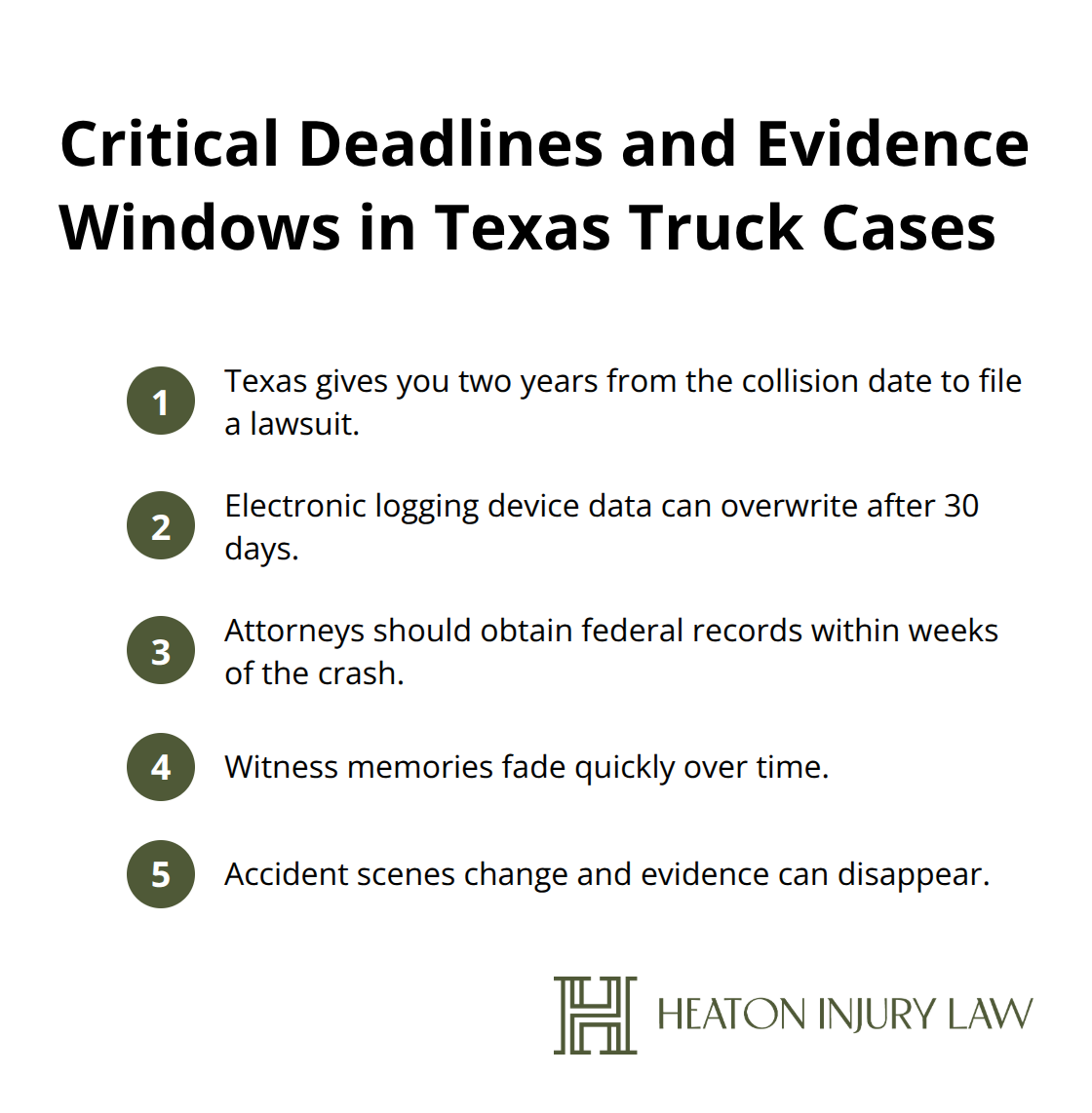
This narrow window transforms the timeline from your advantage into a liability. Waiting months or years to consult an attorney means losing access to the objective evidence that transforms your negotiating position from weak to unassailable. The two-year filing deadline applies to the lawsuit itself, but the evidence you need to win that lawsuit vanishes far sooner.
Federal Records Establish Objective Negligence
Electronic logs, maintenance records, and cargo documentation exist independently of any victim’s actions or positioning during the collision. An experienced attorney obtains these federal documents immediately because they establish objective negligence that insurers cannot reasonably dispute. These records (maintained by federal mandate) create an irrefutable timeline of driver hours, vehicle maintenance failures, and cargo violations that directly caused the accident.
Time becomes your enemy only if you face the insurance company alone. An attorney who understands federal trucking regulations accelerates claim resolution by eliminating delay tactics and forcing insurers to negotiate based on facts rather than pressure. This is precisely why understanding what federal records exist and how to obtain them transforms your position from vulnerable to powerful.
Final Thoughts
Truck accident claims demand specialized knowledge that goes far beyond standard personal injury law. Federal regulations, electronic logging devices, maintenance records, and cargo documentation create a complex landscape where insurers exploit victim confusion to minimize payouts. Without understanding how these federal systems work and what evidence proves negligence, you negotiate from a position of weakness while insurance companies control the narrative.
Insurers count on injured victims accepting inadequate settlements because they know most people lack the resources to fight back effectively. They deploy lowball offers, excessive documentation requests, and blame-shifting tactics specifically designed to wear you down before you fully understand your injuries or claim value. Electronic logs overwrite after 30 days, witness memories fade, and accident scenes change-the objective proof that would transform your negotiating position vanishes quickly.
A Texas trucking collision attorney with experience fighting insurers levels the playing field by immediately securing federal compliance records and understanding how to weaponize them. We at Heaton Injury Law, PLLC bring litigation experience on both sides of injury claims, giving us insider knowledge of exactly how insurers operate and what tactics actually work against them. Contact Heaton Injury Law, PLLC to discuss your claim and understand what your case is actually worth.
The information provided in this blog is for general informational purposes only and does not constitute legal advice. Every case is unique, and laws may vary by jurisdiction. Reading this content does not create an attorney-client relationship. For guidance specific to your situation, please consult with a qualified personal injury attorney licensed in Texas.
Artificial intelligence may have been used to assist in generating some text or images in these articles.