
Meredythe | June 24, 2026 | Blog
Rideshare accidents in Austin happen more often than most people realize, and they come with unique legal challenges that differ from standard car accidents. When you’re injured in an Uber or Lyft, determining who’s liable and what insurance applies requires specific expertise.
We at Heaton Injury Law, PLLC understand these complexities and know how to build strong cases for injured rideshare passengers and drivers. This guide walks you through what separates winning cases from weak ones.
Why Rideshare Accidents Happen in Austin
Driver Fatigue Creates Dangerous Conditions
Driver fatigue ranks as one of the most dangerous factors in rideshare accidents across Austin. Unlike traditional taxi drivers with regulated schedules, Uber and Lyft drivers often work 10-12 hour shifts with minimal breaks to maximize earnings. The National Highway Traffic Safety Administration reports that fatigued driving causes approximately 6,000 fatal crashes annually in the United States. This statistic reflects a real problem on Austin roads where rideshare drivers push themselves to exhaustion.
Distracted Driving Behind the Wheel
Distracted driving compounds fatigue significantly. Rideshare drivers must constantly monitor their phones for navigation, passenger requests, and incoming ride offers while managing traffic. A study from the Virginia Tech Transportation Institute found that taking eyes off the road for more than two seconds doubles crash risk. In Austin’s congested traffic corridors on I-35 and MoPac, this distraction becomes catastrophic.
Vehicle Maintenance and Mechanical Failures
Vehicle maintenance issues also contribute substantially to rideshare accidents, though many drivers neglect routine maintenance because they absorb repair costs personally. Worn brake pads, bald tires, and faulty suspension systems create hazardous conditions that go undetected until an accident occurs. The Texas Department of Insurance acknowledges that vehicle maintenance issues represent a significant liability factor in rideshare incidents. Drivers who operate older vehicles face higher mechanical failure rates.
Traffic Violations and Reckless Behavior
Traffic violations and reckless behavior round out the primary causes. Rideshare drivers frequently run red lights, make illegal lane changes, and exceed speed limits to reach pickups faster and complete more trips per hour. Austin’s aggressive driving culture, combined with pressure from algorithmic rating systems that reward speed and availability, incentivizes dangerous shortcuts. These systemic pressures create an environment where safety takes a backseat to earnings and ratings.
How Accident Causes Affect Your Claim
When you suffer injury in a rideshare accident caused by these factors, the evidence becomes critical to your case. Establishing driver negligence requires detailed accident reconstruction, witness statements, and phone records showing distraction. Vehicle maintenance records prove liability when mechanical failure caused the crash. Understanding what caused your accident directly strengthens your claim’s value and your path to fair compensation.
Key Factors That Strengthen Your Rideshare Accident Claim
Photograph and Preserve Scene Evidence Immediately
The difference between a winning rideshare accident claim and one that collapses comes down to what you collect, preserve, and document in those critical first hours after the crash. The scene itself holds evidence that vanishes quickly-skid marks fade within days, witnesses scatter, and your own recollection becomes hazier as shock wears off. Photograph everything from multiple angles: the vehicle damage, road conditions, traffic signals, street signs, weather conditions, and the other vehicle’s position. Get the rideshare driver’s name, insurance information, and their Uber or Lyft account details. Collect contact information from every witness, not just one or two.
Request the police report number and follow up to obtain the full report within 7-10 days, not weeks. Most injured people skip this step entirely and later discover the police report contradicts what they remember or the officer took the other person’s version of events over yours. Documenting the driver’s behavior, vehicle condition, and the exact circumstances becomes critical for your claim and forms the foundation that forces insurance companies to take your case seriously.
Determine Which Insurance Policy Applies to Your Accident
Insurance coverage in rideshare accidents operates differently than standard car crashes, and this complexity separates strong claims from weak ones. Lyft accident claims often involve complicated insurance coverage, unique driver classifications, and disputes over liability, making it essential to understand which policy protects you. However, this coverage has strict limitations and only applies during specific periods of your trip.
The rideshare company’s insurance typically doesn’t cover damage to your own vehicle or medical expenses until you’ve exhausted your personal policy. You must determine exactly when the accident occurred relative to your rideshare activity-were you waiting for a ride request, actively driving a passenger, or between trips? This timing directly determines which insurance policy applies. Request documentation from the rideshare company showing your app activity and trip status at the time of the crash. This precision in timing and documentation transforms a questionable claim into a compelling one.
Build Your Medical Record Into an Unassailable Case
Medical documentation converts a claim from questionable to powerful. Get treatment immediately after the accident, even if injuries seem minor, because delayed treatment gives insurers ammunition to claim your injuries weren’t serious. Document every medical visit, procedure, prescription, and expense. Keep records of lost wages, transportation costs to medical appointments, and how the injury affected your daily life.
Insurers scrutinize claims lacking comprehensive medical records and often deny them or offer minimal settlements. Photographs of visible injuries immediately after the accident and during recovery strengthen your claim significantly. These concrete, documented facts-scene evidence, insurance details, and medical records-build the foundation that forces appropriate compensation. The next step involves understanding what happens when you file your claim and how to navigate the process without making costly mistakes.
What to Do Right After a Rideshare Accident
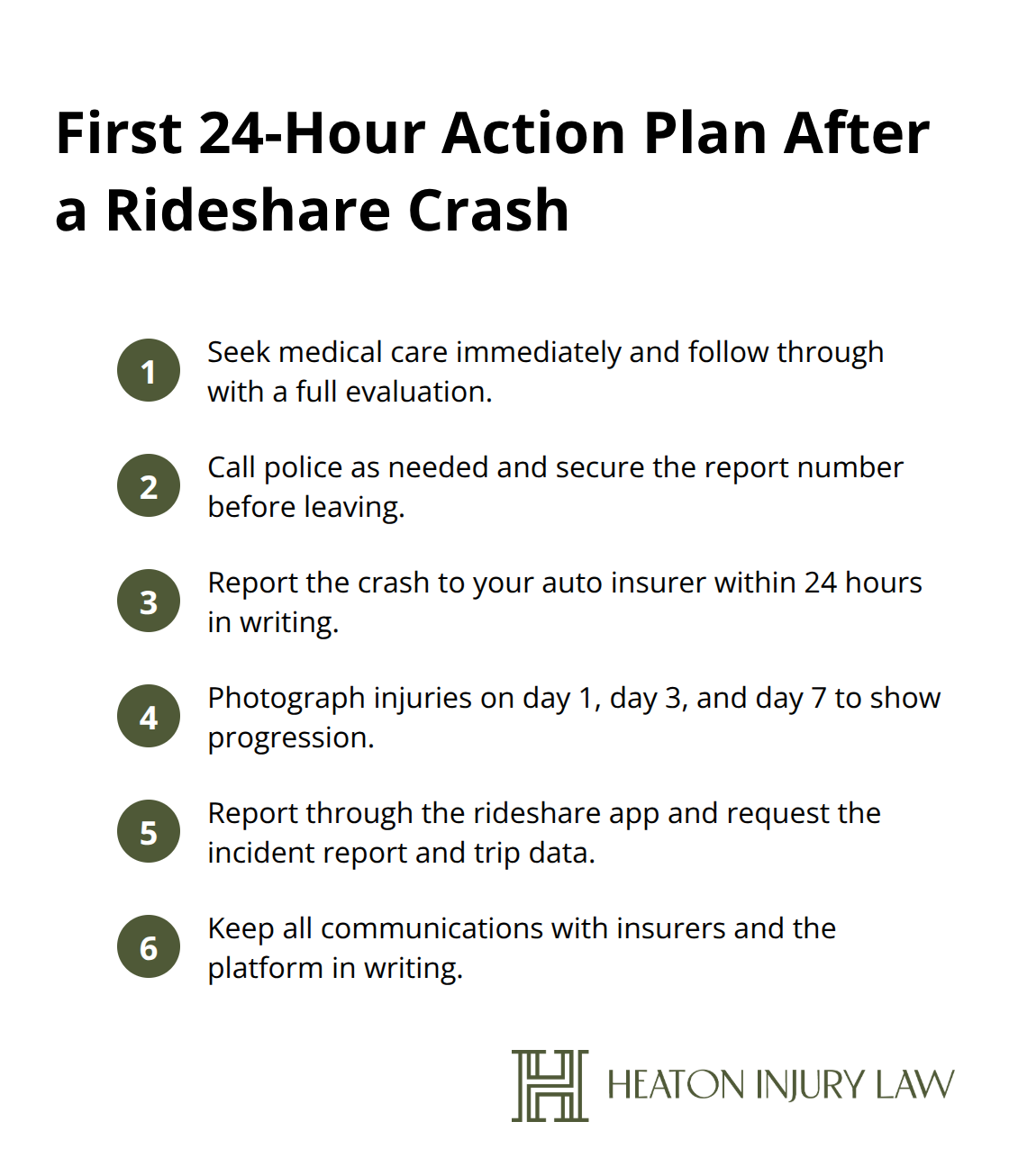
Your actions in the first 24 hours after a rideshare accident directly determine whether your claim succeeds or fails. Seek medical attention immediately, even if you feel fine, because adrenaline masks injuries that surface hours or days later. Request a full medical evaluation and keep every receipt, prescription, and medical record. Call the police non-emergency line if the accident caused significant damage or injuries, and obtain the police report number before leaving the scene.
Report the Accident to Your Insurance Company
Contact your personal auto insurance company within 24 hours to report the accident, but do not admit fault or speculate about what happened. Tell them only the facts: time, location, vehicles involved, and whether you were a rideshare passenger or driver. Written communication works better than phone calls because it creates a permanent record that prevents misunderstandings about what was discussed. Do not sign any documents the insurance company sends without reviewing them carefully first.
Document Your Injuries Thoroughly
Photograph your injuries on day one, day three, and day seven to show progression or healing, because insurance adjusters heavily weight visual evidence of harm. These images create concrete proof that strengthens your claim significantly. Keep detailed records of all medical visits, procedures, prescriptions, and expenses related to the accident.
Gather Information From the Rideshare Company
Contact the rideshare company directly through your app to report the accident and request their incident report, which contains critical data about your trip status, the driver’s account history, and their insurance information. The Texas Department of Insurance recommends confirming what coverage applies to your specific situation, which depends entirely on whether you were waiting for a pickup, actively transporting a passenger, or between trips when the crash occurred. Request written confirmation from the rideshare company showing your app activity and trip status at the exact time of the accident.
Protect Your Rights During Communications
Do not post about the accident on social media, do not discuss details with anyone except medical professionals and legal representatives, and do not speak directly with the other driver’s insurance company. If the other driver’s insurance contacts you, direct them to your own insurance company instead. Preserve all communication with insurance companies and the rideshare platform in writing, never by phone, because written records prevent misunderstandings about what was discussed and create documentation that protects your legal position.
Final Thoughts
Rideshare accidents demand specialized legal knowledge that standard car crash cases simply don’t require. Insurance coverage rules differ dramatically, liability questions become far more complex, and large companies apply intense pressure to minimize payouts. Without proper guidance, injured passengers and drivers accept settlements worth a fraction of what they deserve, leaving them to cover ongoing medical expenses and lost income from their own pockets.
We at Heaton Injury Law, PLLC bring extensive litigation experience to rideshare accident cases, with deep knowledge of how insurance companies operate and what tactics they use to undervalue claims. Our approach combines trial readiness with personalized representation, which means we prepare every case as if it will go to court and forces insurers to take settlement negotiations seriously. Contact Heaton Injury Law, PLLC today for a free consultation where we review your accident details, explain what your case is worth, and outline your path forward without pressure or hidden fees.
We work on contingency, so you pay nothing unless we recover compensation for you. A rideshare accident lawyer Austin residents trust will fight to get you fair compensation for medical bills, lost wages, pain and suffering, and any permanent injuries you sustained. The insurance company has already assigned an adjuster to your case-that adjuster works for them, not for you, so let us level the playing field and protect the recovery you deserve.
The information provided in this blog is for general informational purposes only and does not constitute legal advice. Every case is unique, and laws may vary by jurisdiction. Reading this content does not create an attorney-client relationship. For guidance specific to your situation, please consult with a qualified personal injury attorney licensed in Texas.
Artificial intelligence may have been used to assist in generating some text or images in these articles.