

Meredythe | July 14, 2026 | Blog

A serious injury can change your life overnight, and the path to recovery often extends far beyond the initial treatment phase. Long-term rehabilitation in Austin requires careful planning to ensure you receive the right care, at the right time, and in the right setting.
At Heaton Injury Law, PLLC, we understand that navigating rehabilitation options while managing your recovery is overwhelming. This guide walks you through the essential steps to build a sustainable care strategy tailored to your needs.
What Counts as Long-Term Rehabilitation
Understanding Long-Term vs. Short-Term Care
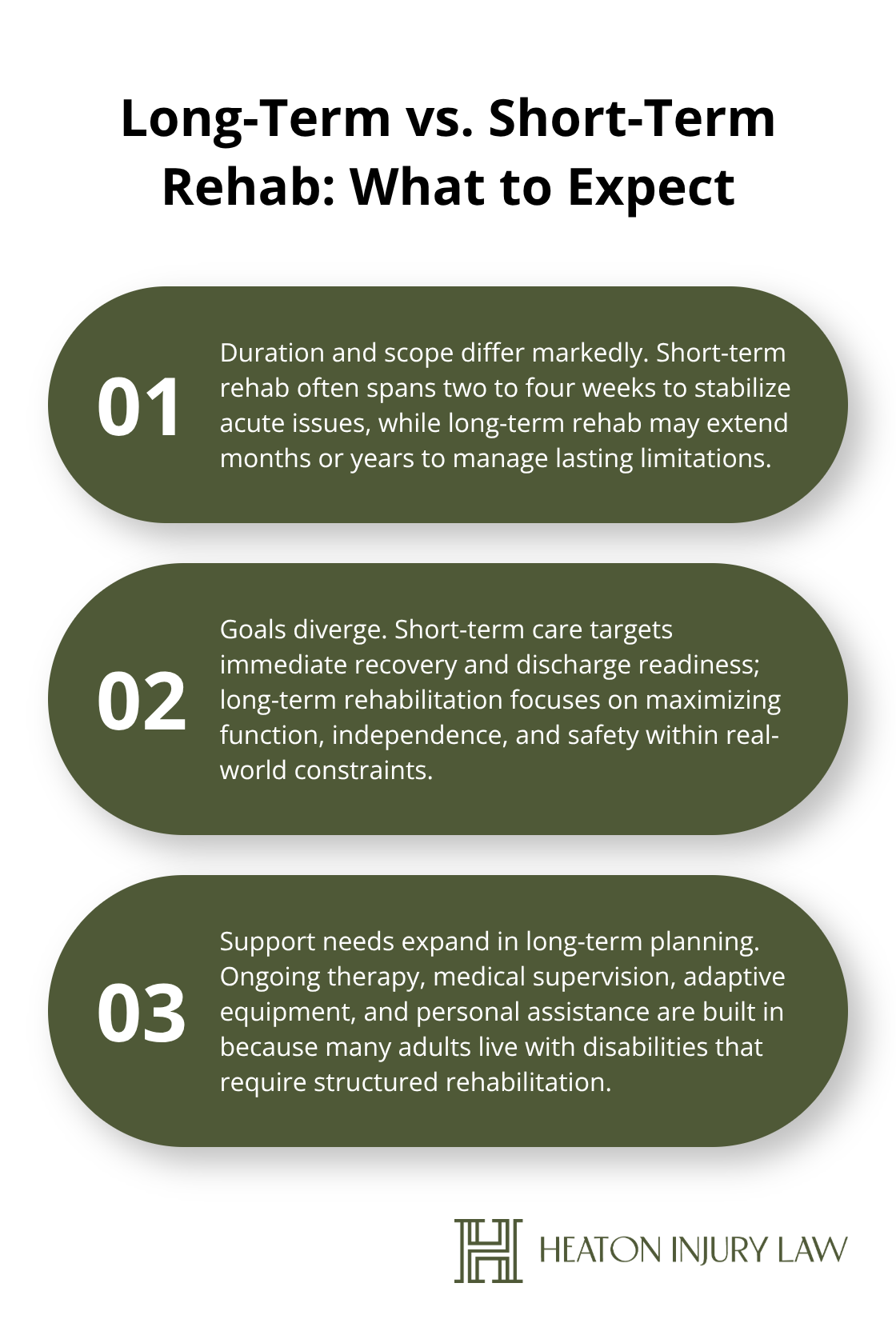
Long-term rehabilitation addresses the reality that serious injuries demand care extending months or years beyond initial hospital discharge. Unlike short-term rehab, which typically lasts two to four weeks and focuses on stabilizing acute conditions, long-term rehabilitation tackles permanent functional limitations and builds sustainable independence. The distinction matters because short-term care often assumes you’ll return home with minimal support, while long-term planning accounts for ongoing therapy, medical supervision, adaptive equipment, and personal assistance. About 1 in 4 adults in the U.S. has some form of disability, according to the CDC, and many require structured rehabilitation to manage their conditions.
Why Austin Needs Coordinated Long-Term Care
Austin’s population is aging rapidly, making coordinated lifelong care across hospital, home, and community settings essential. The city’s growth means more demand for specialized rehabilitation facilities and home-based services. You’ll find that planning ahead-rather than scrambling after discharge-positions you to access the best available resources and avoid gaps in care that compromise recovery.
Core Components of Long-Term Rehabilitation
Long-term rehabilitation includes physical therapy to rebuild strength and mobility, occupational therapy to restore daily living skills, speech-language pathology for communication and swallowing disorders, and cognitive rehabilitation for brain injuries. Behavioral health support addresses anxiety, depression, or trauma that often accompanies serious injury. Attendant care-personal assistance with hygiene, dressing, and transfers-forms another critical pillar. Home modifications such as wheelchair ramps, accessible bathrooms, and safety equipment enable independence within your living space. The goal isn’t recovery in the traditional sense; it’s maximizing function and quality of life within realistic constraints.
Injuries That Trigger Long-Term Rehabilitation Planning
Traumatic brain injury, spinal cord injury, severe orthopedic trauma, amputation, extensive burns, and chronic neurological conditions most often require long-term rehabilitation planning. Stroke survivors frequently need months of specialized therapy to regain speech, movement, and cognitive function. Individuals with spinal cord injuries face permanent paralysis and must adapt to wheelchair use, bowel and bladder management, and prevention of secondary complications like pressure wounds. Orthopedic injuries-such as multiple fractures or joint reconstructions-may require intensive physical therapy over 12 months or longer to restore walking and functional mobility. Brain injuries present complex challenges: physical dysfunction coexists with cognitive impairment and behavioral changes, demanding a multidisciplinary team approach.
Building Your Rehabilitation Team
Starting rehabilitation planning early-even before hospital discharge-improves outcomes significantly. A coordinated team including physicians, physical therapists, occupational therapists, speech-language pathologists, nurses, social workers, and a case manager yields measurably better results than fragmented care. Central Texas Rehabilitation Hospital in Austin, a 50-bed inpatient facility, specializes in exactly these conditions with CARF-accredited stroke programs and Joint Commission accreditation across comprehensive inpatient rehabilitation. Their individualized approach to brain injury, spinal cord injury, and orthopedic rehabilitation reflects the standard of care you should expect. The reality is that serious injuries reshape daily life, and the right team makes the difference between merely surviving and actually rebuilding independence. Understanding what resources exist in Austin and how to access them sets the foundation for effective long-term planning-which brings us to the practical steps you’ll take to assess your specific medical needs and financing options.
Building Your Medical and Financial Roadmap
Assess Your Actual Functional Status and Realistic Trajectory
Assessing what you actually need versus what sounds good in theory separates effective rehabilitation planning from wishful thinking. Document your current functional status honestly: Can you walk, transfer from bed to chair, bathe yourself, manage stairs? Project forward realistically based on your specific injury. A spinal cord injury at age 30 means 50+ years of care costs; a stroke at 72 with existing heart disease follows a different trajectory. Work with your physician to identify which therapies address your specific impairments rather than generic protocols.
Match Therapies to Your Medical Reality
Physical therapy makes sense if you have realistic potential to regain movement; cognitive rehabilitation targets documented memory or executive function deficits; speech therapy addresses swallowing or communication problems. Your care plan must account for how your condition changes over time and what interventions actually prevent decline versus merely maintain status quo. A multidisciplinary team including physicians, physical and occupational therapists, nurses, social workers, and a dedicated case manager produces measurably better outcomes than isolated specialists working independently.
Understand Your Financing Foundation
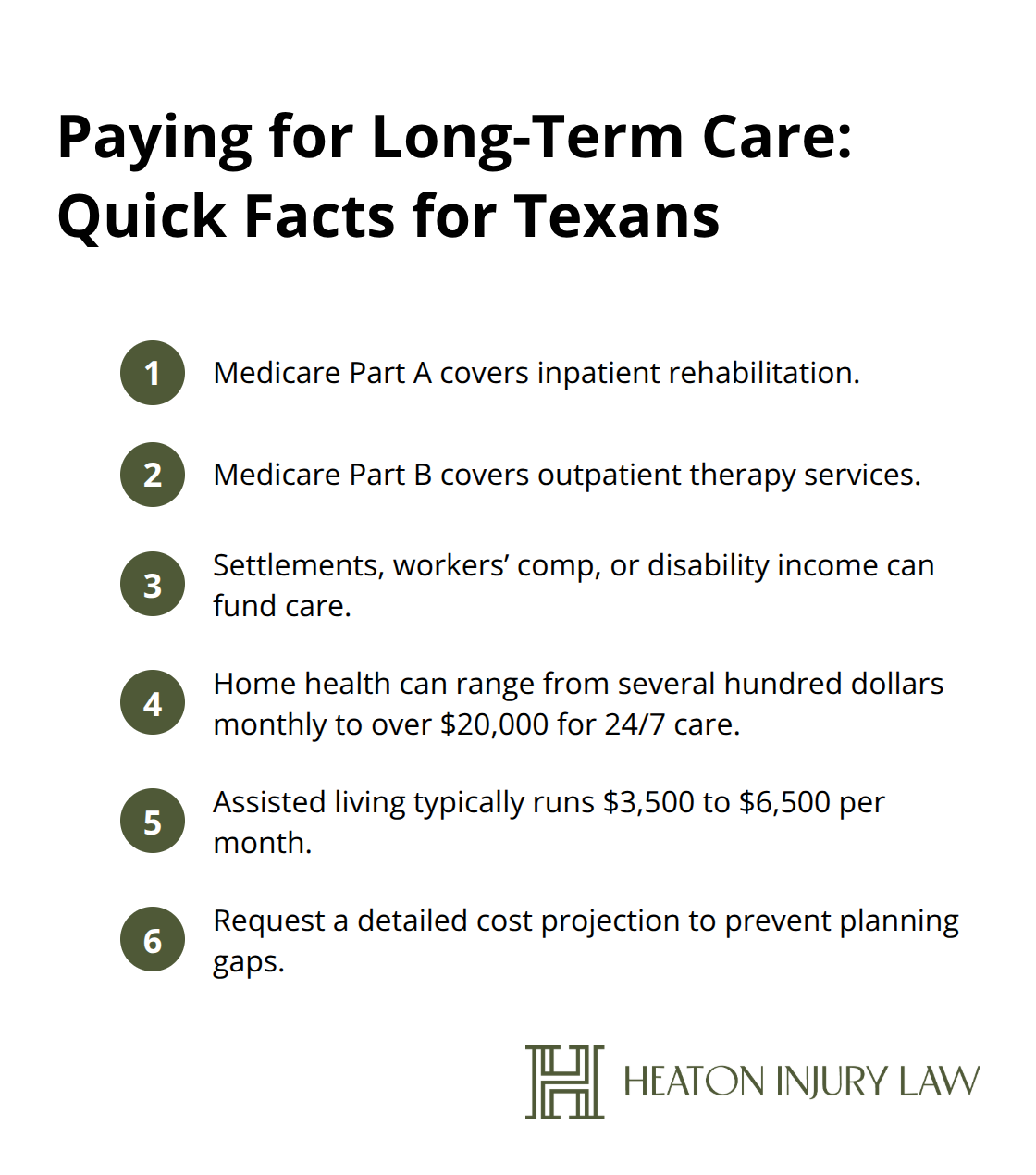
Medicare Part A covers inpatient rehabilitation, Part B covers outpatient therapy, but understanding your personal eligibility matters more than general rules. If you received a personal injury settlement, workers compensation award, or have disability income, these funds often become the foundation for long-term care. The median cost of home health care in Texas ranges from several hundred dollars monthly for part-time assistance to over $20,000 for 24/7 care, while assisted living typically runs $3,500 to $6,500 monthly. Request a detailed cost projection from your rehabilitation provider or case manager; vague estimates create planning gaps that hurt you later.
Plan Your Care Setting and Home Environment
Discharge planning should begin before you leave the hospital, not weeks afterward. Identify whether you’ll recover at home with visiting therapy, move to an inpatient facility for intensive daily treatment, or transition through multiple settings. Home modifications cost money upfront but prevent falls and hospitalizations that cost far more; grab bars, adequate lighting, ramps, and accessible bathrooms aren’t luxuries. Engage your family early and honestly about what caregiving demands.
Activate Your Support System and Legal Timeline
Caregivers need training on safe transfers, medication management, and recognizing complications. Caregiver burnout directly correlates with worse patient outcomes, so respite care and caregiver support groups aren’t optional add-ons. Set a review schedule-every 6 to 12 months-to adjust therapies, equipment, and supports as your needs evolve. Conditions progress, new treatments emerge, and insurance rules change. Static plans fail. If you sustained your injury through someone else’s negligence, act promptly on legal claims to preserve compensation for long-term care; most personal injury claims have a two-year filing window in Texas, and waiting costs you money when you need it most. Understanding your financial resources and care structure positions you to navigate the specific Austin resources and support services available to you.
Austin Rehabilitation Services and Support Resources
Inpatient Rehabilitation Facilities in Austin
Central Texas Rehabilitation Hospital at 700 W 45th St operates as Austin’s primary specialized inpatient facility for serious injury recovery, with 50 beds dedicated to stroke, brain injury, spinal cord injury, amputation, and orthopedic rehabilitation. The facility holds Joint Commission accreditation for comprehensive inpatient rehabilitation and CARF accreditation for its stroke specialty program, meaning the care meets recognized national standards. Their individualized programs address physical dysfunction, cognitive impairment, and behavioral issues through coordinated multidisciplinary teams-exactly what research shows produces measurably better outcomes than fragmented care. You can schedule a tour or request a virtual walkthrough before admission, which eliminates guesswork about whether the facility matches your specific needs. Gait training, stair climbing, transfer training, strengthening, endurance work, fall safety, activities of daily living, and driving readiness form the core of their orthopedics program, while general debility rehabilitation helps patients relearn daily tasks after serious injury or chronic illness.
Outpatient and Home-Based Rehabilitation Services
Austin’s rehabilitation ecosystem extends beyond inpatient facilities to include outpatient clinics, home health agencies, and community-based programs that sustain recovery after hospital discharge. Home-based rehabilitation reduces hospital readmissions when it includes nurse visits, physical and occupational therapy, and caregiver training, according to the Agency for Healthcare Research and Quality. Medicare Part B covers outpatient rehabilitation services, but eligibility and coverage limits vary based on your specific condition and medical necessity documentation from a healthcare provider. Telehealth rehabilitation has expanded dramatically, with some payers now covering remote physical therapy and occupational therapy sessions, reducing travel burden for rural patients or those with mobility limitations.
Care Coordination and Discharge Planning
A dedicated case manager or care coordinator becomes essential once you leave the hospital because gaps between inpatient care, outpatient services, and home support directly predict worse outcomes. Social workers embedded in hospital discharge planning identify community programs, secure Medicaid applications if needed, and connect you with Area Agencies on Aging resources that offer caregiver training and respite care. The Area Agencies on Aging in Central Texas provide navigation assistance for long-term care options, including home modification resources, assistive device programs, and connections to skilled nursing facilities or assisted living communities when home care becomes insufficient.
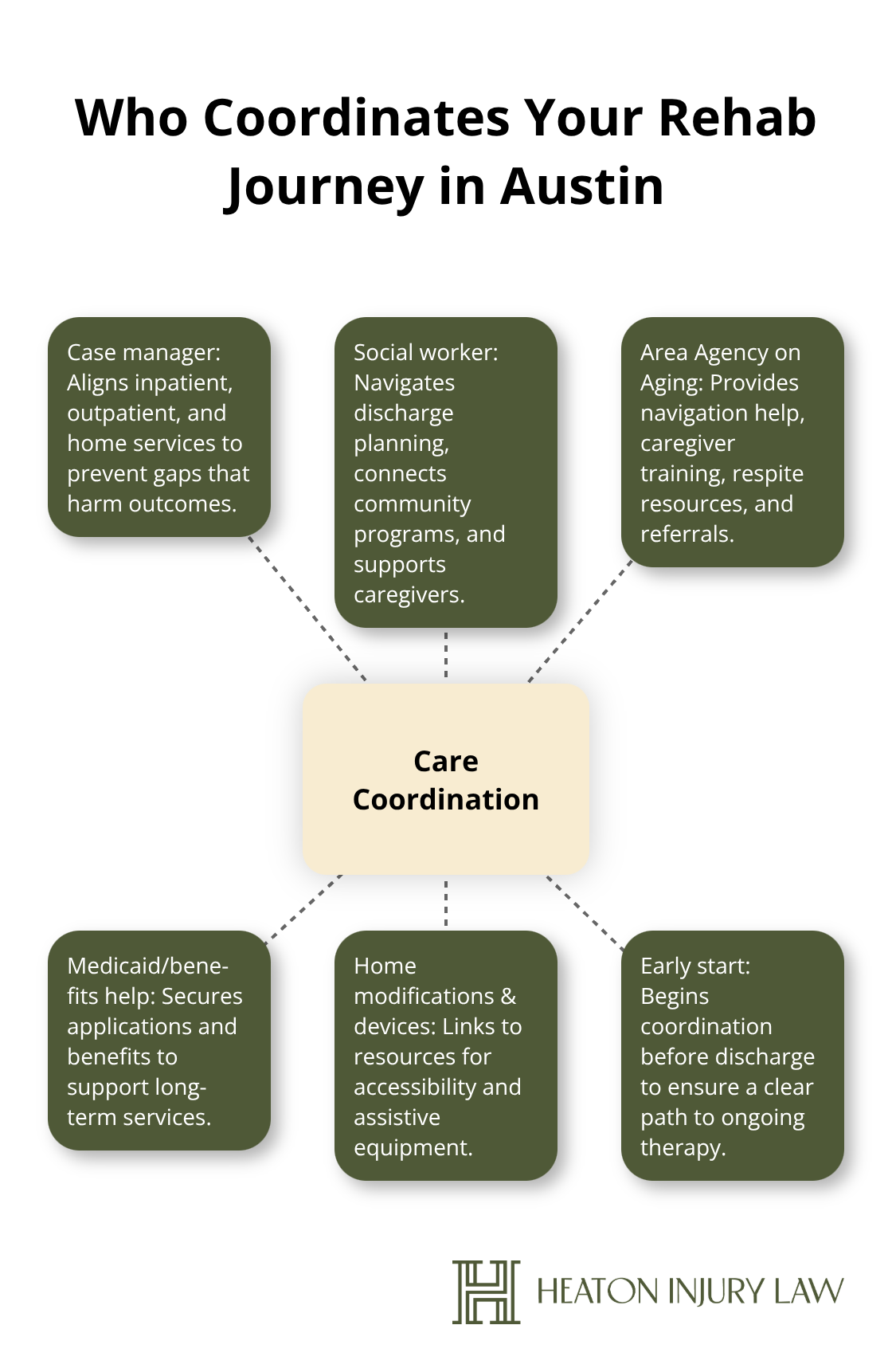
Starting this coordination before hospital discharge prevents the common scenario where patients leave without a clear pathway to ongoing therapy or support services.
Funding Your Long-Term Care Plan
Your case manager should help you understand how workers compensation, personal injury settlements, or disability income streams toward long-term care costs, ensuring every available dollar reaches care rather than slipping through administrative gaps. If you sustained your injury through someone else’s negligence, Heaton Injury Law, PLLC can help you pursue compensation that funds your rehabilitation and long-term care needs. The firm handles car, motorcycle, truck, brain and catastrophic injuries, rideshare crashes, slip-and-fall, workplace injuries, and wrongful-death claims with a trial-ready approach designed to maximize your recovery.
Final Thoughts
Long-term rehabilitation in Austin demands action, not passive waiting. Serious injuries reshape your life, and the quality of your recovery depends entirely on decisions you make in the weeks and months following discharge. Your medical team, your care setting, your financing structure, and your support system either work together to rebuild independence or fragment into gaps that compromise your progress.
Start planning before you leave the hospital by requesting a discharge meeting with your social worker, case manager, and physician to map out your first 90 days at home or in a rehabilitation facility. Identify which therapies address your specific functional deficits rather than following generic protocols, and understand your financing foundation through Medicare coverage, workers compensation benefits, personal injury settlements, or disability income. Connect with Austin’s rehabilitation resources immediately-Central Texas Rehabilitation Hospital, outpatient clinics, home health agencies, and Area Agencies on Aging exist to support your recovery, but you must initiate contact and navigate eligibility requirements.
If your injury resulted from someone else’s negligence, act promptly on your legal claim because most personal injury cases in Texas have a two-year filing window. We at Heaton Injury Law, PLLC handle car, motorcycle, truck, brain and catastrophic injuries, rideshare crashes, slip-and-fall, workplace injuries, and wrongful-death claims with a trial-ready approach designed to maximize your recovery. Your long-term rehabilitation in Austin succeeds when you secure compensation early and fund your care when you need it most.
The information provided in this blog is for general informational purposes only and does not constitute legal advice. Every case is unique, and laws may vary by jurisdiction. Reading this content does not create an attorney-client relationship. For guidance specific to your situation, please consult with a qualified personal injury attorney licensed in Texas.
Artificial intelligence may have been used to assist in generating some text or images in these articles.