

Meredythe | August 24, 2026 | Blog

Injury settlement negotiations in Texas require strategy, evidence, and a clear understanding of what your case is worth. Insurance companies often start with lowball offers, hoping you’ll accept without question. We at Heaton Injury Law, PLLC help injured Texans navigate these negotiations to secure fair compensation.
This guide walks you through proven tactics that maximize your settlement value while avoiding costly mistakes.
How Settlement Negotiations Work in Texas
Settlement negotiations in Texas follow a structured path that starts only after your injuries stabilize and your medical treatment ends or reaches maximum medical improvement (MMI). This is the point where your doctors determine that no further recovery is expected. Rushing into negotiations before MMI creates a critical problem: you won’t know your full damages. Once MMI is established, your attorney sends a demand letter to the at-fault party’s insurance company. This letter outlines what happened, why the other party is liable, and exactly how much compensation you’re seeking. The demand includes both economic damages (medical bills, lost wages, property damage) and non-economic damages (pain and suffering, emotional distress, loss of enjoyment of life).
The Insurance Company’s Response
The insurer will respond with a Reservation of Rights Letter, which is routine and simply means they’re reserving the right to deny or dispute the claim. From there, the back-and-forth begins. The insurer makes a counteroffer, your attorney responds with a reasoned counteroffer, and this cycle continues until either you reach an agreement or the deadline approaches. The insurer’s first offer is typically low-this is standard practice, not a sign of good faith. Your attorney counters with a figure backed by evidence and damages documentation. Each round of negotiation narrows the gap between what you demand and what the insurer offers.
What Really Drives Settlement Value
Insurance adjusters calculate settlement offers using specific methods, not guesswork. The multiplier method is most common in Texas: the adjuster totals your medical bills and other economic damages, then multiplies that figure by 1.5 to 5 depending on injury severity. A severe, permanent injury receives a higher multiplier than a minor fracture. If your economic damages total $15,000 and the multiplier is 3, your pain and suffering value reaches $45,000, making gross settlement $60,000. The per diem method assigns a daily rate for your suffering and multiplies it by recovery days.
Documentation makes the difference. Medical records showing ongoing treatment, imaging results proving the injury, and expert testimony about long-term effects all push the multiplier higher. Pre-existing conditions can lower the multiplier because the insurer argues your baseline health was already compromised.
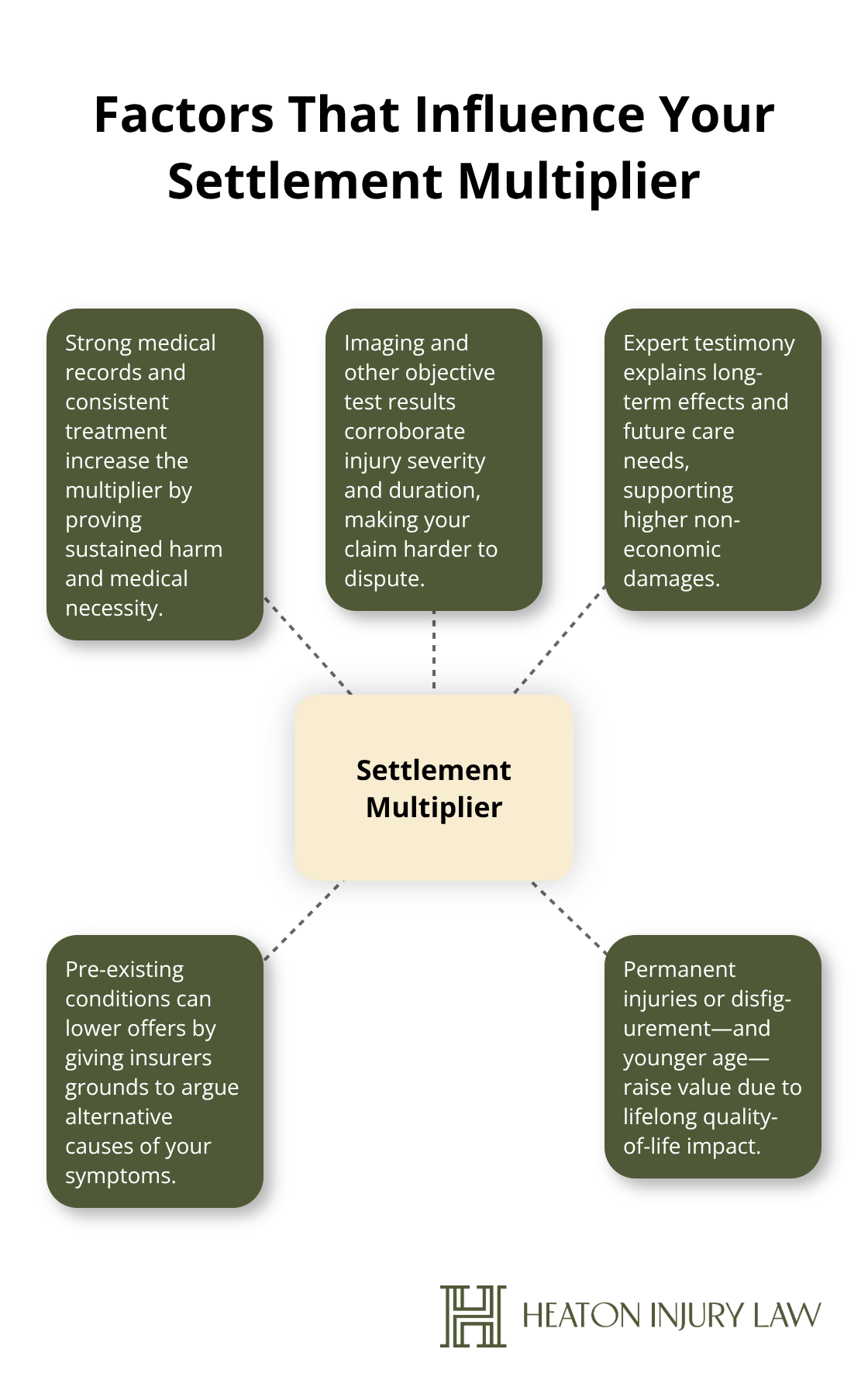
Permanent injuries and disfigurement increase settlement value significantly because they affect your quality of life indefinitely. Age matters too: a 30-year-old with a permanent injury faces more years of impact than a 65-year-old, so younger claimants often receive higher awards.
Liability and Comparative Negligence Shape Your Recovery
Texas uses a modified comparative negligence rule under Chapter 33 of the Texas Civil Practice and Remedies Code. If you’re found 50% or less at fault, you can still recover damages minus your percentage of fault. If you’re 51% or more at fault, you recover nothing.
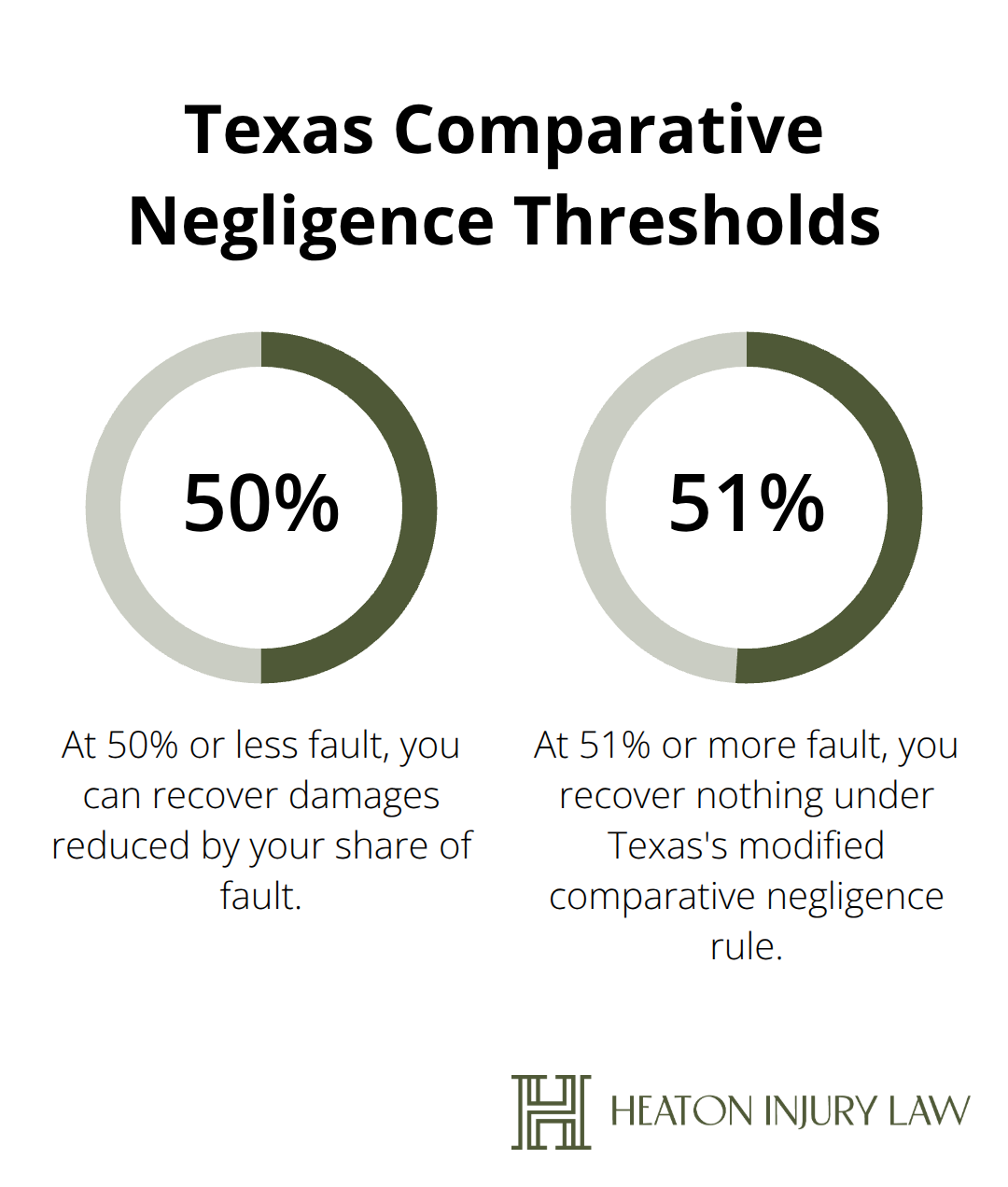
This is why establishing the other party’s liability early is essential-it directly affects your recovery amount. Strong evidence of the other party’s negligence (police reports, witness statements, accident reconstruction) strengthens your negotiating position and prevents the insurer from inflating your share of blame.
How to Build a Bulletproof Settlement File
Collect Evidence Immediately After Your Injury
The difference between a strong settlement and a weak one comes down to documentation. Insurance adjusters make offers based on what they can see in your file, and gaps in evidence give them room to dispute your damages and lowball you. Start collecting evidence immediately after your injury. Obtain the police or accident report, photograph the scene and your injuries, and gather witness contact information while details remain fresh. Medical records form the backbone of your claim, so request copies of every visit, imaging study, and treatment note from your healthcare providers. X-rays, MRIs, and CT scans provide objective proof of your injury that the insurer cannot argue away.
Organize Your Financial Documentation
Compile pay stubs or W-2s showing lost wages, receipts for out-of-pocket medical expenses, and documentation of any property damage. If you’re self-employed or receive tips or bonuses, gather records proving that income loss too. Create a spreadsheet tracking all medical bills, dates of treatment, providers, and costs. This organized approach makes it far easier for your attorney to calculate total economic damages accurately. About 95 percent of personal injury claims settle before trial, and those that do settle typically involve claimants who invested time upfront in thorough documentation.
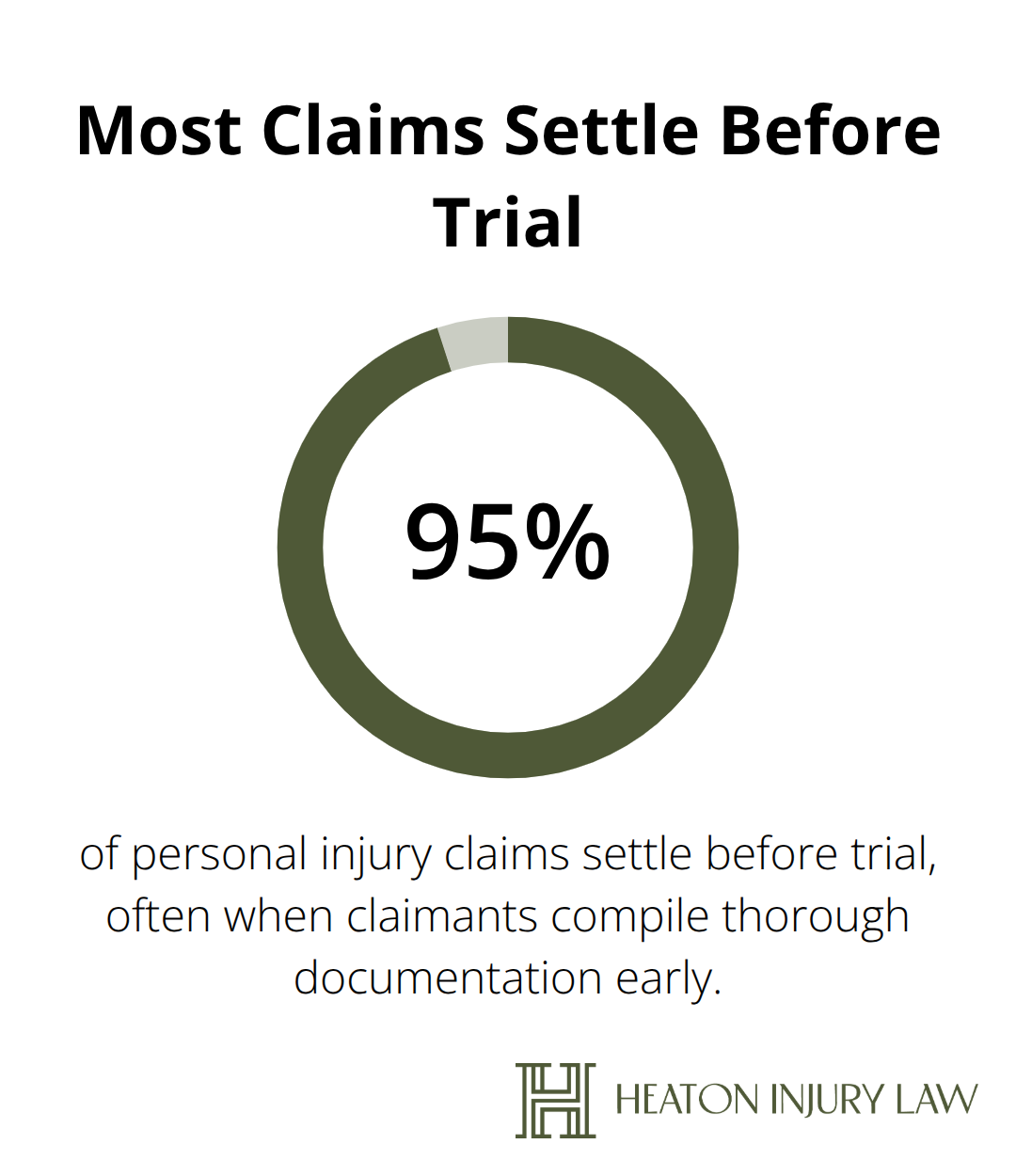
The insurer will scrutinize your file for inconsistencies or missing pieces, so a complete record prevents them from using gaps as negotiating leverage.
Attach Supporting Documents to Your Demand Letter
When the demand letter goes out, attach supporting documents that corroborate every damage claim. Medical records showing ongoing treatment and future care needs push the multiplier higher because they prove lasting impact. If your injury required surgery or ongoing physical therapy, those records demonstrate severity far better than your word alone. Expert testimony from medical professionals carries enormous weight during negotiations. A physician’s statement about permanent limitations, chronic pain, or reduced earning capacity gives the insurer concrete reasons to increase their offer rather than dispute your claims.
Address Pre-Existing Conditions and Permanent Injuries
Pre-existing conditions complicate your case, but medical records showing you were functioning normally before the accident prove the injury made your condition significantly worse. Your attorney will know whether to retain an independent medical examiner or life-care planner depending on your injury’s complexity. For permanent injuries or disfigurement, these experts calculate long-term costs and quality-of-life impacts that the multiplier method alone cannot capture. The insurer will make a lowball first offer regardless of your evidence, but responding with a demand backed by medical proof, wage documentation, and expert analysis forces them to justify why they’re offering less.
Prepare for Litigation if Settlement Talks Stall
If negotiations stall and the two-year Texas statute of limitations approaches, your attorney can file a lawsuit to preserve your rights. Many cases settle during litigation after discovery exposes facts the insurer hoped to avoid. The evidence you gathered from day one becomes your foundation for depositions, interrogatories, and trial preparation. Strong documentation transforms your negotiating position from defensive to offensive-the insurer now must respond to your proof rather than attack your claims. This shift in leverage often moves settlement discussions forward when they’ve reached an impasse, making the next phase of negotiation or litigation far more favorable to your recovery.
Mistakes That Tank Your Settlement
The path to fair compensation collapses faster than most people realize, often through decisions made in the first weeks after injury. Insurance adjusters count on injured Texans making avoidable errors that shrink settlement offers by thousands of dollars.
Rejecting Lowball First Offers
The insurer’s opening bid is not a legitimate starting point-it’s a test to see if you’ll accept without resistance. When an adjuster sends an initial offer, it’s deliberately low, often 30 to 50 percent below what the case is actually worth. Accepting this first offer without mounting a reasoned counteroffer backed by documentation signals weakness and leaves money on the table permanently. Your attorney’s response must cite specific damages, medical evidence, and the calculation method used to arrive at a higher figure. Silence or passive acceptance teaches the insurer that aggressive lowballing works, and you forfeit leverage you can never recover.
Avoiding Social Media Traps
Insurance companies hire investigators who monitor social media accounts specifically to find inconsistencies between your claimed injuries and your online activity. A photo of you smiling at a restaurant, a post about returning to work part-time, or a video showing mobility contradicts your damage claims and gives the adjuster ammunition to deny or drastically reduce your offer. One careless post costs you tens of thousands in settlement value because the insurer will argue your injuries aren’t as severe as documented. Avoid discussing your case, your injuries, or your recovery on any platform during negotiations and litigation. This includes private messages and comments on family members’ posts-screenshots exist forever and can be used against you.
Understanding Your Full Damages Before Settlement
Many injured Texans accept offers before reaching maximum medical improvement, meaning they don’t know if their condition will improve, stabilize, or worsen. Settling prematurely locks you into a fixed amount with no recourse if you later need surgery, ongoing physical therapy, or treatment for complications. Your medical records must show your current status and your doctor’s prognosis for future treatment before you sign any settlement agreement. If your injury involves permanent effects (chronic pain, reduced earning capacity, ongoing medication), you need expert calculation of those future costs. A settlement agreement is final and binding; once signed, you cannot reopen the case to claim additional damages you didn’t anticipate. An experienced attorney ensures you understand the full scope of your injuries and projected recovery before any settlement is finalized, protecting you from accepting inadequate compensation that leaves future medical needs unfunded.
Final Thoughts
Injury settlement negotiation in Texas demands strategy, evidence, and representation that understands how insurers operate. We at Heaton Injury Law, PLLC have navigated these negotiations for years, which gives us insight into the tactics adjusters use and how to counter them effectively. Our approach centers on building an airtight case file from day one, calculating your damages accurately, and refusing to accept lowball offers without pushing back hard.
The difference between a fair settlement and an inadequate one often comes down to preparation and representation. You now understand how to document your injuries, organize your financial losses, and recognize the mistakes that tank settlement value, but executing these strategies under pressure while managing recovery requires experienced legal guidance. We at Heaton Injury Law, PLLC handle car accidents, motorcycle crashes, truck collisions, brain injuries, catastrophic injuries, rideshare accidents, slip-and-fall claims, workplace injuries, and wrongful-death cases throughout Austin and Texas (led by Meredythe Heaton Wilkinson with over 14 years of experience navigating both sides of litigation).
We represent clients on contingency, meaning you pay nothing unless we recover money for you, and your interests align completely with ours. If you’ve been injured in Texas, contact Heaton Injury Law, PLLC to discuss your case, as the two-year statute of limitations moves faster than most people realize and early consultation protects your rights while we build your strongest possible claim.
The information provided in this blog is for general informational purposes only and does not constitute legal advice. Every case is unique, and laws may vary by jurisdiction. Reading this content does not create an attorney-client relationship. For guidance specific to your situation, please consult with a qualified personal injury attorney licensed in Texas.
Artificial intelligence may have been used to assist in generating some text or images in these articles.