

Meredythe | October 15, 2026 | Blog

A slip and fall accident can happen in seconds, but the legal steps that follow require careful planning and documentation. At Heaton Injury Law, PLLC, we help injured Texans understand their rights and build strong claims against negligent property owners.
This guide walks you through the slip fall legal process-from proving liability to negotiating fair compensation. You’ll learn what evidence matters, how to document your injuries, and when to pursue settlement or trial.
Who Is Liable When You Fall on Someone Else’s Property
Understanding Property Owner Duty of Care
Texas property owners must maintain their premises in reasonably safe condition, and this duty of care shifts based on your status when you get hurt. If you are a business invitee-a customer at a store, restaurant, or office-the property owner must actively warn you about or fix dangerous conditions they know about or should know about. Texas courts recognize constructive knowledge, meaning an owner faces liability even if they didn’t personally witness the hazard but should have discovered it through reasonable inspection. The CDC reports that slip-and-fall injuries cost the United States over 50 billion dollars annually, yet many property owners cut corners on maintenance and inspections, betting that injured people won’t pursue claims.
Common Hazards That Trigger Liability
Wet or waxed floors without warning signs, cracked or broken flooring, missing handrails, loose or torn carpeting, uneven steps, potholes, and obstacles left in walkways all create liability exposure. Stores face particular risk because high foot traffic creates constant opportunities for spills, debris, and wear. A wet floor that sits for hours without signage or repair demonstrates negligence because a reasonable business owner would address it immediately. The National Safety Council identifies falls as the third leading cause of unintentional deaths in the United States, and if current trends continue, fatalities from accidental falls will increase by 30 percent by 2030, making property maintenance failures increasingly dangerous.
The Four Elements You Must Prove
To win a slip-and-fall claim in Texas, you must prove four specific elements of negligence: the property owner owed you a duty of care, they breached that duty, your injury resulted directly from that breach, and you suffered measurable damages. You cannot simply prove you fell and got hurt; you must show the owner failed to act reasonably.
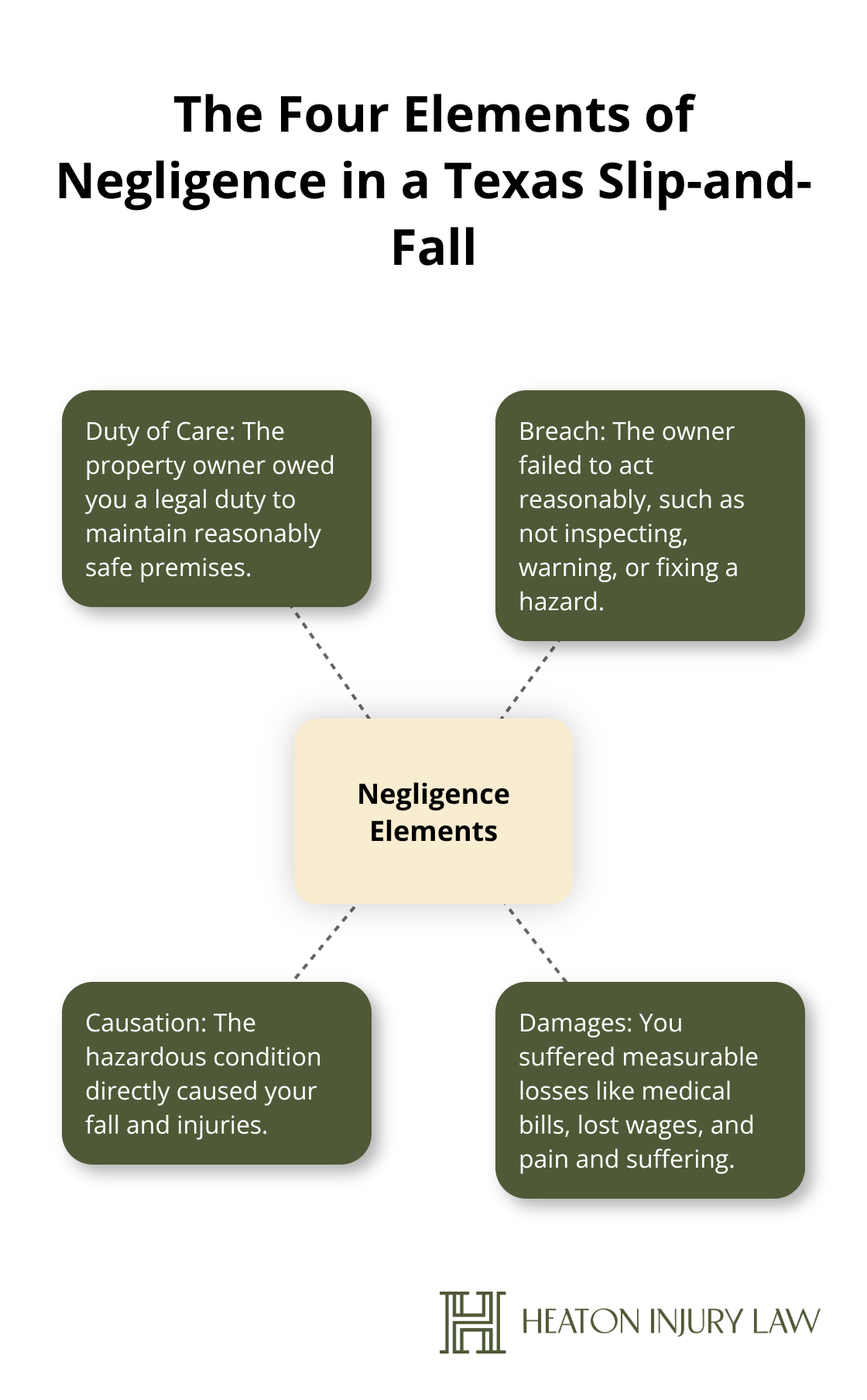
Timing matters critically-a hazard that exists for days without being addressed or marked is far easier to prove as negligence than one that appeared minutes before your fall.
Building Your Evidence Immediately
Photograph the exact spot where you fell and document the hazardous condition clearly right away. Collect contact information from anyone who witnessed your fall, and report the incident to management or the property owner in writing. Many injured people leave without creating a paper trail, then struggle months later to prove the condition existed. Insurance adjusters exploit this gap ruthlessly, claiming they have no evidence the hazard was present.
Surveillance footage from the property becomes your strongest proof because it shows exactly when the hazard appeared and whether the owner took reasonable steps to address it. Medical records establishing your injuries and linking them directly to the fall are equally important; delayed medical treatment gives adjusters ammunition to claim your injuries weren’t serious or weren’t caused by the fall. Texas uses a modified comparative negligence rule, meaning if you are found to be 51 percent or more at fault, you cannot recover any damages. Proving the owner’s negligence without contributing to your own fall matters tremendously, which is why the evidence you collect at the scene directly impacts your ability to recover compensation.
Building Your Slip and Fall Case
Act Fast to Preserve Evidence
The first 24 hours after your fall determine whether you’ll have strong evidence or an uphill battle. Photograph the exact hazard from multiple angles, including wide shots showing the location within the property and close-ups revealing the specific danger-a wet floor, broken tile, or loose carpet. Capture the surrounding area too, because context matters; photos showing poor lighting, lack of warning signs, or absence of maintenance equipment strengthen your claim. If the property has surveillance cameras, request footage immediately in writing and keep a copy of that request, because video disappears quickly and property owners sometimes claim equipment malfunctions after incidents.
Document Your Medical Treatment Immediately
Medical records establish causation and must be created the same day or within 48 hours of your fall. Seek treatment promptly and tell doctors exactly how the fall happened and which body parts struck the ground. Insurance adjusters scrutinize delayed medical treatment as a sign your injuries weren’t serious, so a gap between your fall and first medical visit gives them leverage to undervalue your claim. Medical bills, receipts for related expenses, and records of lost work time should be organized chronologically because adjusters will calculate damages based on documented costs.
Collect Witness Information While Memories Are Fresh
Witness statements carry enormous weight because they provide independent verification of conditions the owner should have known about. Collect names, phone numbers, and email addresses from anyone who saw you fall or observed the hazard before your incident. Write down what each witness observed while their memory is fresh, then follow up with formal statements later. Many injured people skip this step, then months later find witnesses have moved away or forgotten details.
Build a Timeline That Proves Negligence
Texas courts recognize that property owners should discover hazards through reasonable inspection, and timing proves negligence; a wet floor that persisted for hours without signage or cleanup demonstrates failure to maintain safe conditions. Document everything in a dedicated folder with dates and times noted on each photograph and record. If the property owner or manager offers an incident report, request a copy immediately and verify it accurately reflects what happened-inaccurate reports can later be used against you. Expert witnesses become valuable if your case proceeds toward settlement negotiations or trial; they can testify about how long a hazard likely existed and how it caused your specific injuries, which strengthens your causation argument significantly.
Understand Your Deadline for Action
The statute of limitations for slip-and-fall claims in Texas is two years from your injury date, but waiting months to gather evidence weakens your position because witnesses disappear, memories fade, and property conditions change. Treat evidence collection as an urgent priority, not something to handle later when you have time. Once you have organized your evidence and medical documentation, you’ll be ready to identify all parties who bear responsibility for your injuries and begin the process of pursuing fair compensation.
Settling Your Claim or Going to Trial
Insurance Adjusters Count on Your Desperation
Insurance adjusters count on injured people accepting lowball offers because they lack organized evidence or understand their claim’s true value. When the adjuster makes their first settlement proposal, it typically falls 40 to 60 percent below what your case actually warrants, banking on your medical bills piling up and desperation setting in. Your documented evidence from the scene, witness statements, medical records, and photographs directly determine your negotiating position; claims backed by surveillance footage and expert testimony command substantially higher settlements than those with sparse documentation.
Counter Low Offers With Your Evidence
The adjuster will argue the hazard was open and obvious, that you contributed to your own fall, or that your injuries weren’t serious enough to warrant full compensation. Counter these arguments with your evidence: timestamped photos showing poor lighting conditions, medical records linking your specific injuries to the fall, and witness statements confirming the hazard existed long enough for the owner to discover and fix it. An organized claim file with clear documentation of your damages-medical bills, lost wages, receipts for replacement services, and professional evaluations of non-economic harm like pain and suffering-gives you concrete numbers to defend during negotiations.
Settlement negotiations in 2025 typically take several months, and according to Personal Injury Law Statistics 2025, settlements rose 8 percent from 2024 as digital evidence and telehealth records gain recognition from insurance companies. Most personal injury cases settle before trial, but accepting a settlement offer means waiving your right to pursue additional compensation later, so never rush this decision.
Evaluate Settlement Offers Against Your Documented Damages
Deciding whether to accept a settlement hinges on whether the offer covers your documented damages plus a reasonable amount for pain and suffering and future complications. If your injuries are straightforward with clear medical documentation and the adjuster’s offer matches or exceeds your calculated damages, settlement protects you from trial uncertainty and gets you compensation quickly. However, if your injuries are catastrophic, involve permanent disability, or the adjuster refuses to acknowledge the owner’s negligence, pursuing trial may yield significantly higher recovery.
Legal Representation Shifts the Power Dynamic
Hiring legal representation increases negotiating power and settlement amounts because adjusters know you have someone who understands Texas negligence law and won’t accept inadequate offers. Your attorney investigates the property owner’s maintenance history, requests incident reports, obtains surveillance footage, and builds the factual record that forces the adjuster to take your claim seriously. Expert witnesses-medical professionals who testify about injury severity and causation, or property maintenance experts who establish how long the hazard existed-add credibility that adjusters cannot dismiss.
Trial Readiness Motivates Fair Settlement Offers
If settlement negotiations stall, your attorney files suit in the appropriate Texas district court, and the discovery process compels the property owner to produce maintenance logs, inspection records, and communications that often prove negligence conclusively. Most claims settle during or after discovery when both sides recognize trial risk, but being trial-ready throughout negotiations signals you won’t accept an insulting offer, which motivates the adjuster to propose fair terms.
Final Thoughts
Your slip fall legal steps begin the moment you hit the ground, and the evidence you collect in those first hours-photographs, witness names, incident reports-directly determines whether you recover fair compensation or accept a lowball settlement. Medical documentation created immediately after your fall establishes causation and prevents adjusters from claiming your injuries weren’t serious. An organized claim file with timestamped evidence, medical records, and witness statements gives you negotiating power that forces insurance companies to take your claim seriously.
We at Heaton Injury Law, PLLC understand how property owners and their insurers operate, and that knowledge means we recognize when adjusters use delay tactics, undervalue your pain and suffering, or when surveillance footage will prove negligence conclusively. Our trial-ready approach signals to insurance companies that we won’t accept inadequate offers, which motivates them to propose fair settlements rather than risk trial. You don’t have to navigate Texas negligence law alone or face insurance adjusters without someone who understands their tactics.
Contact Heaton Injury Law, PLLC to discuss your slip and fall claim with an attorney who has secured millions for injured clients. We handle your case on contingency, meaning you pay nothing upfront and our fee comes only from your recovery. Your deadline matters-Texas gives you two years from your injury date to file suit, but evidence disappears and witnesses move away long before that deadline arrives.
The information provided in this blog is for general informational purposes only and does not constitute legal advice. Every case is unique, and laws may vary by jurisdiction. Reading this content does not create an attorney-client relationship. For guidance specific to your situation, please consult with a qualified personal injury attorney licensed in Texas.
Artificial intelligence may have been used to assist in generating some text or images in these articles.